
(Kashmir Rechords Archival Desk)
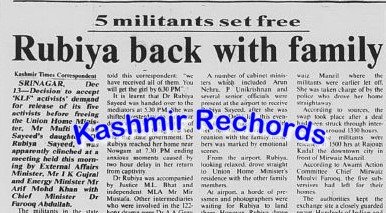
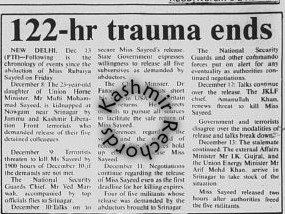
Thirty-six years have passed, yet the kidnapping of Dr. Rubaiya Sayeed—daughter of then Union Home Minister Mufti Mohammad Sayeed—continues to cast a long, mysterious shadow over Kashmir’s turbulent history. And with the CBI further probing the case recently, the events of those nerve-racking days in December 1989 feel more alive—and more confounding—than ever.
But what many from today’s generation don’t know, and what many from that era have almost forgotten, is the extraordinary—and unlikely—team of negotiators who risked everything to bring Rubaiya home.
This was a chapter where a High Court judge, a surgeon, a lawyer, and an MLA outmaneuvered fear, bureaucracy, and hardened militants to negotiate one of the most controversial prisoner exchanges in India’s history.
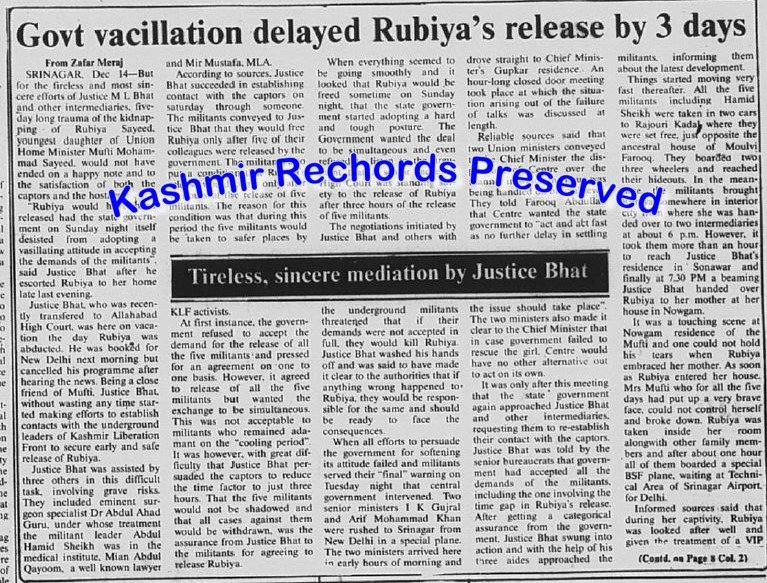
Thanks to an archival newspaper cutting unearthed by Kashmir Rechords : http://www.kashmir-rechords.com—a detailed byline story by the journalist Zafar Meraj, published in Kashmir Times on December 15, 1989—we finally revisit the tense back-channel dealings that shaped this saga.
A Judge Steps Into the Shadows
When Rubaiya was abducted on December 10, 1989, Kashmir was already a pressure cooker. Militancy was rising, politics was volatile and official responses were scattered.Into this chaos stepped a man few would have expected:
Justice Moti Lal Bhat, a Kashmiri Pandit and a sitting judge of the Allahabad High Court—transferred from the J&K High Court barely a month earlier.
He had flown to Srinagar on vacation. He was scheduled to leave for Delhi the morning after the kidnapping. But upon hearing the news, he cancelled his plans. As a close friend of Mufti Mohammad Sayeed, he felt compelled to act—and he did so immediately, quietly, and without official sanction.His decision would alter the course of the crisis.
The Unlikely Quartet of Negotiators
According to Zafar Meraj’s report, Justice Bhat did not operate alone. He assembled a team of intermediaries who were trusted—strangely enough—by both the establishment and the underground:
Dr. Abdul Ahad Guru, the celebrated cardiac surgeon who happened to be treating militant leader Abdul Hamid Sheikh.
Mian Abdul Qayoom, prominent lawyer and later Bar president.
Mir Mustafa, MLA and influential political figure.
Together, they made a quartet unlike anything seen before or after in Kashmir’s conflict narrative. And in a cruel twist of fate—both Dr. Guru and Mir Mustafa were later assassinated by militants belonging to the same organisation whose cadres they helped secure freedom for.
Contact Established—And the Clock Begins
Zafar Meraj’s report reveals that Justice Bhat managed to establish contact with the captors on the sixth day, after painstaking efforts at building trust.
The militants’ demand was clear and uncompromising: Release five jailed JKLF militants, including Abdul Hamid Sheikh. Only then, and only after a 48-hour “cooling period,” would Rubaiya be freed.
The cooling period, they said, was needed to safely move the militants to hidden locations. The government initially resisted—suggesting a one-for-one formula, then demanding simultaneous exchange. The militants rejected both. Tension escalated.
Justice Bhat negotiated relentlessly and managed to bring down the cooling-off period to three hours, giving his personal assurance that the freed militants would not be re-arrested or shadowed.
But when everything seemed to be aligning, the state government hardened its stance.
Talks Collapse. A Final Warning. Delhi Steps In.
On Sunday night, the militants issued a chilling message: Accept all demands, or Rubaiya will be killed. Justice Bhat, disappointed and angry at the government’s vacillation, told officials bluntly that the responsibility would lie with them.
With the crisis slipping out of control, the Centre intervened decisively.
Union Ministers I.K. Gujral and Arif Mohammad Khan flew to Srinagar at daybreak and held a closed-door meeting with Chief Minister Farooq Abdullah—and the tone was unmistakably stern.
The message: Resolve it. Now. Or Delhi will take charge.
Only after this intervention did the state government return to the negotiators, agreeing fully to the militants’ terms—including the three-hour gap.
The Exchange: A Choreographed Twilight Deal
The final act unfolded with cinematic tension.The five militants—including Abdul Hamid Sheikh—were quietly driven to Rajouri Kadal, near the ancestral home of Moulvi Farooq. They disappeared into the maze-like inner city on auto-rickshaws. Simultaneously, Rubaiya was moved from one hideout to another in the densely populated neighbourhoods of downtown Srinagar.
At around 6 PM, she was handed over to two intermediaries. An hour later, they reached Justice Bhat’s Sonwar residence. At 7:30 PM, a relieved and emotional Justice Bhat personally escorted Rubaiya to her home in Nowgam.
The Reunion: A Moment That Melted the Valley.
Witnesses recall the scene as unforgettable: Rubaiya’s mother—who had displayed remarkable composure for five days—collapsed into tears the moment she embraced her daughter.
Within an hour, the family boarded a waiting BSF aircraft for Delhi.
During captivity, militants had reportedly kept Rubaiya with women and treated her “like a sister”—a phrase they had publicly declared earlier. She appeared unharmed but visibly shaken.
At Justice Bhat’s home, she lost her composure briefly upon seeing senior bureaucrats, refusing to enter in protest—before being persuaded gently by Justice Bhat and his doctor-daughter.
A Story That Refuses to Fade
Today, as investigators reopen the case and new details emerge, the forgotten role of Justice Moti Lal Bhat and his team regains its rightful place in the narrative.
Their courage, their mediation, their risks—all played out in an era where the Valley was teetering on the edge.
And as Kashmir Rechords revisits Zafar Meraj’s original reporting, we are reminded that history is never linear. It is layered, fragile and often shaped by individuals working out of the spotlight.
The Rubaiya Sayeed kidnapping was not just an incident. It was a turning point.
And the negotiators—some later killed, some forgotten—carried the burden of that moment with extraordinary courage.