

| Kashmir Rechords Op-Ed
Ghulam Ahmad Mehjoor is celebrated, quoted, canonised—and rightly so. He is Kashmir’s “Poet of Revolution,” the lyrical conscience of a society in transition. His words continue to echo across generations, his name etched into textbooks, stamps and cultural memory.
But here lies the uncomfortable question:
Why does history remember Mehjoor—but forget the woman who made Mehjoor possible?
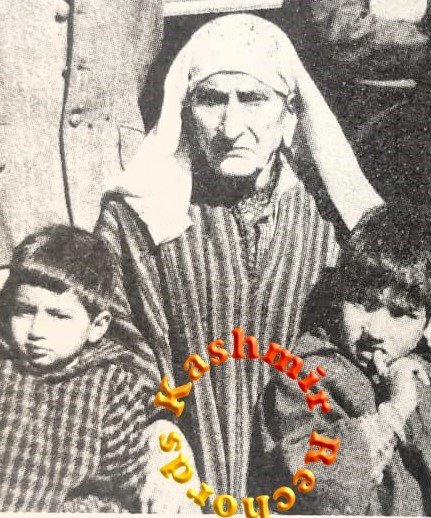
Her name was Mehtab Begum. And history has almost forgotten her.
The Myth of the Lone Genius
We are often sold a convenient myth—that great men rise on talent alone. That genius is self-sustaining. That poetry flows untouched by the burdens of daily life.
But reality is far less romantic.
Ghulam Ahmad Mehjoor was not living in some idyllic poetic bubble. He was a Patwari, constantly on the move—traversing remote terrains, enduring harsh conditions, sometimes even going without food or shelter. His own letters admit as much.
So the real question is: Who held the world together while the poet wandered through it?
The answer is simple, yet inconvenient for mainstream narratives: Mehtab Begum
While Mehjoor wrote about revolution and romance, she lived the far harsher reality:
- Running a household in prolonged absence
- Managing uncertainty, finances and social pressures
- Absorbing the emotional cost of a life lived on the margins
She did not write poetry. She enabled it.
She was not visible in literary circles. She made literature possible.
Call it what it is—she was the infrastructure behind the poet’s legacy.
It is not that Mehtab Begum never existed in public memory. There was a moment—brief, almost accidental—when her voice surfaced.
In 1980, All India Radio’s Srinagar station, then called Radio Kashmir Srinagar, aired a special feature on Mehjoor’s 28th death anniversary.
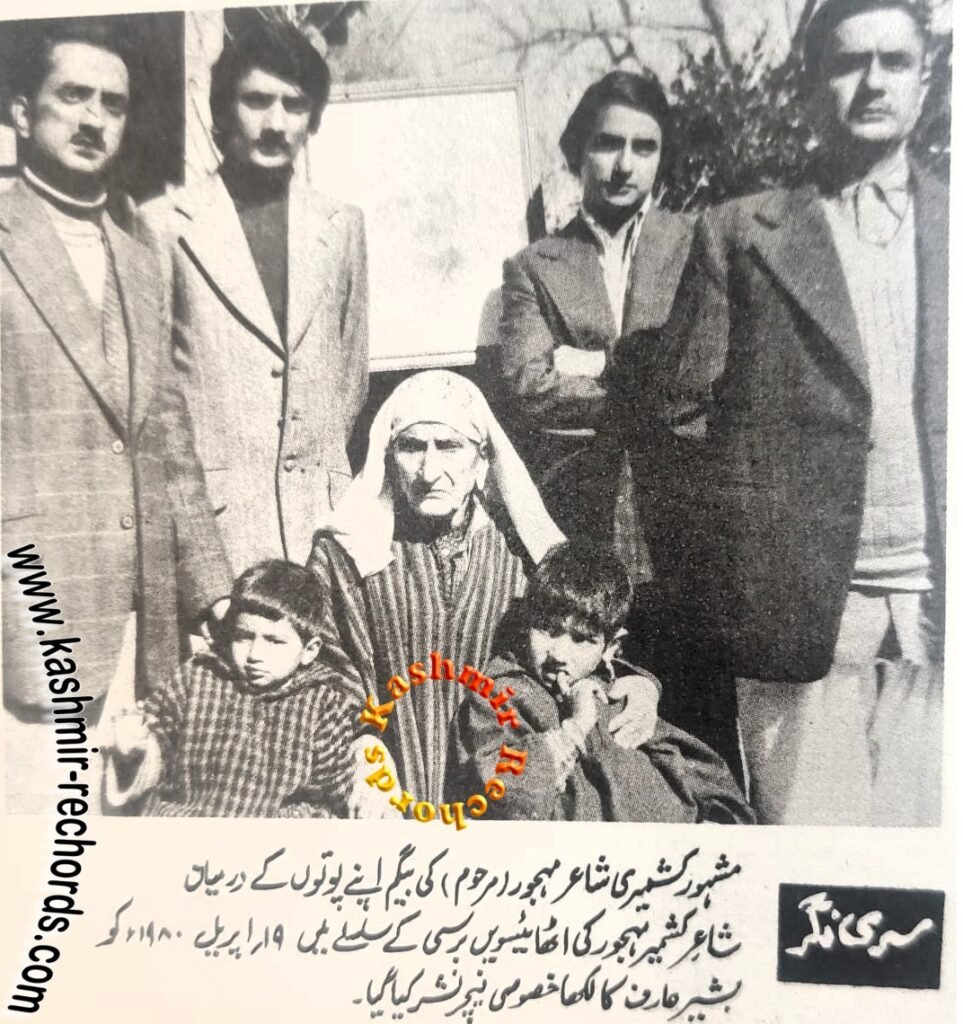
Written by Bashir Aarif, it included a rare recorded conversation with Mehtab Begum herself. This special feature was broadcast on April 19, 1980.
And then—silence.
No follow-up.
No institutional effort to preserve or promote her story.
No attempt to integrate her into Mehjoor’s narrative.
The Archival Failure We Don’t Talk About
Let us be blunt.
If that 1980 recording is lost—as is feared—it is not just an archival lapse. It is a cultural failure.
- This represents a failure of institutions like All India Radio and a significant lapse by literary historians. Furthermore, it highlights a collective oversight by Kashmir’s own intellectual class
Because what was lost was not just audio—it was perspective.
The perspective of a woman who lived history, but was never allowed to narrate it.
Rewriting the Narrative
Mehjoor will—and should—remain a towering figure in Kashmir’s literary tradition.
But continuing to celebrate him without acknowledging Mehtab Begum is not just incomplete—it is intellectually dishonest.
History does not just erase by omission. It erases by habitual neglect.
The Final Word
If Mehjoor was the voice of Kashmir,
then Mehtab Begum was its unheard heartbeat.
And perhaps it is time we asked:
How many more Mehtab Begums lie buried beneath the weight of “great men” in our history?
Until we answer that, our understanding of the past will remain—not just partial—but profoundly flawed.
Readers are encouraged to post their comments, make their opinion at the end of this write-up, below