

(Kashmir Rechords Exclusive)
This is not cinema.This is not propaganda.This is not imagination.This is history—frozen in photographs, printed in newsprint and buried in selective memory.
On the Friday night of January 19, 1990, Kashmir crossed a line from which there was no easy return. What followed was not a spontaneous migration, not an administrative relocation and certainly not a myth scripted later. It was a forced civilisational rupture, witnessed, recorded and legitimised by the streets themselves.
As darkness fell over the Valley, thousands of local Kashmiri Muslims—men and women alike—poured into the streets. This was no silent protest. Slogans echoed through neighbourhoods, mosque loudspeakers blared incendiary calls and the night throbbed with a fevered euphoria. The anger was directed not merely against the Indian State—but squarely at minorities, especially Kashmiri Pandits and others who believed in the idea of India in Kashmir.
The message did not need translation.“Leave, convert or die.”
It travelled faster than fear, reaching homes where families huddled, listening, counting breaths and deciding—often within hours—that survival meant escape.
Photographs That Refuse to Lie
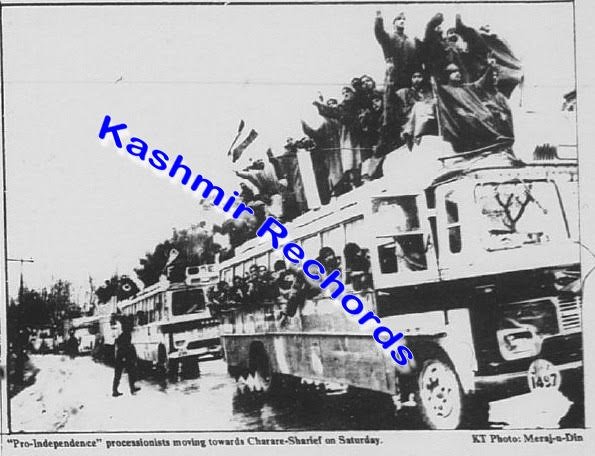
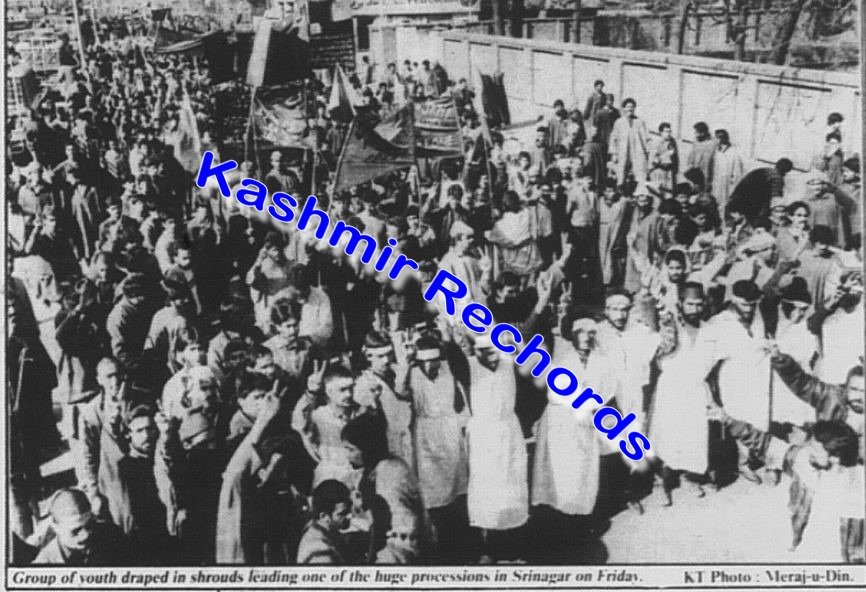
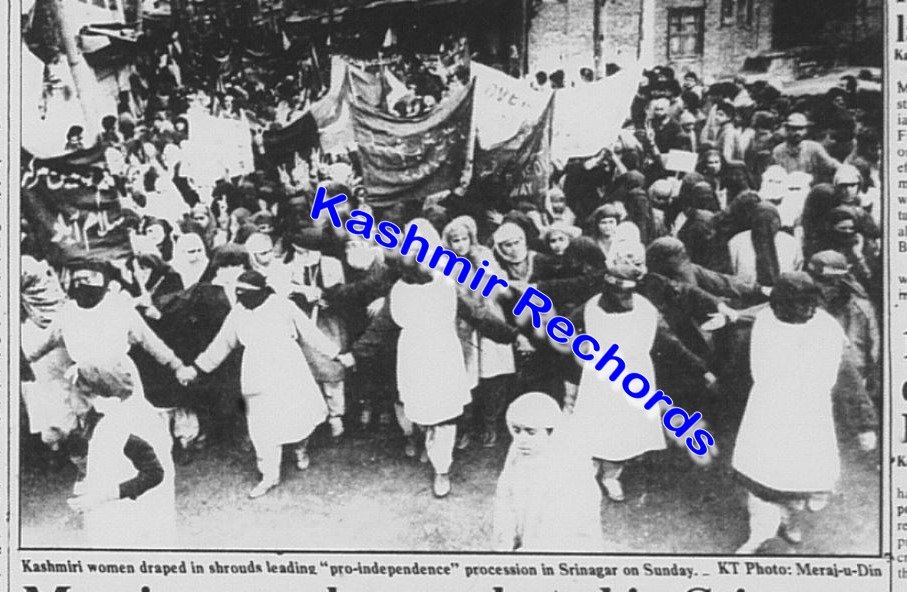
What makes this story from Kashmir Rechords different—what makes it irrefutable—are the photographs. They come without disclaimers. No “any resemblance is coincidental.” The photographs are not recreated, not stylised and also not AI generated.
These are the real images, clicked during the second and third weeks of January 1990, carried by the then most widely read and trusted for building narratives by a Jammu-based English newspaper of that era—a paper that had a full bureau at Srinagar and was adored by common Kashmiri, respected by the intelligentsia writing for it and consumed daily by the very society now struggling with collective amnesia.
The images show:
- Crowds swelling with militant fervour
- Streets overtaken by slogans of secession and jihad
- Men and Women drapped in shrouds, romanticising militancy, emboldening terror.
- Shrouds paraded, guns glorified, violence normalised.
These photographs, preserved and now presented by Kashmir Rechords, do not editorialise. They do not accuse. They simply show.
And what they show is devastating.
The Myth of ‘Nothing Happened’
For decades, a convenient narrative has been repeated:
- Kashmiri Pandits left voluntarily or on official instructions.
- There was no mass intimidation.
- Everything was exaggerated later.
- Films and books manufactured the pain and created hysteria.
- Stories of 1990 are exaggerated. Write-ups manufactured victimhood.
These photographs dismantle that lie—frame by frame.
They are a mirror held up to a society that once cheered, once marched, once shouted—and later chose to forget. A mirror in which some may still recognise faces from the crowd. And perhaps, uncomfortably, see the origins of a tragedy their children were never told about.
A Celebration That Became a Curse
What was chased in those days was an illusion—something impossible. In that intoxication, Kashmir sacrificed its plural soul. The immediate casualty was the Kashmiri Pandit community, driven out overnight from homes their ancestors had lived in for centuries. The long-term casualty was Kashmir itself.
The violence that began with slogans did not end with migration. It shattered communal harmony, militarised society, destroyed generations, normalised death and fear and left a Valley searching for peace it once possessed.
Many Kashmiris today quietly admit a shame they cannot undo—ashamed of elders who mistook rage for revolution and guns for glory.
History, Documented—Not Debated
This is not a story told for the first time.
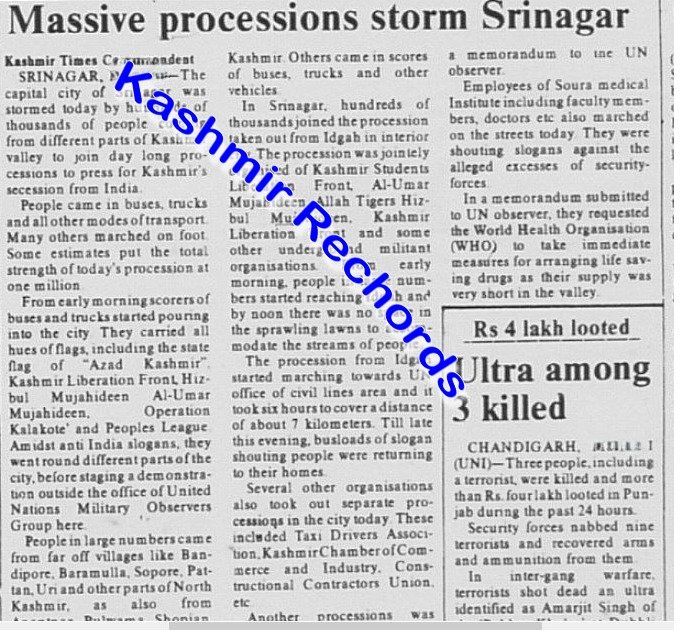
But this is the first time it is told with these pictures—uncensored, unpublished and undeniable.
A photographer clicked them. A reporter captioned them. Both were beloved by the people of Kashmir at the time.
The Cost of Euphoria
Beyond documenting intimidation, the photographs and the bewsreport indict something deeper.
They capture a society intoxicated by momentary euphoria, unaware that it was laying the foundation for decades of bloodshed, militarisation and loss. The first victims were Kashmiri Pandits—but the eventual casualty was Kashmir’s own future.
Today, many in the Valley quietly admit an inherited shame:
Ashamed of elders who chose violence. Ashamed of crowds that mistook militancy for heroism. Ashamed of the silence that followed
A Mirror for the Past—and the Present
These images are not meant to inflame. They are meant to confront. They stand as a mirror to those who deny the exodus—To those who call it manufactured and to those who dismiss lived trauma as fiction.
Some may even recognise familiar faces in the crowd. Others may realise why their parents never told them the full story. The mirror does not lie. Neither do these images.
What happened on January 19, 1990, was not an accident of history. It was a moment of collective collapse—one that forced an entire community into exile and altered Kashmir forever.
This is not about blame alone.
It is about truth.
And truth, once seen, cannot be unseen.
==========
We request our readers to share this story with friends, families and acquaintances. Not for sensation, not for argument—but because truth deserves circulation.
For far too long, the real story of January 19, 1990 has been blurred, diluted, and dismissed. When facts are questioned, documentation becomes duty. And when history is denied, memory must speak.
The right to know the truth is fundamental. It belongs not only to those who suffered, but also to those who inherited a distorted version of events. This story, supported by real photographs and recorded history, exists so that silence does not triumph over fact.
I have always been puzzled until recently why so many among the Muslim majority community joined the hysterical mobs that January night in 1990, roaming around in the streets especially around the mosques, and shouting slogans like crazed and fanatical people. Now we know that the ISI had directed the JKLF to announce the independence of Kashmir and formation of a “Government of Independent J&K” on 19 January 1990. While the change in the Governor of J&K on the very same day thwarted that plan, Muzaffarabad based Amanullah Khan finally announced the formation of the “Interim Government of the Independent Jammu & Kashmir” on 18 June 1990 with 23 Ministers from all the regions of J&K, including 1 Sikh and 3 Hindus. The latter being Shri Karan Singh, Shri Bushan Bazaz, and Shri Hriday Nath Wanchoo. 🙏🏻 Vijay Sazawal