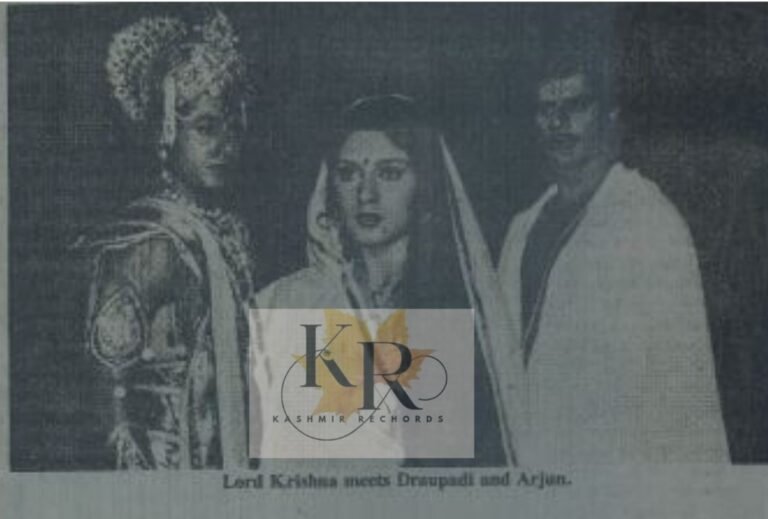
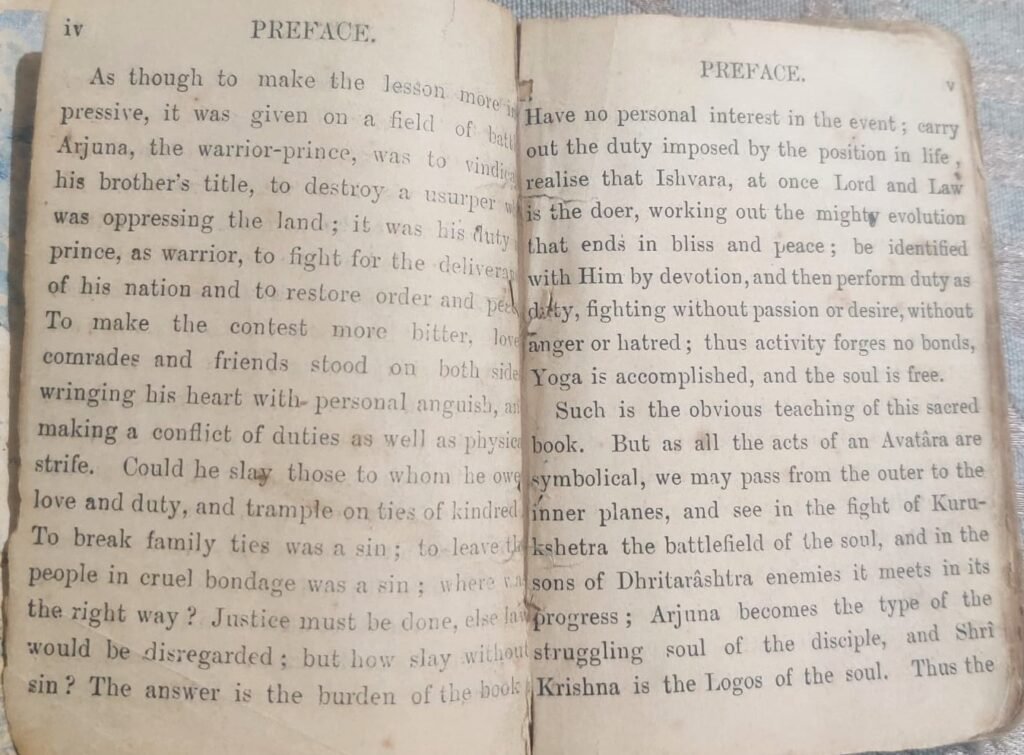
`Mahabharata’, a Hindi-language epic television serial based on the ancient Sanskrit epic Mahabharata, is perhaps the last television serial which the Kashmiris watched back then, when the peace of the bygone era still prevailed.
The original airing, which consisted of a total 94 episodes, were broadcast from October 2, 1988 to 24 June 1990 on Doordarshan. Majority of Kashmiri Pandits had left Kashmir by March 1990. Even as the battle between good and evil was shown on a small screen, Kashmir had surely by then turned into Karukheshtra of other kind.
Each episode used to be of 40–46 minutes long with a title song that consisted of lyrical content and two verses from the Bhagavad Gita. The title song and verses rendered by Mahendra Kapoor were followed by a narration by Harish Bhimani as a personification of Time, detailing the current circumstances and highlighting the spiritual significance of the content of the episodes.
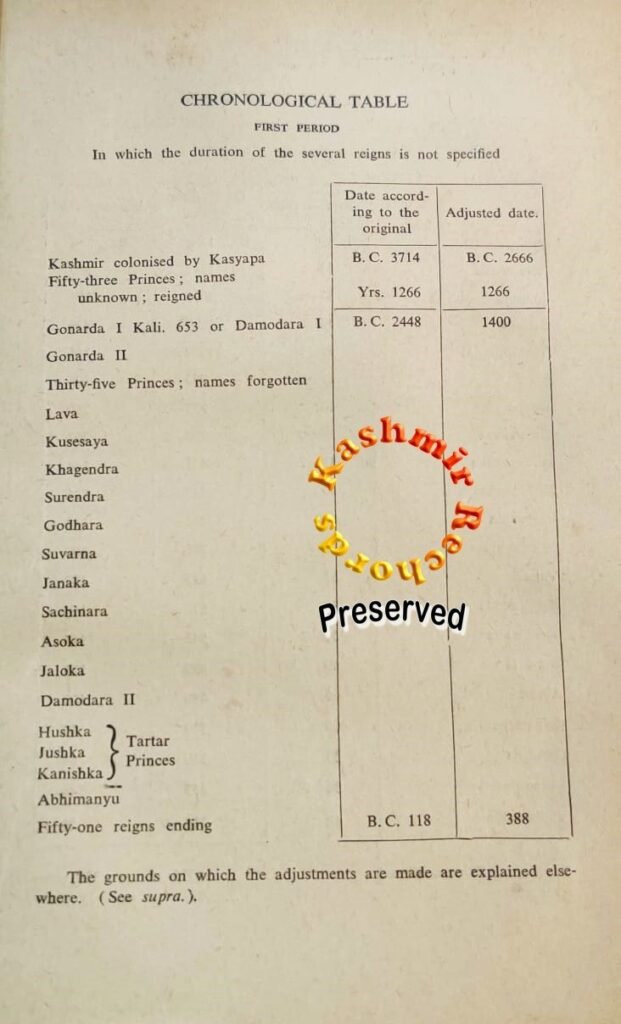
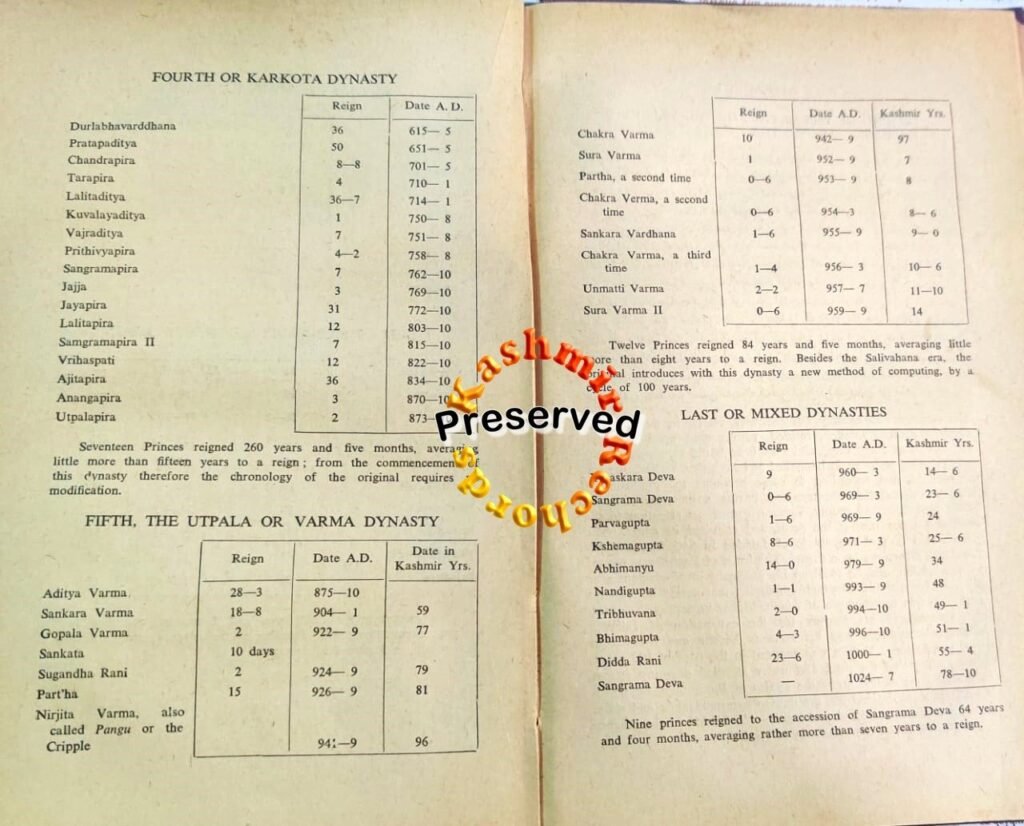
This meticulously compiled chronological Table of ancient Kashmiri Kings and dynasties (Preserved by Kashmir Rechords) is an extract from the brilliantly researched Book `The Hindu History of Kashmir’ written by H H Wilson ( 1960 edition).
As per the current trend throughout the world, we are witnessing the legacy of leaders having lead political movements and put on a high pedestal being demolished and blown to Smithereens.
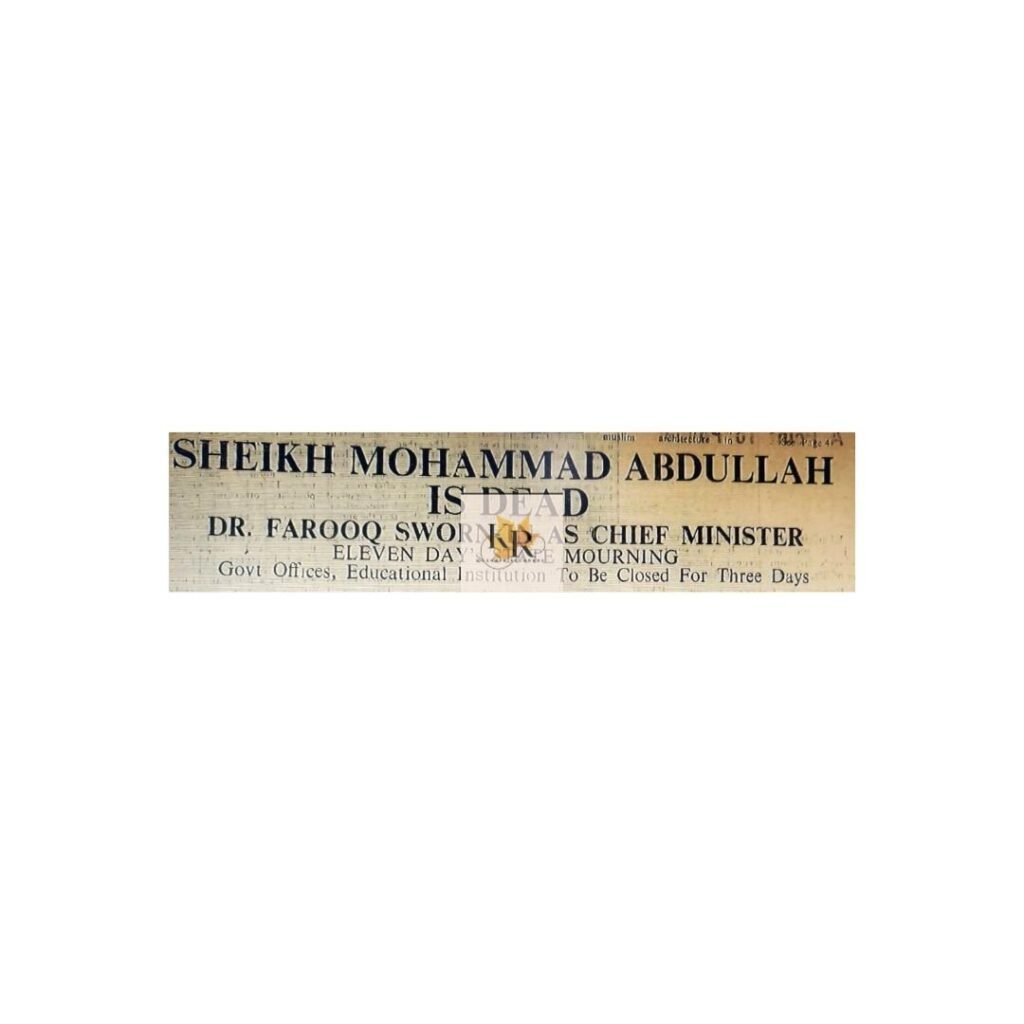
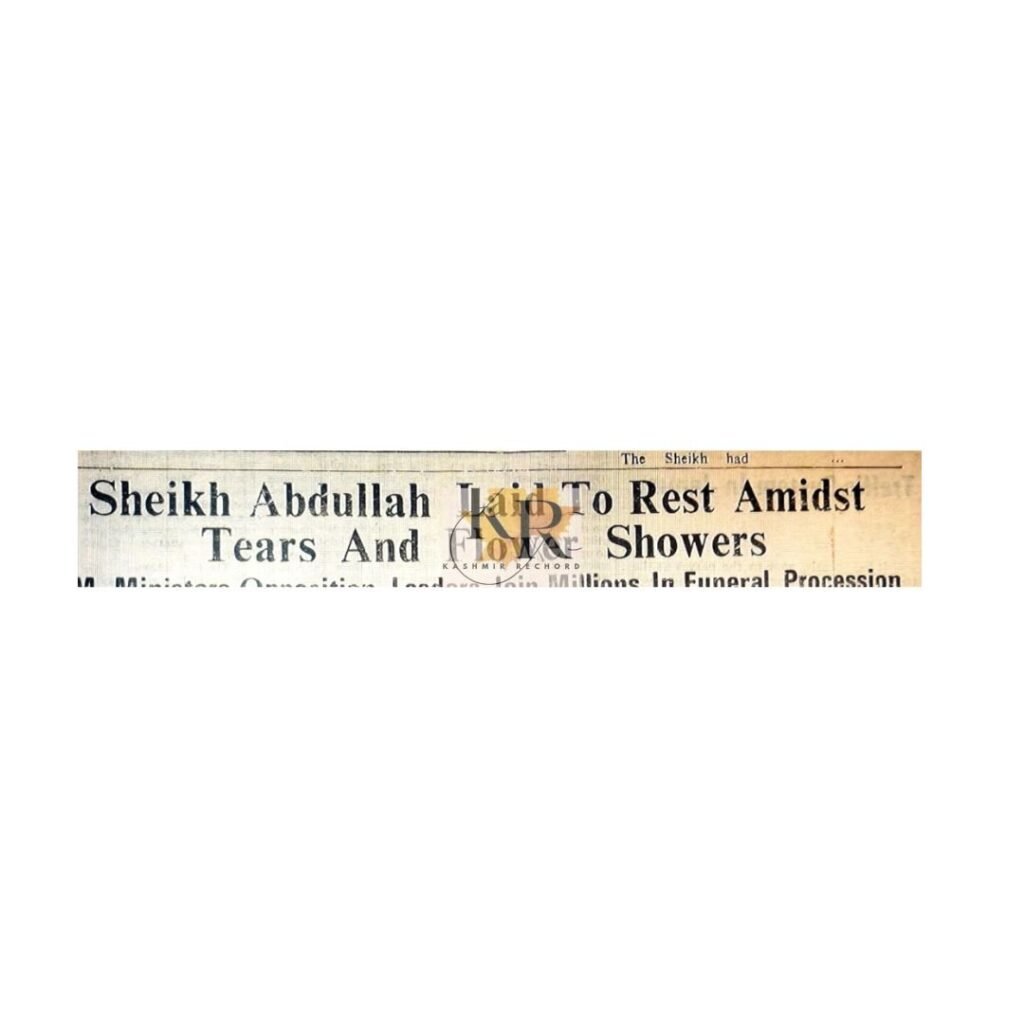
The aura once associated with Sheikh Mohd Abdullah, the “Mehboob’’ leader `Sher-i-Kashmir’ for Kashmiris, is fighting to safeguard his own legacy, 41 years after his death, (September 8, 1982), as the socio-political discourse of Kashmir has changed drastically over the years.
The revolutionary iconic leader, social reformer and the harbinger of Naya Kashmir—all combined into one, who literary implemented the slogan “Land to the Tiller’’, empowered Kashmiri Muslims with free Universal Education, positions, businesses and enabled them to better their conditions at the expense of Indian largesse.
An esteemed and important member of the Constitution Committee, Sheikh Mohd Abdullah, who inspired awe and tremendous respect even up to the point of devotion in the hearts of Kashmiris, however, seems to fight for his legacy in the changed history of Jammu and Kashmir post 1990s.
In life as well as in death, he remained tall—so much so that the whole Indian Nation mourned his demise. History was created when both the President and the Prime Minister flew to Srinagar to attend to his last rites on the Banks of world-famous Dal lake, where his grave stands guarded presently by an elaborate security set-up following several attempts to desecrate the same by the very Kashmiris who had once emotionally treasured his name in their hearts. Even a modicum of respect for the great Sheikh by observing December 5 (his birthday) as a Public Day was done away with in 2019 and the so-called Sher-e-Kashmir medals are now history.
The astute political awareness of Kashmiris is certainly that the great Sheikh built in them but he is also the most denigrated one for which Kashmiris as well as rest of the Nation have to ponder over.
No other personality has come close to the persona of Shri Krishna who combined in himself all the attributes of an ideal human being and whose life projected the radiance of all the colours that the Universe could design.
The greatest in childhood, greatest as a warrior, householder and a King and the Ultimate as the Lord of Yoga (Yogeshwara).
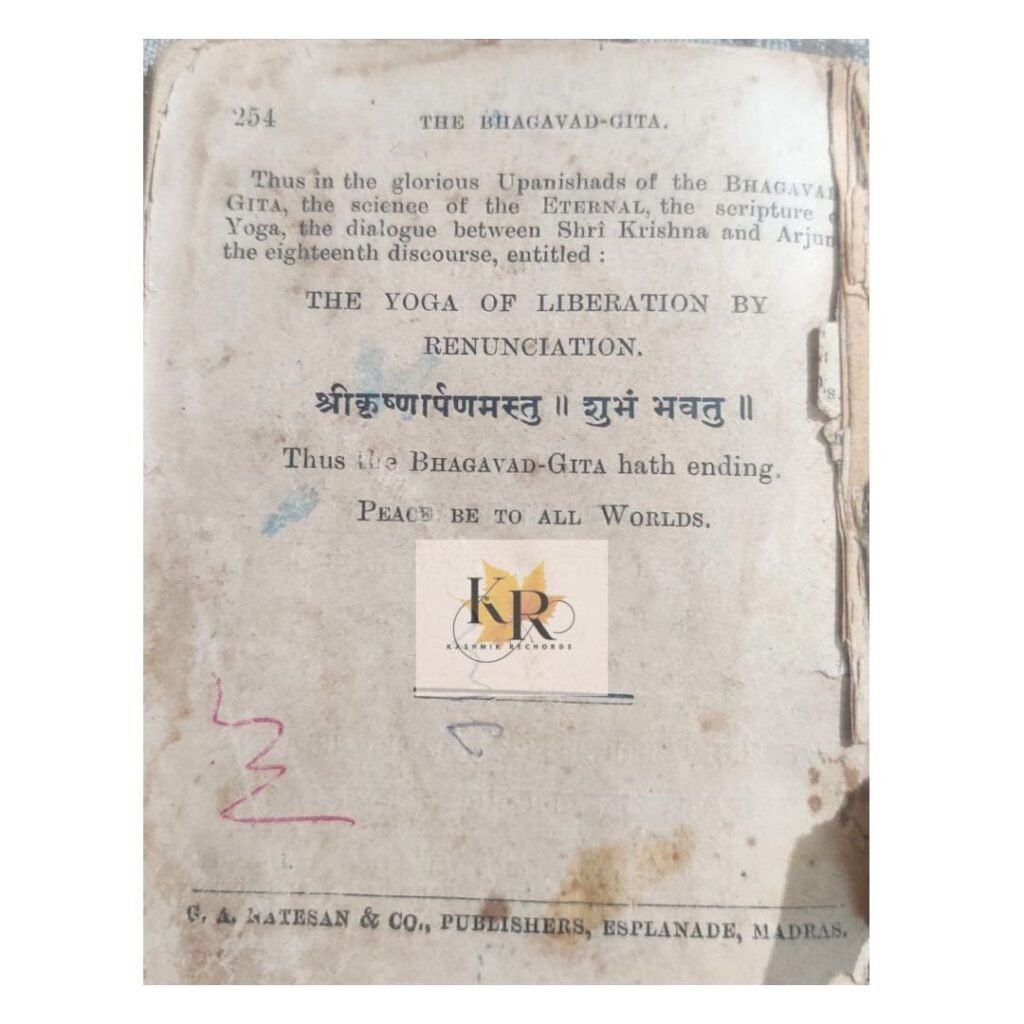
Kashmir Rechords takes pride in bringing to our esteemed readers a pocket size rare edition of Shrimad Bhagatwat Gita “The Lord’s Song’’, published by noted nationalist, Sh Ganapathi Agraharam Annadhurai Ayyar Natesan (G. A. Natesan) who was an Indian writer, journalist, publisher, politician and freedom fighter from the erstwhile Madras Presidency.
Bhagavad Gita “The Lord’s Song’’, 1908 edition, was authored by none other than the founder of Theosophical Society of India, Madam Annie Besant, who is equally remembered as the First women President of Indian National Congress. Besant was a British socialist, educationist, theosophist, women’s rights and a campaigner for Indian nationalism
On the other hand, G A. Natesan was the founder and proprietor of G. A. Natesan & Co. Madras, which took a lead in publishing nationalist books, the most prominent among whom was The Indian Review.
Kashmir Rechords also requests the interested parties to help in the preservation of this extremely rare book written by a very rare devotee of Shri Krishna.
Dr Sarvepalli Radhakrishnan, a teacher of world repute, a greatly respected scholar, who dominated the philosophical discourse during his time, even though he belonged to the Southern State of Tamil Nadu, commanded a great respect throughout the country.
The Urdu Press in Kashmir, particularly, would devote central space to this illustrious son of India and people even to this day, continue to harbour great sentiment for him besides getting enlightened by this scholar President. Independent India celebrates his birthday as Teacher’s Day. Kashmir Rechords, from its archives, is reproducing these sentiments Kamal Ahmad Siddique’s write-up published on 22nd November 1963 bears testimony to this
Rashtriya Swayamsevak Sangh (RSS) chief Mohan Bhagwat’s recent suggestion asking people not to use the word “India” and instead use “Bharat”, has already generated heat and dust in both India and I.N.D.I.A. While some high profile dignitaries have already taken a cue from Bhagwat’s speech in avoiding INDIA, the word BHARAT is right now viral, notwithstanding the fact that Hindi and Urdu media have already been using this word since decades for our Country, like our neighbor—Pakistan who is also addressing us as Bharat— now a viral word !
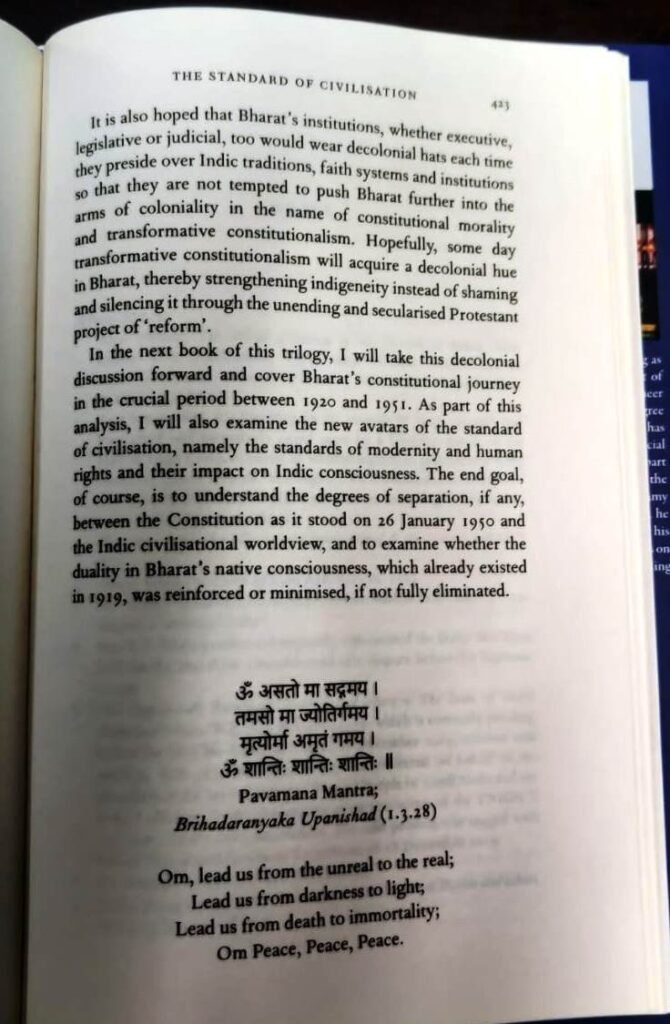
Kashmir Rechords in the meantime located J Sai Deepak’s book `India That is Bharat’ from its library. The book is arigorous survey of India’s political history since the Papal Bull of 1493 and a topical one to discuss right now!
India That is Bharat: Book Review
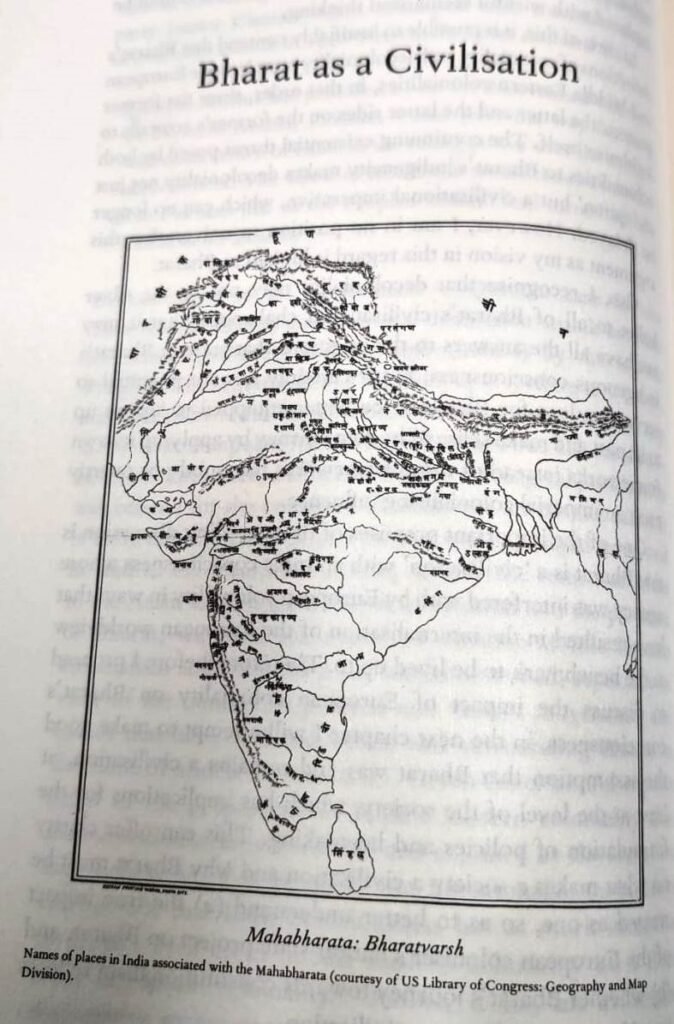
The Book touches upon issues like colonisation of India so much so that scholars from the West interpreted everything about India from a Christian perspective. In addition to Colonialist, Deepak discusses Bharat’s Civilization and Constitution.
The Book lays the foundation for its sequels by covering the period between the Age of Discovery, marked by Christopher Columbus’ expedition in 1492, and the reshaping of Bharat through a British-made constitution-the Government of India Act of 1919. This includes international developments leading to the founding of the League of Nations by Western powers that tangibly impacted this journey. It also puts forth the concept of Middle Eastern coloniality, which preceded its European variant and allies with it in the context of Bharat to advance their shared antipathy towards the Indic worldview.
Naming India as Bharat
The Book discusses the presence of ‘India, that is Bharat’ in Article 1 of the Constitution, besides the Resolution adopted by the Constituent Assembly on 22 January 1947. In addition to the above-proposed amendments with respect to constitutionally naming the country as Bharat, the insertion of Part 1-A to the Constitution after Part 1 was proposed by Shibban Lal Saksena, which have also been touched upon by the author.
Kalidasa and Bharat
The Book also talks about the most celebrated and world-famous poet Kalidasa, who had used `Bharat’ in his immortal work depicting the story of his two great characters-King Dushyanta and his queen Shakuntala. The son born of them was named ‘Bharat’ and his Kingdom was known as ‘Bharat’. The Book questions as to why “ we are reluctant to accept from the core of our heart the word ‘Bharat Varsha’ as the name of our country’’.
Like Mohan Bhagwat, it says that “ We must know that this name (India) was given to our country by foreigners who having heard of the riches of this land were tempted towards it and had robbed us of our freedom in order to acquire the wealth of our country. If we, even then, cling to the word ‘India’, it would only show that we are not ashamed of having this insulting word which has been imposed on us by alien rulers.
The Book mentions that ‘Bharat’ or ‘Bharat Varsha’ is and has been the name of our country for ages according to our ancient history and tradition and in fact this word inspires enthusiasm and courage. The author sumps up his work with a Shaloka from Brihadaranyakqa Upanishad…. “Om, lead us from the unreal to the real; Lead us from darkness to light; Lead us from death to immorality; Om Peace, Peace, Peace’
Dr. Sunil Chandra Ray’s ``Early History and Culture of Kashmir’’ gives an interesting account of Kashmir history, society and the life of the people, besides their food and drinking habits. According to the author `drinking of wine seems to have been quite popular in early Kasmira’’ (page number 206)
There is also the reference of the same in Kalhana’s Chronicle of the kings of Kasmira, where “we meet with a large number of personages who are addicted to drinking’’. The drinking of wine, far from being forbidden, has been specially recommended on ceremonial occasions in the Käśmiri Purana. Dr Ray says that Juices from grape and sugarcane, both of which grew in the valley, were distilled into spirituous liquors. The wine, cooled and perfumed with flowers, was appreciated as a delicious drink. Of drinks other than alcoholic, Kalhana mentions a kind of cold sweet drink (tuhina sarkaram) which was taken with great delight in hot summer days
Book Review: Early History and Culture of Kashmir
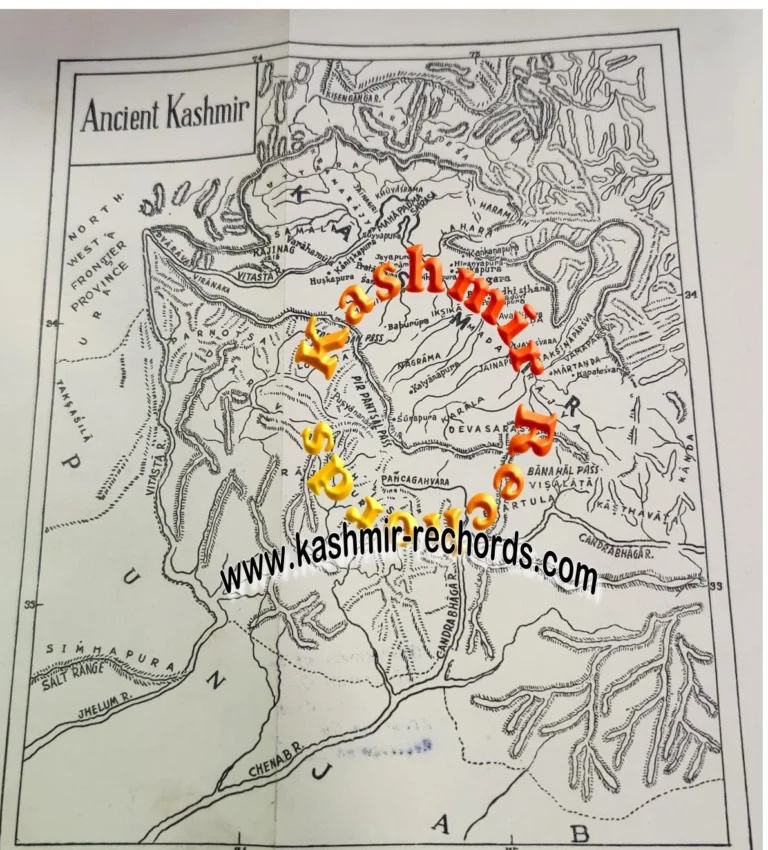
The book gives a general survey of the history of Kashmir down to 1338, when the throne was seized by the upstart Sahamera, who became the first Muslim Sultan of Kashmir under the name of Shams ud-din. The book, first published in 1957, includes a folding map of ancient Kashmir and some photographs, makes a mention of the Bharata Natya Shastra— an ancient treatise on the arts, originated in Kashmir. It has influenced dance, music, and literary traditions in Indian culture.
Published at Calcutta by U. N. Dhur & Sons Private Ltd, Dr. Ray’s “Early History and Culture of Kashmir’’ is an outstanding piece of research on a very important region of India.
Kashmir and Kingdom of Kuchi
The conversion of intermediate kingdom of Kuchi seems to have been the work of Kashmirianscholars. We know from the life of Kumarajiva that it was customary for youngmen of Kuchi to be sent to Kashmir for higher learning. Through Kuchi and Khotan the influence of Kashmirian scholars spread to China and in the list of learned monks from India preserved in the records of China, those from Kashmir, hold a high place.
The book makes a mention of Buddhism, Saivism and Sanskrit learning that had flourished in the valley and produced a remarkably rich culture until the Muslim conquest overturned the social structure of Kashmir. The integration of Kashmir life was so complete that one of his most remarkable books that Kshemendra, who was himself a Saivaite, produced was on the Avadanas of the Buddha, a classic in later Buddhist literature.
Dr. Ray, through this book, brings out some unique characteristics of Kashmir history. Not only does he give a connected narrative of Kashmir’s political evolution based on all available sources, literary, archaeological, numismatic, foreign allusions etc. but brings out the cultural, religious and social development of the people of the valley.
Like 2023 Opposition parties’ Conclaves being held at places like Patna, Bengaluru or Mumbai, forty years ago one such , similar Opposition `Unity’ Conclave was organised at Srinagar, in October 1983 by then Chief Minister, Dr. Farooq Abdullah!
Opposition stalwarts like Badal, Biju Patnaik, Jagjivan Ram, N.T Rama Rao etc, representing 17 parties, were found together in a bid to `show resistance’ to former Prime Minister, Indira Gandhi. Andhra Pradesh Chief Minister N.T Rama Rao was the architect of opposition unity.
The same modus operandi is now being adopted by present day opposition (INDIA) in an unsuccessful bid to take on Prime Minister, Narendra Modi.
In 1983, Mrs Gandhi was the first to take the wind out of the Srinagar conclave. On the day the participants were drawing up a fire-spewing resolution against the Centre, she dismissed the Darbara Singh government—-, a move that was welcomed by the entire country – much to the conclave’s embarrassment.
Srinagar Opposition Conclave & 1983 India us West Indies ODI
Apart from Opposition Conclave held in Srinagar in October 1883, in the same month and same year, Kashmir was again in the news! The first One Day International (ODI) cricket match was played at Sher-i-Kashmir Stadium in Srinagar on October 13, 1983. India played the West Indies but spectators digging the pitch during the lunch interval affected the match due to the protests.
It was considered a “deliberate’’ move by Farooq Government only to embarrass Indira Gandhi. Farooq Abdullah had to pay for it when he was dismissed as Chief Minister of Jammu and Kashmir on July 2, 1984.
Tight controls on freedom of expression have been a hallmark of the Pakistani government’s policy in Pakistan Occupied Kashmir (PoK). While militant organizations are being given full coverage to propagate their views and disseminate literature, those critical of the Pakistani and PoK government, are facing repression.
The Pakistani government has long limited dissemination of news in Pakistan Occupied Kashmir. That is evident from the fact that there is no locally based news agency. In addition, PoK has just two dailies and equal number of weeklies, being published locally. As compared to PoK, newspapers published from Jammu and Srinagar cities on daily basis are more than 370!
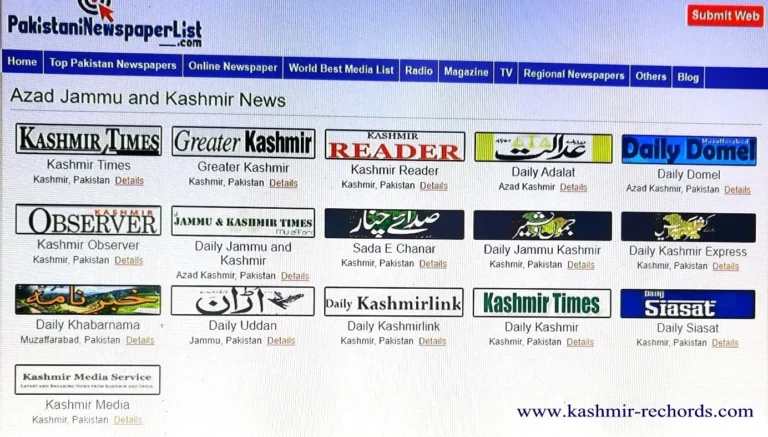
Pakistan Occupied Kashmir has no English newspaper of its own, either published from Muzaffarabad or Mirpur—the two major cities of the occupied territory. Ironically, PoK websites show newspapers like Kashmir Times, Greater Kashmir, Kashmir Reader, Kashmir Observer etc. ( all published from Srinagar), as their publications!
Pakistan’s “Kashmir Affairs Ministry” denies permission to PoK newspapers
People living in PoK largely rely on local editions of Pakistani newspapers for news and information. In order to publish within the territory of PoK, newspapers and periodicals need to be granted permission by the Kashmir Council and the Ministry of Kashmir Affairs in Islamabad. These bodies unlikely grant permission to any proposed publication, which are sympathetic to any discourse on Kashmir and its affairs other than that sanctioned by the Pakistani government. The same rules apply to the publication of books. Members of the press have been complained of the intrusive and coercive policies of the PoK government particularly of the ISI and the Pakistani military.
There have been many instances in PoK when journalists, who did not toe to Government or Army line, were subjected to severe kind of torture. Waheed Kiyani, a local journalist working for the Reuters news agency, was once arbitrarily arrested by the ISI when he was returning from the city of Rawlakote after covering a political meeting.
Book on Mangla Dam banned
The PoK `government’ regularly bans books that it considers to be prejudicial to the “ideology of the State’s accession to Pakistan.” This includes all books that propagate or discuss Kashmiri nationalist discourse with its emphasis on “independence for a united Kashmir’’ or merger with India.
Muhammad Saeed Asad, a self-described `Kashmiri nationalist’, living in PoK, has authored numerous books on Kashmir Affairs. Employed as a Social Welfare Officer in PoK, he was, however, suspended in 2002 for writing a book on the Mangla Dam that had questioned Pakistan’s right to water sources originating in Kashmir.
Pakistan has banned three books written by Saeed Asad for being “anti-state and an attempt to promote nationalist feelings amongst Kashmiris.” These include Shaur-e-Farda, banned in 1996, which comprises letters written by Maqbool Butt to his friends and relatives over a span of two decades. Saeed Asad’s book on the Mangla Dam controversy was banned on November 21, 2002, and a book on the Northern Areas was banned in June 2004.
The government of Pakistan is on the other hand willing to fund books and propaganda to the tune of millions of rupees to propagate its own views and stance. People of PoK are forced to listen to “Azad Kashmir’’ Radio, a subsidiary of the state-controlled Radio Pakistan that is mandated to spread canards against India and Indian State.
Official repression of freedom of expression is not limited to controls and censorship specific to Kashmiri nationalists and journalists. Even local public, if they raise anti-Government voice or try to register their anger, are subjected to harshest punishments and troubles.
In spite of imposing a media blackout, social media is abuzz with videos of angry protesters denouncing Islamabad’s step-motherly treatment of PoK as well as heartrending visuals of people scrambling to get hold of a bag of flour!
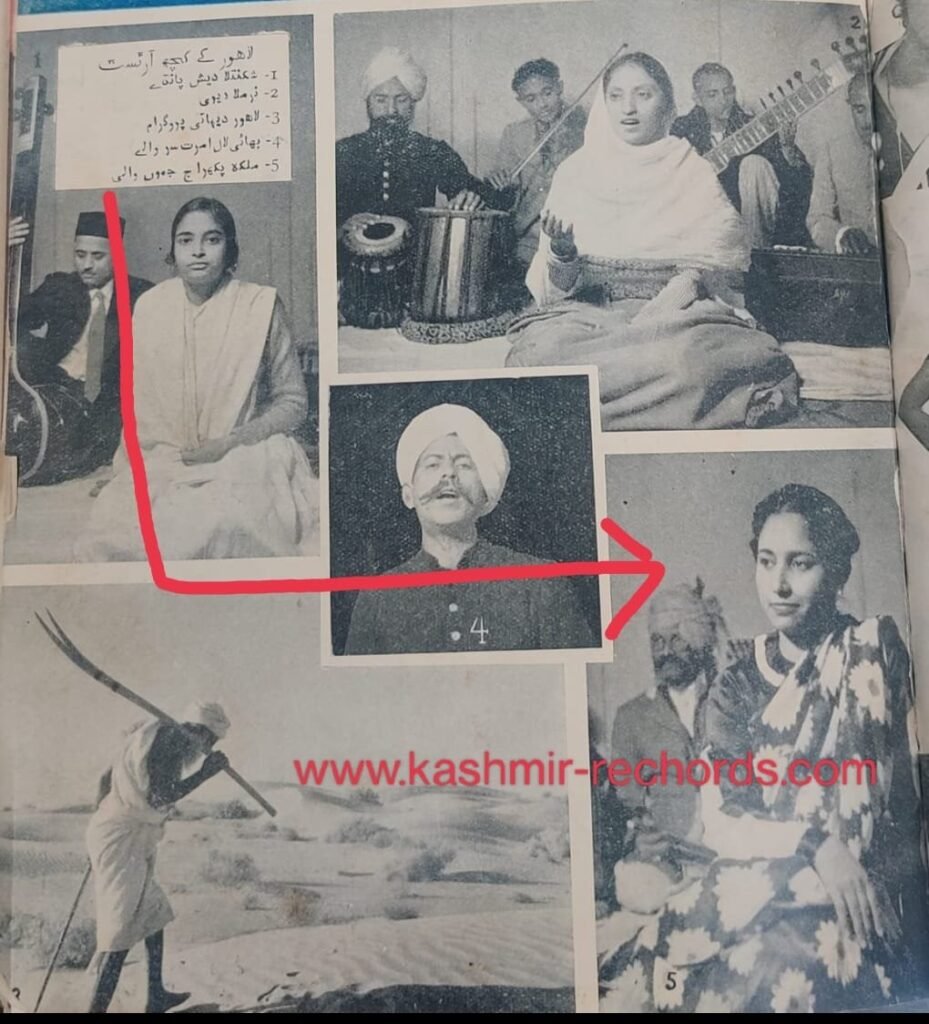
The gifted singer whose musical voice echoed the earthly sounds of melody and became synonym with Dogra ethos, Malika Pukhraj (Jammu Wali), will always remain inextricable part of modern Dogra lore as well as the shared legacy of the sub-continent.
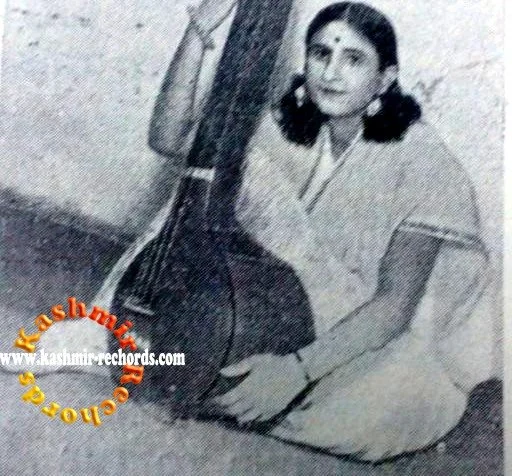
Born in 1912, in village Mirpur near Akhnoor, Jammu, Malika Pukhraj needs no introduction! Her journey from Akhnoor to Kanak Mandi, Jammu to Lahore is itself very interesting! Kashmir Rechords is reproducing two of her rarest photographs to bring home the fact that she is, what she used to sing, “ Abhi to Mein Jawan Hoon’’— both in everyone’s thoughts and pictures”.
Jammu Wali Malika Pukhraj had an opportunity to sing during the coronation ceremony of Maharaja Hari Singh as she was bestowed with the honour of being a court singer at the young age of nine. However, her childish act (laughing in Maharaja’s darbar) was the turning point in her life, as the same was viewed as contempt, recalls noted journalist, Lalit Gupta in one of his writeups.
Journey from Jammu to Lahore
According to Gupta, due to some court intrigues, she had to leave Jammu for good at a very young age. At Lahore, she associated herself with All India Radio, Lahore, where she was every time addressed as “Malika Pukhraj Jammu Wali’’. The pictures produced by Kashmir Rechordsdates back to January 1940. Pukhraj must have been 28 at that time!
After partition, Malika Pukhraj lived in old Lahore City where she was married to Shabbir Husain Shah, a Government Officer. She had six children. He daughter– Tahira Syed, having learnt singing under her mother’s strict discipline, also turned out to be a well-known Pakistani singer. Continuing in her style, Tahira re-sung many of her mother’s famous songs, including her Dogri songs.
Malika Pukhraj had visited Jammu for the last time in 1988 along with her daughter Tahira.
All India Radio’s Legend of Voice
In recognition of her contribution to music, she received Pakistan’s Presidential Pride of Performance Award in 1980. But before that, in 1977, All India Radio had awarded her with the ‘Legend of Voice’ award.
Malika Pukhraj died at Islamabad on February 4, 2004, at the age of 90, but her Dogri songs, “nazm” recitations and ghazal renditions live on. She is remembered in the Jammu as a cultural icon and Lahore is still nostalgic with the resonance of her gayaki.
On the top of it—- She was always addressed as “Malika Pukhraj—-Jammu Wali!’’
Shyama Zutshi (1910-1953) and Zaira Wasim (born 23 October 2000) have something in common to share. While Shyama Zutshi was the first Kashmiri girl who joined Hindi films in 1934, Zaira Wasim is perhaps the last from the same cultural background/lineage. Both Shyama and Zaira have remained quite successful and sought after stars but suddenly moved out from films for nearly identical reasons. Shyama Zutshi is believed to have quit films as her fellow Kashmiri Actor, Chander Mohan Wattal used to tell her always to quit acting as the same was “not meant for Kashmiri girls’’. As per some of the statements of Zaira Wasim, Bollywood industry had “conflicted with her religious identity and beliefs’’.
Shyama Zutshi: An actor, freedom fighter
Shyama Zutshi, a Kashmiri pandit, born at Anand Bhawan, Allahabad, after passing her BA examination, had joined Hindi cinema. She had acted in films like Shiv Bhakti (1934), Majnu (1935), Kaarwaan- e- Hayaat (1935) and Khooni Jadugar (1939) and had remained a prominent artist on the panel of All India Radio, Delhi. Her father, Ladli Prasad Zutshi was a freedom fighter. Shyama was admitted to Sacred Heart Convent, Lahore by her mother Lado Rani. Fluent in English, Gujarati, Marathi, Urdu, Kashmiri and Hindi, Shyama Zutshi was also proficient in horse riding and singing.
Her major hit was Karwan-E-Hayat (1935) in which she acted with K. L. Saigal, T. R. Rajakumari, Pahari Sanyal, and Rattan Bai. She became a very successful actor, but with the influence from her elder sister Manmohini, she moved out from films and focused on politics and freedom struggle. Another reason for Shyama Zutshi to quit films was the advice from a fellow Kashmiri actor Chander Mohan Wattal who was a close friend of Zutshi family. Later, Shyama became a Women Congress leader and a frontline freedom fighter influenced by Mahatama Gandhi‘s non-violent struggle along with her mother and three sisters (Chandra Kumari, Manmohini and Janak) . After some time Lado Rani arranged the marriage of Shyama in a well off Chopra family.
Shyama’s father, Ladli Prasad Zutshi was a prominent lawyer in Lahore and was the nephew of Pandit Motilal Nehru. Lado Rani infused the light of patriotism in her daughters by participating in the freedom movement.
Kashmiri actresses Yashodhara Kathju and Zaira Wasim
Once Shyama Zutshi was out, another girl namely Yashodhara Kathju (niece of Pandit Nehru) was next in line of Kashmiri Pandit girls to join the Indian Film Industry. Chander Mohan Wattal tried to ensure that Yashodara alsoleaves the films but this girl was tough. She ignored all requests from Chander Mohan. Yashodhara Kathju acted in many films from 1942 to 1960. Chnderlekha (1948) and Talaaq (1958) were her milestone films. She married a Navy officer Suraj Prakash Chopra and lived a very unnoticed quiet life. The other Kashmiri girl of modern times and National Award-winning actor, Zaira Wasim announced her “disassociation” from the field of acting in 2019. Since then, she has often shared posts on social media in support of her religion
Death had stalked Swami Amarnath ji pilgrims in August 1996 as never before scores of people had perished due to the unseasonal snowfall and the torrential rains that had begun with the movement of pilgrims from Pahalgam, the base camp of Amarnath to the holy cave shrine.
Bad weather had made it impossible to carry on with the rescue operations, as authorities, who were caught unawares, failed to rescue the stranded pilgrims, who later died mainly of cold.
From the year 1991 to 1996, the annual pilgrimage to the holy cave shrine of Amarnath was held under the threat of militant groups operating in Jammu and Kashmir. But in 1996, when the militants had reportedly “assured’’ that they would not interfere in the pilgrimage, the number of pilgrims swelled from the previous years. The erstwhile State of Jammu and Kashmir was also going for the elections around the same time in 1996.
It was Shiva’s Tandav
Due to the clear and dry weather, the pilgrimage in 1996 had in fact begun in July itself. The dry weather had continued up to August 20. It abruptly turned violent! Between August 21 and 25, one lakh pilgrims were simultaneously moving either up or down from the base camp to the holy cave and no one had predicted that the tragedy was a step away on the tedious track. Soon after August 25, there was unusually heavy snowfall along with severe blizzards along the yatra route. The Yatris, over 250 in number, had died due to exhaustion, exposure, freezing, and other factors.
Due to the clear and dry weather, the pilgrimage in 1996 had in fact begun in July itself. The dry weather had continued up to August 20. It abruptly turned violent! Between August 21 and 25, one lakh pilgrims were simultaneously moving either up or down from the base camp to the holy cave and no one had predicted that the tragedy was a step away on the tedious track. Soon after August 25, there was unusually heavy snowfall along with severe blizzards along the yatra route. The Yatris, over 250 in number, had died due to exhaustion, exposure, freezing, and other factors.Government of hiding the facts and accusing the Government for laxity. Gowda’s Home Minister, Inderjit Gupta had admitted the lapses leading to the tragic incident.
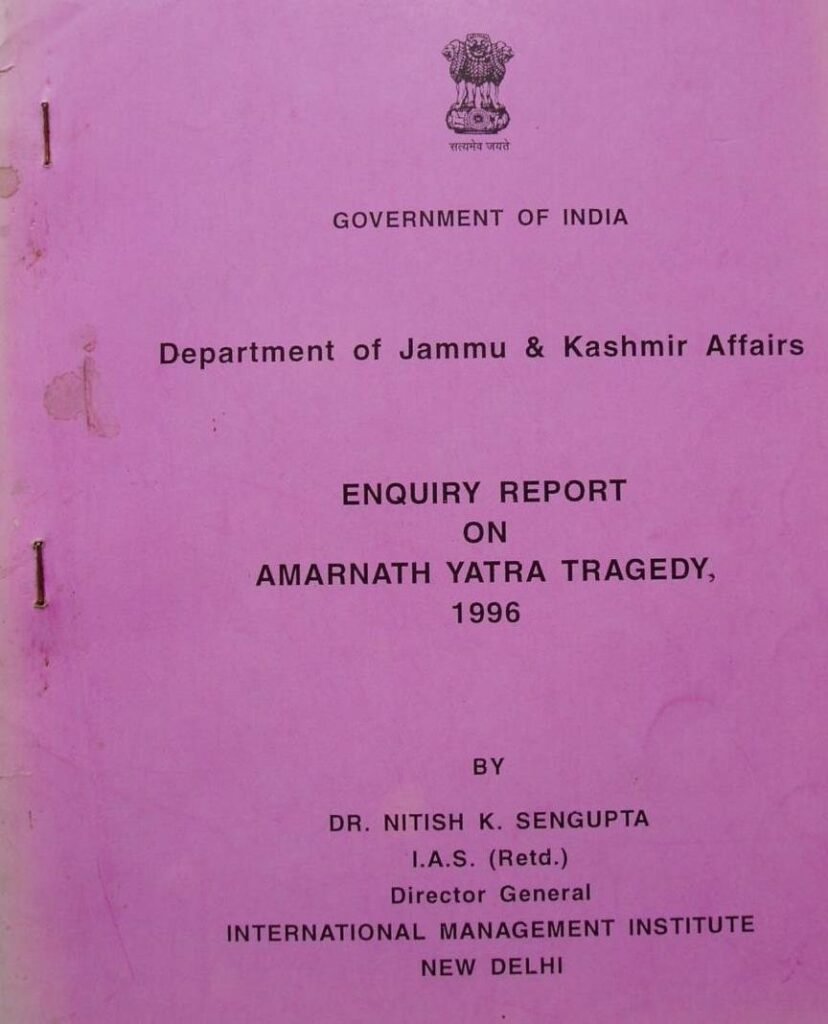
Nitish Sengupta Committee
The then State Government had constituted a committee headed by the retired IAS officer Nitish Sengupta to conduct a probe. The Committee had opined that the heavy casualties were due to excessive flow of the pilgrims, State Government’s `priority’ in election being held at the same time and thus the consequent inability to face the crises.
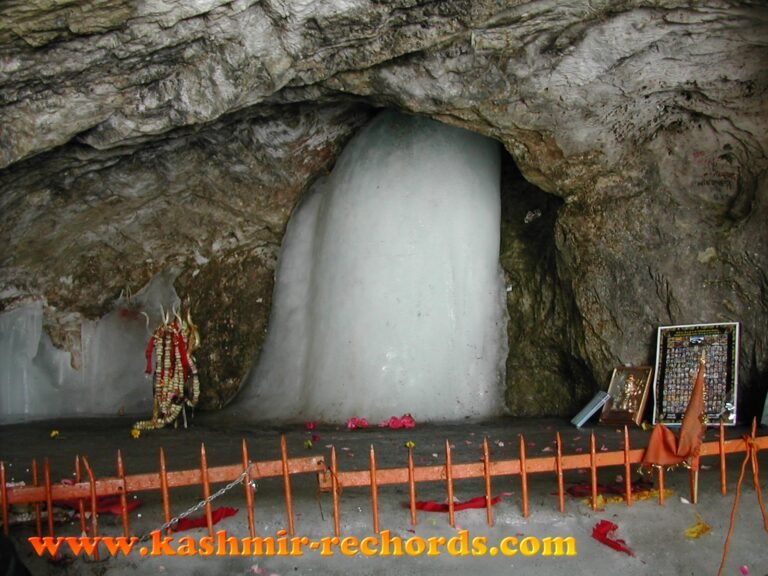
Ice lingam was not fully visible in 1996
The reports assessed by Kashmir Rechords, suggest that in 1996, the holy lingam was down from its normal eight feet to just three 3 feet. Worried about the same, the then state government officials had flown up a 10-ft-high picture of the lingam to the icy cave and pasted it there on August 21.
Nature believed it was time for irony. The next day freezing rain and snow began to fall. It continued for three days, and temperatures plunged to well below zero. For the pilgrims (more than one lakh moving on the track), it turned into a seemingly endless march of death. More than 214 died on the road to Amarnath, while others had lost life at base camps and hospitals. It was like Shiva’s tandav nritya (dance of death)
Army and Air Force helicopters had ferried survivors to hospitals in Srinagar. The tragedy had also brought out the best in the people of Kashmir. All along the route, local Muslims had opened their houses to dazed pilgrims, giving them food and shelter.
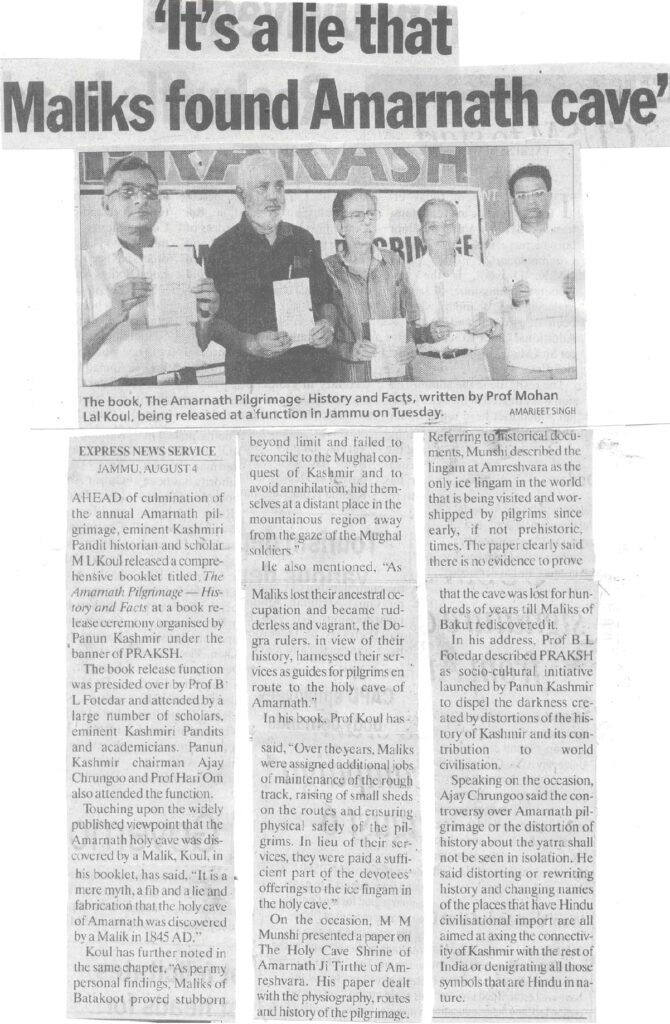
Eminent Kashmiri Pandit historian and scholar, Prof ML Koul in his book “The Amarnath pilgrimage- History and Facts’’ categorically states that, “ it is a mere myth, a fib, lie and fabrication that the holy cave of Swami Amarnath Ji was discovered by a Kashmiri Muslim Malik family in 1845 A.D.
In his book, released in Jammu in 2009, Prof Koul notes in one of the chapters that “Maliks of Batakoot are those who proved stubborn beyond limits and failed to reconcile to the Mughal conquest of Kashmir and to avoid annihilation, hid themselves at a distant place in the mountainous region away from the gaze of the Mughal soldiers”.
The Book mentions that, “as Maliks lost their ancestral occupation and had become rudderless and vagrant, the Dogra rulers, in view of their history, harnessed their services as guides to the pilgrims’ en-route to the Holy Cave of Amarnath”.
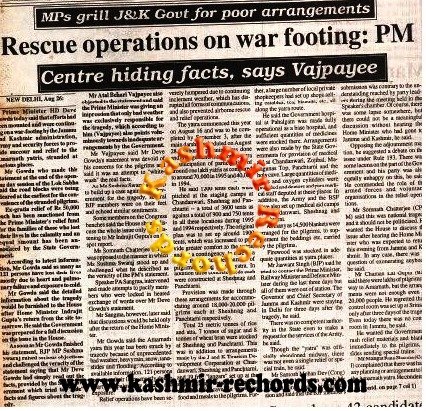
The eminent author states that Maliks were assigned the additional jobs of maintenance of the rough track, rising of small sheds on the routes and physical safety of the pilgrims. In lieu of their services they were paid a sufficient part of the offerings that the devotees offered to the icy lingam in the holy cave. Indian Express in its August 5, 2009 issue of the paper had carried a detailed story on Prof Koul’s book release function. Kashmir Rechords, from its archives, is reproducing a newspaper cutting for the benefit of the esteemed readers.
Swami Amarnath Yatra culminates every year on Raksha Bandhan which coincides on Shravan Purnima.