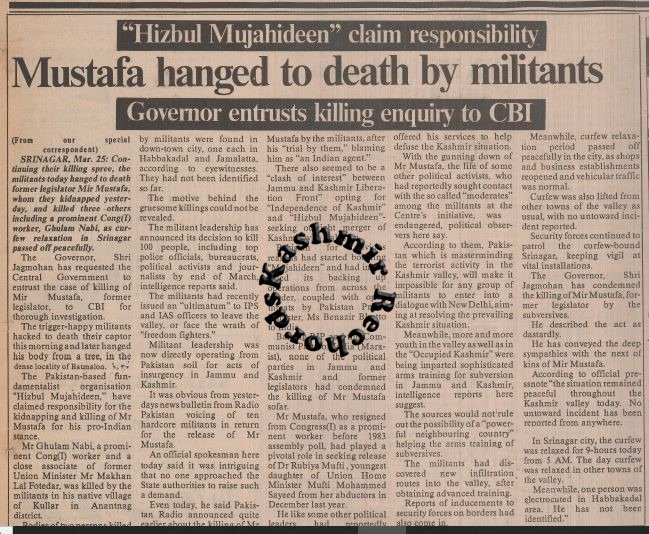
Thirty-four years ago, on March 25, 1990, another “ Indian Agent’’ was killed! This time, the `Agent’ was a former Legislator, Mir Mustafa, who was first kidnapped and later hanged to death by terrorists on a killing spree.
As per the relevant newspaper reports available with the Kashmir Rechords, before pronouncing a “death sentence’’, terrorists had “interrogated’’ the slain leader and made him to `confess’ his `crime’.
Ghulam Mustafa Mir, popularly known as “Mir Mustafa’ was a former member of the Jammu and Kashmir Legislative Assembly, representing Chadoora constituency.
On the fateful day of March 24, 1990, Mir Mustafa was abducted by terrorists for being an “Indian Intelligence’’ Agent. It was Radio Pakistan, who was providing inputs to terrorists to execute their plans. That was evident from the fact that Radio Pakistan had initially demanded release of 10 terrorists in lieu of abducted Mir Mustafa. As negotiations did not materialise, Mir Mustafa was killed and his body found lying on March 25, 1990 in Batmaloo area, after dubbing him a `Mukhjbir’. Local and national dailies had carried the shocking incident of his death in their March 26, 1990 editions.
Where are Mir Mustafa’s killers?
Even as his killers were identified after then Governor Jagmohan had handed over the case to CBI, it took 18 years after his death to sentence a former Hizbul Mujahedeen terrorist to 19-years rigorous imprisonment by a TADA court in February 2009. The court had convicted Mohmmad Maqbool Tantray of conspiring with the other accused in kidnapping and killing of Mir Mustafa in 1990. Incidentally, authorities in June 1990 had released the pictures of three terrorists responsible for the killing of Mir Mustafa, whose whereabouts are, however, still unknown.
Mir Mustafa’s killing is yet another instance where fair justice has not been delivered to the nears and dears of Bhats, Taploos, Pandits, Pirs , Ganjoos or Ranjoors who were all killed by terrorists only for representing India in Kashmir.
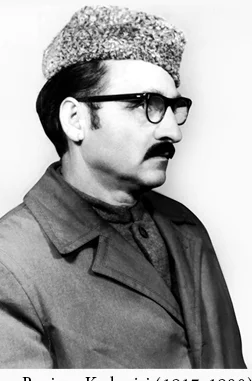
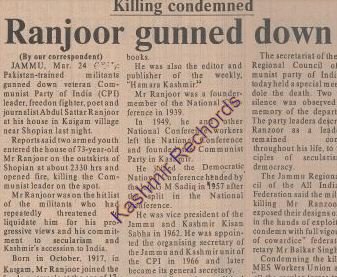
Circa March 1990:Kashmir Rechords in its recent blogs reported about the killing of a Telecom Engineer B K Ganjoo and that of Deputy Director, Food and Supplies Kashmir A K Raina who were killed in the month of March 1990. During the same period, terrorists in Kashmir had killed leaders of other mainstream political parties as well. The killing of veteran Communist Party leader Abdul Sattar Ranjoor is one such instance.
On March 23, 1990, Communist Party leader Abdul Sattar Ranjoor was having an ordinary evening, sitting by the side of his wife at their home in Keegam, Shopian, and Kashmir. Terrorists had entered the room with an intention to kill Ranjoor at point blank range. Ranjoor was shot dead because of his love for Kashmir and its people irrespective of their faith and belief.
Ranjoor was a secular and anti- communal. That is evident from the fact that he had fought for Ahmedia Muslims during his life. ( refer to is auto-biography)., He took on fundamentalists of all faiths with equal disdain. Notwithstanding his deep engagement on socio-political front, Ranjoor had immensely contributed to Kashmiri Literature. He had started writing poetry while he was a teenager.
His family was denied pension for five years after terrorists shot him dead while on duty! Over three and a half decades after his death, the family is still not aware whether his killers have been brought to justice? His younger son is desperately fighting for recognising his father’s martyrdom! The martyr is none other than Late A K Raina, the then Deputy Director of Food & Supplies, J&K Government, Srinagar who was shot dead by terrorists in his Office Chambers on March 20, 1990. Raina’s only fault was that he was in the line of duty and wanted to ensure uninterrupted food supplies channel to the residents of Kashmir, who were otherwise facing hardships on account of curfew, which was clamped in most parts of the Valley at that time.
Despite continuous “ strict’’ curfew in Srinagar, terrorists had easily managed to enter his office, which was incidentally at a stone’s throw distance from Police Station Shaheed Ganj. On the same day, (March 20, 1990), terrorists had also killed a State Police constable, Jagan Nath and an Intelligence Bureau man, Joginder Singh in Kashmir. Mohd Yousuf of Qazigund, Kashmir and his two other family members were also critically injured by terrorists the same day, labelling them as Police Informers.
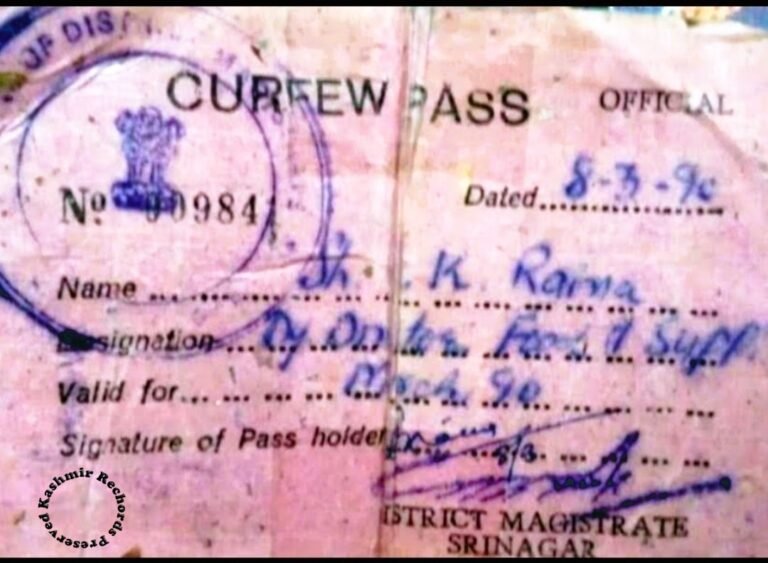
A Curfew Pass!
In the killing of Mr A K Raina, terrorists wanted to ensure that Government gets crumbled and locals come out on streets once food channel is disturbed. This Kashmiri Pandit officer (A. K Raina) was an obstacle in their nefarious designs.
At the time of his death, Raina was just carrying a Curfew Pass in his pocket, issued by District Magistrate, Srinagar for the entire month of March 1990. …..And on the other hand, terrorists were openly brandishing highly sophisticated weapons.
According to his younger son Vivek Raina, the Curfew Pass was in his father’s coat pocket, which was later handed over to the family at the time of handing over the body. Vivek recalls that his father believed that “ Nobody can harm him as he had never hurt anyone and was an upright Officer’’. However, he was possibly unaware of the snakes in his backyard.
Even as when his salary was not released on 14th March 1990 due to the turmoil in Kashmir, Raina did not mind for that but ensured that food and supplies chain does not get affected in Kashmir. Vivek recalls that since curfew was clamped most of the time, his father being on a higher post would always be on a Magisterial Duty. Moreover, Food and Supplies was naturally categorised as “Essential Services” and he had to perform duty even at odd hours.
On the fateful day of his killing, A K Raina had got up early in the morning and after a customary Puja ceremony, he had left for his office. It was a matter of few minutes soon after leaving his house that he was pumped volley of bullets in his office chambers. On his way to a Hospital, he was declared as “ brought dead’’.
Denial of Family Pension, Recognition
The Life had turned a hell for the family soon after their shifting to Jammu. The tragedy was further compounded by the authorities at the helm of affairs who caused so many obstacles , as a result of which the family pension of Mr A K Raina was not settled for more than five years after his death!
During the past two years, the Jammu and Kashmir government had named and dedicated so many schools and roads after martyrs and other eminent people. The initiative was a part of the decision to honor those who have died serving the nation. Vivek Raina has been requesting everyone to recognise the services of his father by dedicating at least a room after his name where he was shot dead. The administration has so far failed to do so despite several reminders from slain officer’s son even to the highest authorities at the Sate and Central level, including Lt Governor and Prime Minister.
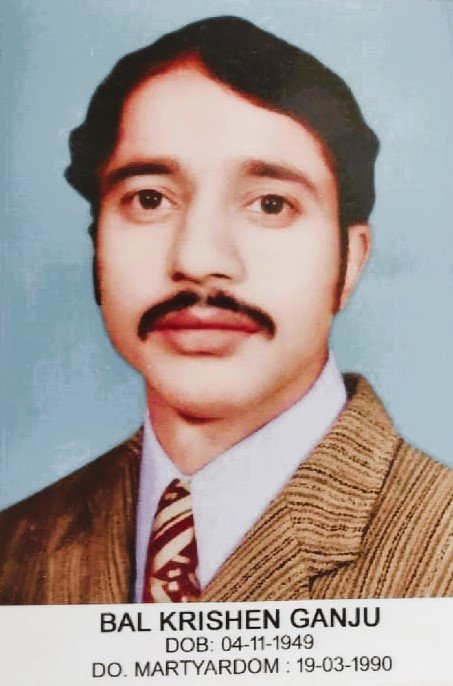
On March 19, 1990, Bal Krishan Ganjoo, an Engineer working with Indian Telecommunication Department, was shot dead by terrorists on the same day when “Multi- Party Political Leaders’’ of India were requesting terrorists in Kashmir to shun the path of violence. The appeal fell on deaf ears as terrorists continued with their target killings to scare away minorities.
Newspaper reports of that day ( one available with Kashmir Rechords) say that “militants had spread bullets on B K Ganjoo from a deadly Kalashnikov rifle near his residence at Chota Bazar, Srinagar and managed to escape in the adjoining locality in a car which was waiting for them at a distance’’. B. K Ganjoo’s only fault was that he was a Kashmiri Pandit who wanted to ensure that telecommunication services did not get affected. He was thus on the hit-list of terrorists for his dedication towards his duty.
It is believed that terrorists had followed Ganjoo when he was on his way to home. Upon entering the house, his wife reportedly hid him in a barrel of rice kept in their attic. Terrorists had entered the house intending to kill Ganjoo, but they left after they could not find him. However, one of Ganjoo’s neighbours snitched to terrorists that Ganjoo was hiding in a rice barrel. Terrorists had gone back into his house and shot him dead inside the barrel.
Vivek Ranjan Agnihotri in his 2022 The Kashmir Files has gone a step ahead in showing to the masses that Ganjoo’s wife was then forcefully fed the blood-soaked rice. Newspapers of March 20, 1990, having carried the gruesome incident, however, mention that one Dinesh Lal was critically injured during the shoot-out. The news item also mentions that with the killing of BK Ganjoo, more members of minority community had started leaving the Valley in panic. Ganjoo was the second official of the Telecom Department who was killed in Srinagar during March 1990.
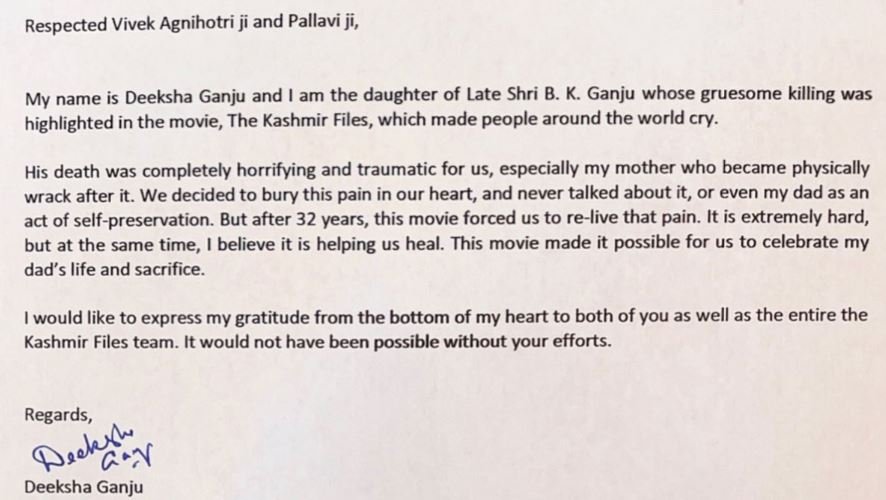
After the release of The Kashmir Files, B K Ganjoo’s daughter, Deeksha Ganjoo in a letter to Vivek Agnihotri and Pallavi had expressed her gratitude for highlighting the killing of her father in the movie. The letter was later shared by Agnihotri on his twitter account.
Multi-Party Failure Meet on Kashmir
On the day when B K Ganjoo was killed, some politicians of National Parties were already in Kashmir. On the same day, they had released a joint statement, which was adopted by leaders of Janata Dal, Telegu Desam Party, Asom Gana Parishad, Bharatiya Janata Party (BJP) Communist Party of India (CPI), CPI-M, Congress-(I), besides State’s National Conference.
The leaders of these political parties had appealed to terrorists to“ abjure violence and uphold peace’’. However, the statement did not carry a single word about Kashmiri Pandits or that of B K Ganjoo’s killing.
As politicians failed to prevail upon terrorists to shun the path of violence, the latter had instead resorted to more target killings during the last 10 days of March 1990. Kashmir Rechords will try to highlight those killings in its future Blogs.
The historical materials pertaining to Hindu religious thought in Kashmir consistently pique the interest of scholars and academics. It is this enduring relevance that prompts us to revisit these materials in search of solutions to our contemporary challenges. Such activities have been integral to Kashmir, fostering the development of its profound native thought and contributing significant value to Advaita, the core of Indian religious and spiritual philosophy.
Through rigorous inquiry, Kashmir’s spiritual masters developed their own philosophy known as ‘Shaiva Advaita,’ which not only articulates the profound connection between the individual and the universe but also endeavors to comprehend one’s own nature.
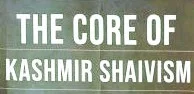
Dr. R.L. Bhat, a prolific writer with a profound interest in history, philosophy, and the contemporary human condition, has recently published an intriguing book titled ‘’The Core of Kashmir Shaivism’’. In the tradition of Kashmir’s scholarly inquiry, he has positioned himself among serious academicians. Among his other acclaimed works are translations from Kashmiri, Sanskrit and Persian into English. These include titles as diverse as ‘Faith Besieged,’ ‘Lal and Her Vaakh,’ ‘Azad – the Poet of Lool,’ and ‘Abhinava Pathaof Srimad Bhagavad Gita.’ Additionally, he has offered his own interpretations of Allama Iqbal’s Urdu poem ‘Shikva.’ Furthermore, he has developed a unique method for transcribing Kashmiri into Roman script without relying on diacritical marks and has dared to include and introduce the same in his books.
No Compromise with Tradition
Dr. Bhat’s remarkable quality lies in his unwavering adherence to the sources and disciplines espoused by the tradition. While interpreting the profound philosophy of Shaiv Darshana, he abstains from relying on mere opinions or speculations. Instead, he strictly adheres to the established tradition, considering that the ‘Aagams,’ the ‘Tantras,’ and the ‘Shiv Sutras’ are the most sacrosanct sources. In the foreword to his book, he humbly acknowledges, ‘The gems of Shaiv Darshana remained scattered in shambles till Swami Ram came and put them together again.’ He further attributes the reinstatement of these teachings, as they were in the days of Acharyapaada Abhinavagupta, to Swami Ram.
Kshemraja’s contribution
Dr. Bhat’s profound passion to introduce Kashmir’s unique philosophy not only extends beyond the urgency of recognition of the fact of dwindling number of Kashmiri Hindu youth and the race against time to somehow bring forth the same to them but also underscores a pressing need to cherish and perpetuate this golden tradition within contemporary Kashmir. The introduction of the philosophy, along with its diverse communities and schools catering to various orientations and natures, has been immaculately detailed. The book delves into the life and teachings of Kshemraja, the direct disciple of the great Abhinavagupta. It meticulously explores Kshemraja’s contributions in explaining the core tenets of Shaiva Darshana, which evolved significantly from Vasugupta to Abhinavagupta over a period of centuries. By selecting Kshemraja as the focal point, the book aptly portrays him as a pivotal link encompassing the entirety of Shaiv Darshana.
The book effectively emphasizes the significance of awareness in Shaiva Darshana. It elucidates that this awareness begins at the individual level and goes on expanding as one accumulates energy, leading to a profound understanding of one’s inner nature and its magnificence. Unlike many other schools of Indian philosophy, Shaiva Darshana does not reject worldly experiences (“bhoga”), thereby recognizing joy in the diverse experiences the life offers. Consequently, there is no notion of renouncing the world. However, ethical conduct in Shaivism arises naturally from understanding one’s immediate and inner environments, representing what we now understand as default behavior associated with this Darshana.
The subjects such as “Pratyabhijna Hridayam” and the “Matrikachakra” have naturally attracted Dr. Bhat’s attention also. However, unlike Swami Laxman Joo’s extrapolations in “Kashmir Shaivism : The Secret Supreme” (as revealed to John Hughes), Dr. R.L.Bhat has not extensively elaborated on the subjects. Nonetheless, introductory passages in this regard do exist. Similarly, a brief mention has been made to shed light on stages of consciousness from “Jagrit” to ‘Turya”. However understandably due to the esoteric nature of these subjects, no further exploration can be expected either.
Science of Sleep and “Maatrikaa Vigyaan’’
The book also provokes the reader to delve deep into his or her inner world amidst the chaos projected by the outside world. Similarly the book raises the question as to when will the current structure of scientific research and exploration deem it fit to inquire into the subtleties of “Maatrikaa Vigyaan” and the science of sleep variously known as “Yog Nidra” also.
The reader may find it challenging to adapt to Dr. Bhat’s consistent advocacy for the elimination of diacritical marks, as this approach has not yet been widely accepted as a standard mode of expression. However, young readers are likely to appreciate the merit of this book, as it endeavors to elucidate essential truths in a rational manner, free from the rigidity and barrenness usually associated with religious discourse.
*Kanwal Krishan Lidhoo, an accredited translator of Kashmiri, Urdu and Hindi by Sahitya Akademi New Delhi and Indian Institute of Languages Mysore, has remained associated with the institution of All India Radio (AIR) where he worked as Senior most Producer. His books of Translation include “Samay Matrika” , the translation of 10th century Sanskrit classic of the same name by Acharya Ksemendra of Kashmir, Sahitya Akademi New Delhi’s “Hum Kaal Sindhi Afsana Sombran” a Kashmiri translation of Hindi scripted “Samkaleen Hindi Kathayen”, and under publication “Navi Yogikie Vaaeris Dar” a Kashmiri translation of English scripted collection of Punjabi short stories of renowned Punjabi short story writer Mohinder Singh Sarna, Indian Institute of Languages publication “Hindustaenie Falsafekie Khad-o-Khal”, the Kashmiri translation of “Outlines of Indian Philosophy” by world renowned Professor M.Hiriyanna besides a monograph on veteran and doyen of Kashmiri poetry, Makhan Lal Kanwal, (a Sahitya Academy Publication, Delhi)
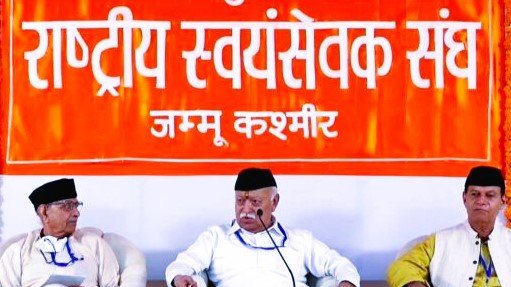
Rashtriya Swayamsevak Sangh (RSS) and Jammu and Kashmir have a unique bonding even before the Princely State had acceded to India. Even as certain agencies, for their vested interests, have painted Sangh black, the fact that most of the people are unaware of, is that RSS had played a major role in the unity and integrity of Jammu and Kashmir and helped Army and local agencies in thwarting the tribal raid engineered by Pakistan in October 1947. There is a little mention of this historic fact in the annals of Indian history.
Newspaper records available with Kashmir Rechords (https://kashmir-rechords.com/blog/) point out that the initial attack by Pakistani raiders was made on October 11, 1947 when they were on a killing spree in areas like Mirpur and Kotli which later fell into Pakistani hands. The reports further mention the role of RSS volunteers in protecting hapless refugees at Jammu who were coming from Pakistan and Pakistan Occupied Kashmir (PoK). Besides, volunteers had helped in broadening Jammu aerodrome and assisted Army garrison. In Kashmir, the Sangh volunteers had also joined militia and stood by Indian Army to push back Pakistani raiders. In defending Srinagar, one Kashmiri Pandit Sangh worker, Pandit Manmath had lost his life. The newspaper reports of yesteryears, quoting “RSS Vision in Action” further say that Sheikh Abdullah’s Government had allowed RSS to work in the militia until Kashmir valley was cleared of raiders.
The RSS had begun its activities in J & K in the 1940s when late Prof Balraj Madhok was a Pracharak. Madhok (25 February 1920 – 02 May 2016) came from a Jammu-based Khatri family and was born in Skardu, Baltistan. He had studied in Srinagar, Jammu and Lahore.
When Patel Sought Golwalker’s Help
As the fate of Jammu and Kashmir was hanging in balance even after India’s Independence on August 15, 1947 and the situation was getting delicate with every passing day, in such a condition, India’s Union Home Minister, Sardar Vallabh Bhai Patel had sent a message to the then RSS Sarsanghchalak, M. S. Golwalkar, through J&K’s Prime Minister, Mehar Chand Mahajan requesting him to use his influence to prevail upon Maharaja Hari Singh to accede to India.
Golwalkar, fondly known as ‘Guruji’ cancelled all his engagements, had rushed to Srinagar by air to resolve the ticklish and delicate question. Through the efforts of Mehar Chand Mahajan and Pt. Premnath Dogra, a meeting between Guruji and Maharaja Hari Singh was arranged on October 19, 1947.
The newspaper reports of the past suggest that it was RSS Chief M. S. Golwalkar, whose patriotic and authoritative advice to Maharaja Hari Singh finally made the Princely State accede to India. The reports further say that at the time of Pakistani invasion, Sheikh Mohd Abdullah was not in Srinagar but was holidaying in Rajasthan!
The records also point out that RSS had played a major role in accession of J&K and helped in maintaining its unity and integrity. There is, however, a little mention of this historic event in the annals of history.
It is with this sole purpose that Kashmir Rechords, a research-based platform on Kashmir, has come out with this particular blog, supported as usual by authentic documentary evidence based on newspaper reports of yesteryears.
At a time when migration from Kashmir was at its peak during the first week of March 1990, the then Government of India had turned a blind eye towards the plight of Kashmiri Pandits, leaving them high and dry and at the mercy of some Jammu based social organisations. Instead, it was ironically more concerned about the settlement of Bangladeshi refugees in India during the same period!
Records available with https://kashmir-rechords.com/blog/ suggest that the then Union Home Minister Mufti Mohd Sayeed in a reply to a Parliamentarian’s query submitted that 64955 Bangladeshi refugees were accommodated in Indian relief camps as on March 5,1990. Besides 300 Chakma refugees were also provided accommodation in Mizoram.
But the Mufti had no time to even listen to Kashmiri migrants’ sufferings. According to the newspaper reports of March 6, 1990, the Home Minister was scheduled to visit Kashmiri migrants at Jammu but he chose otherwise!
New Home: Gita Bhawan
Finding themselves between the devil and the deep sea, Kashmiri Pandits had no option but to swarm Gita Bhawan Jammu that continued to be the postal address for Pandits for so many years.
It was from the Gita Bhawan where migrants were initially registered and provided a meagre relief measures. Many had to struggle for it or getting themselves registered even as migrants! One such migrant had to lose his life while others were forced to resort to agitation, dharnas and processions!
It was after so much struggle and agitation that Governor’s administration started some Adhoc measures by providing a sustenance allowance of Rs 500 per family, with a plan to send migrants back home by April 1990. This March, Thirty four years have passed, but……..
Bangladeshi refugees on the other hand were officially accommodated in States like Tripura and Mizoram…thanks to the efforts of the then leaders at the helm of affairs at that time! .
The genre of Leela poetry in Kashmiri literature is said to have evolved from “Vachun’’ and we notice a boost in this experimentation since late 1750s onwards. It, however, reached its zenith during Krishan Joo Razdan’s time though he explored the `Saguna’’ tradition of Bhakthi to its full potential. He essentially was a “Nirgunvadi’ in his spiritual practice and discipline. Since he was a “Shavite’’, he composed Leelas mostly in honour of Lord Shiva and his one particular Leela “Bel Tai Madal Vene Gulab Pamosh Daste Poozaye Laage Parm Shivas Shiv Nathas Tai….’’ has not only become a part of folk literature of Kashmir but also of world on account of its aesthetic and devotional sensibility. The golden voice of Ustad Mohammad Abdullah Tibat Bakal imparted to it such ethereal beauty and energy that subsequent musical adaptations of the same pale in comparison to Bakal’s rendition.
Bel Tai Madal in Kashmiri Nastalique
The Evergreen Recording
For our esteemed readers it may be added that Tibat Bakal’s presentation was recorded in the Studios of Radio Kashmir, Srinagar and has attained a cult status among the devotees of Lord Shiva in Kashmir. According to Mr Fayyaz Sheheryar, former Director General, All India Radio,this iconic Leela was composed in early sixties by Mohan Lal Aima under the able supervision of the then Programme Producer of Kashmiri Music, Qaisar Qalander.
Mohan Lal Aima
Qaiser Qalandar
Coinciding with Maha Shivratri which is the premier festival of Kashmiri Pandits, the actual beauty of this festival seems to be wedded to the poetic mystical experience by Pt Krishan Joo Razdan (1850-1926) visible in his work Shiv Lagan. This is said to be an evolved adaptation from Urdu translation of “Shiv Puran’’ by the poet. The elements and symbolism of a typical Kashmiri Pandit marriage in his world famous “ Shiv Lagan Leela’’ have been imbued to the best possible outcome. An earlier generation of Kashmiri Pandit women, both young and old, would sing these Leelas and the debvotional tradition would pass on to subsequent generations. However, with the migration, it has come to a sudden halt.
Nevertheless, Tibat Bakal’s rendition of great poet’s “ Bel Tai Madal Vene Gulab Pamosh Daste Poozaye Laage Parm Shivas Shiv Nathas Tai…. still captures the attention and the interest of the young generation . Mr Sheheryar added that Tibat Bakal imbued this Leela with his own devotional element for Lord Shiva and legend has it that Ustad Tibat Bakal would visit the world famous shrine of Mata Kheer Bhawani at Tulmulla to witness the changing colours of the holy spring and seek blessings.
Mohd Abdullah Tibat Bakal ( Left) and Mohan Lal Aima
This Leela with the wonders of ever evolving technology is awaiting further repackaging so as to make it more popular among the youth. However, the original rhythm and the style is not going anywhere.
(Kashmir Rechords Exclusive in Connection with International Women’s Day)
Once again, we are celebrating International Women’s Day. The exclusivity of such celebrations associated with women unfortunately projects a compulsive need common to all societies of the world and it also reflects the fragile position women find themselves in, in the patriarchal nature of our world. However, it was not the same every time. Sociologists seem to rush to quote Will Durant to justify and claim the glorious position women commanded in the early stages of the formation of human societies followed by retrograde pattern of relegating and pushing them to margins, a universal fact of evolutionary history of human societies.
Back home, in our part of the world that is in Kashmir, there is in fact much to celebrate and cheer vis—as-vis the position of women. There was a time when authority and power was associated with matriarchy. Women were Yoginis, scholars, Advisors and powerful queens famous for institution building and administering justice.
Education: Their Birth Right
In early Käśmira (Kashmir), we learn that the first part of a woman’s life was spent in her father’s house when liberal education was imparted to her. For example, as part of the accepted tradition, curriculum of studies in the 9th century AD included the sexual sciences of Vatsyayana, Dattaka, Vitaputra and Rajaputura, the Natyasatra of Bharata, Visakhila’s treatise on art, Danitila’s work on music, Vrksāyurveda, painting, needlework, woodwork, metal work, clay modeling, cookery, and practical training in instrumental music, singing, dancing, administration, etc.
Sculpture from Awantiswami TempleAwantipur, Kashmir.Excavated tile from Harwan , Srinagar Kashmir depicting a female musician playing on a drum (Period 2nd to 4th Century AD)
Bilhana extols the women of Kāśmira for their learning which allowed them to speak fluently both in Sanskrit and Prakrt. According to Dr Sunil Chander Ray, the eminent Historian of India, the ladies of the royal family were given a good administrative training. The great success with which Kasmirian queens like Sugandha and Didda governed their dominions, naturally presupposes that they were put in the way to efficiency by some previous instruction and practice.
Social position of Kashmiri Women
Dr Ray, in his most acclaimed book “ Early History and Culture of Kashmir’’, (1957) says that women, in early Kashmir played a leading role in the social and political activities of the State of which we have many examples in the pages of Kalhana. The book carrying a very valued forward by K M Panikar, a former Ambassador of India to China startles the readers with the mention that during the time of Kumarajiva, the great Buddhist saint and scholar of Kashmir, it was customary for young men and women of Kuchi and Khotan to be sent to Kashmir for higher learning.
Regarding the proper age of marriage of a woman no positive evidence is forthcoming. A perusal of the Rajtarangni generally leaves the impression that pre-puberty marriage probably was not in vogue in ancient Kāśmira….. Indeed a very enlightening approach. A story related by Kşemendra in the Desopadeśa may indicate that girls were married at a mature age.
The family life, at least of the rich, was polygamous. The kings had seraglio full of queens and concubines and their example was followed by the aristocrats. Polyandry, according to Dr Ray, was quite unknown except perhaps among some aboriginal hill-tribes. (Polyandry to some extent is current among some of the aboriginal tribes of the neighboring regions may be presumed that it was so, even of Kasmiraa in earlier days). However, the widow was expected to live a pure life, devoid of all luxury. The use of ornament or gorgeous dress was forbidden to her…. a pan-India phenomenon.
Sati: An act of volition?
The custom of burning of sati was in vogue in Kashmir from an early time. In the story of Katha Sarit Sagar, which was composed in the valley in 11th century AD, the custom appears to be quite common. Kalhana’s chronicle Rajtarangni also testifies the same. For example it is mentioned that after the death of their husband Samkaravarman, Surendravati and two other queens cremated themselves along with him. When Yashaskara died, his wife Trailokyadev followed her husband to the funeral pyre. Sahi princess Bimba, after the death of the son of Tunga, who happened to be her husband, entered fire as a Sati. There are many other examples of Sati tradition in early Kashmir.
Literary evidence amply testifies to the gross immorality and laxity of character prevailing among certain classes of women of ancient Kasmira. Kalhana’s Rajtarangni delineates in niceties of details the sensual excesses of the ladies of the palace and of the Court. The system of Devdasi practice was also prevalent but must have encountered opposition from the honest and pure minded section of the people. In fact, Al-Beruni testifies to such opposition in North-West India of which Kashmir was an important part.
As the people of Jammu and Kashmir continue to express faith in the democratic and developmental potential of India and when suddenly local politicians of Kashmir are extending goodwill messages for the return of displaced Kashmiri Pandits, it’s imperative to revisit the false narratives surrounding the late Governor Jagmohan, who was wrongly blamed for the exodus of Kashmiri Pandits from the valley. These fake and false narratives are being pedaled since 1990 against Jagmohan, holding him responsible for the unfortunate exodus of Kashmiri Pandits from valley. It was mainly used as a cover both by Pakistani movers and shakers of Kashmir militancy and equally by the mainstream politicians along with a large component of Kashmir’s intelligentsia. All this was done to orchestrate a shield to save them from the guilt trip that they felt would likely see them in their faces either due to their inability to call a spade a spade at that point in time or due to their own culpability at times.
Despite efforts by Governor Jagmohan to dispel these accusations, vested interests perpetuated these falsehoods, shielding themselves from accountability. However, history holds the key to rectifying these misconceptions, as evidenced by the recent Supreme Court judgment on Article 370, which calls for a Truth and Reconciliation Commission to be set up for moving forward. The same should of course also incorporate the role of the then Governor Jagmohan to set the record straight.
Jagmohan’s Appeal that Got Lost
A news report on front page of Kashmir Times on March 8, 1990.
Records available with Kashmir Rechords provide ample evidence of Governor Jagmohan’s attempts to dissuade Kashmiri Pandits from leaving the valley. In a public appeal, he urged them to stay, offering to set up temporary camps and allocate land for their resettlement in Srinagar. The prominent newspapers of the then J&K State including Kashmir Times and Daily Excelsior had prominently given space on their front pages to Jagmohan’s appeal to Pandits not to leave Kashmir .
Daily Excelsior News , dated March 8, 1990.
Despite his efforts, the Pandit community, plagued by fear and uncertainty, chose to leave. In an appeal through official channels and the mainstream media as well carried on March 8th, 1990, Jagmohan goes on record to urge Kashmiri Pandits not to leave the valley even temporarily as he offered to set up camps even for those who will return from Jammu. The late Governor had chalked all the plans for their stay in Kashmir valley itself but the message got lost on Pandits due to the extreme state of fear psychosis they were in. Governor Jagmohan had even ventured to announce giving plots for Kashmiri Pandit families at Srinagar and orders to Srinagar Development Authority to identify the land in Srinagar were in the offing.
Reconciliation… The Way To Move Forward
The Pandit community was however so shaken that they had lost the confidence, so much so that they did not believe even the late Jagmohan, considered to tolerate no nonsense in the implementation of his decisions. Today, as Kashmiri Pandits seek to return, they face resistance from various quarters. While politicians offer lip service and the civil society remains indifferent and continues to parrot the same false narrative, it therefore becomes crucial to acknowledge that Governor Jagmohan wasn’t responsible for their exodus; rather, it was a tragic consequence of circumstances beyond his control. The misery of the Pandits is continuing and their genuine desire to revisit the valley is met with all the resistance by the forces inimical to their return.
Only by confronting the truth can we pave the way for genuine reconciliation and the eventual return of peace to the valley including return of Kashmiri Pandits.
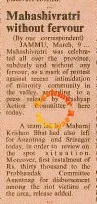
February 23, 1990 is the day that most of the Kashmiri Pandits would not forget! On this day, over 34 years ago, the community performed the last Maha Shivratri Puja before moving en-masse from their birth land.
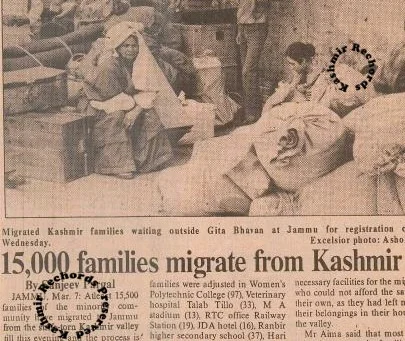
Even as a good number of Kashmiri Pandit families had already migrated to safer areas, the fact is that soon after performing Shivratri Puja that ended on February 26, 1990 the frightened community left everything to save their lives. Between the period from March 1 to March 7, 1990, over 15,000 Kashmiri families had landed in Jammu.
The decision to take extreme step of leaving Kashmir for good, was due to the fact that a day prior to Maha Shivratri of 1990, Kashmiri militants had publically `ordered’ Kashmiri Pandits to leave Kashmir. At the same time, they had asked Kashmiri Muslims who were putting up outside Kashmir, to return to the valley before March 1, 1990. The Pakistan supported Kashmir terrorists were in fact planning to strike in a big way besides had issued a call for “civil disobedience’’ from March I, 1990.
Militants had selected and distributed their areas of operation and specific targets mong themselves. Terrorists had also asked people in the valley to keep stock of the essential commodities in abundance for the month of March, 1990 in order to launch the `final onslaught’. It was in the backdrop of this threat that 99 percent Kashmiri Pandits had moved out of Kashmir before March 1, 1990.
Maha Shivratri of 1986, 1989
The records available with Kashmir Rechords suggest that soon after the Anantnag Riots of 1986, it had become extremely difficult for Kashmiri Pandits to even celebrate Shivratri in Kashmir. On the day of Maha Shivratri on March 9, 1986, some fundamentalist organisations of Anantnag town had once again targeted Kashmiri Pandit houses. An attempt was also made to set on fire a temple at village Lakshibad.
Similarly, a year prior to the mass migration of Kashmiri Pandits, the community could not celebrate Maha Shivratri in 1989. On March 6, 1989, Curfew had to be clamped in entire Kashmir as locals had protested against the publication of Salman Rushdie’s “ Satanic Verses’’. Taking the advantage of the deteriorating law and order situation, some urchins had targeted Kashmiri Pandit Mohallas and localities in order to vent their anger against Rushdie.
Post Migration Maha Shivratri
Following their exodus, Kashmiri Pandit community could not properly perform Shivratri Puja in the initial years of their migration. A day prior to Maha Shivratri on February 13, 1991, heavy hailstorm and rains had lashed Jammu, as a result of which, 5000 Kashmiri Pandit migrant families putting up in various camps, got dislocated and thus couldn’t perform `Vatuk Puja’.
Similarly on March 2, 1992 and February 19, 1993, `Sharika Peeth Sanstha’’ Subash Nagar Jammu and Dharmarth Trust had arranged Samohik Shivratri Puja for Kashmiri Pandits as they were living in rented accommodation or tents where it was not possible for them to perform traditional centuries old “Vatuk’’ Puja.
The study of people of Pakistan Occupied Kashmir (PoK), the so-called `Azad Kashmir’ has of late taken off given the importance of the role of this group as part of the “Pakistani Diaspora’’, particularly throughout countries in North America and Western Europe, such as Great Britain. It is estimated that there are approximately one million Pakistanis in Britain and approximately two-thirds of these Pakistanis are Kashmiris under occupation of Pakistan and for whom “Azad’’ Kashmir is “Azaab’’ Kashmir. “Azaab’’ in Urdu signifies Pain, Torture, or Torment.
“Azad Kashmiris’’ have too often been ignored by historians of Pakistan and by social and political thinkers operating in the West who have tended to adopt the reductionist and essentialist notion of the Pakistani ethnic classification in relation to this group. However, it is quite clear that some “Azad Kashmiris’’ do not see themselves as part of Pakistan, while some Kashmiris from Jammu certainly do not regard them as part of Kashmir either.
Dearth of Literature on PoK
There is a dearth of literature that specifically focuses on the historical, social and political developments of the region of “Azad Kashmir’’ since its illegal occupation by Pakistan in October 1947. It is striking that little is known of the internal struggle facing this body of people during a traumatic time of political change. It is difficult to obtain independent and analytical perspectives on the range of different issues at play that pulled people and groups in different directions in relation to the choice to be made to accede to Pakistan or India during the time of Partition. What really went on during that time? What was the role of different significant actors of the time, from Maharaja Hari Singh to Jawahar Lal Nehru to Sheikh Abdullah? How has the regional polity of the Pakistan Occupied Kashmir been shaped over the decades, and what kind of implications have there been for local communities as part of the political process that can be understood in a wider historical and sociological context?… These and other important questions have not been tackled by scholars or the region’s people until the publication of The Untold Story of the People of `Azad’ Kashmir by Christopher Snedden.
For many Azad Kashmiris'', it is Azaab Kashmir for them!
Christopher Snedden’s Book on PoK
Christopher Snedden, an Australian politico-strategic analyst, author, and academic specializing in South Asia contends that in October 1947, pro-Pakistan Muslims in south-western J&K instigated the Kashmir dispute. He provides comprehensive new information that critically examines Pakistan Occupied Kashmir’s administration, economy, political system, and its subordinate relationship with Pakistan. Snedden, who visited J&K frequently, undertook research and interviewed many elder statesmen involved in Kashmir politics.
Christopher says that the people of PoK are disenchanted with Islamabad as some “Azad Kashmiris’’ now favour independence. Many scholars, after the publication of this book, however, feel that the people of PoK now want to be with India. Christopher’s book is the authoritative modern history of one of South Asia’s most sensitive yet overlooked regions, the part of Kashmir under Pakistan’s illegal control. It is meticulously researched and clearly written, and the account of the origins of the Kashmir conflict. The author says that he was once told by the people that their area is not `Azad’ Kashmir but is `Azaab’ Kashmir.
Robert G. Wirsing, Visiting Professor, at Georgetown University’s School of Foreign Service at Qatar, observes that Christopher Snedden’s masterful historical narrative of the events surrounding the birth and development of Pakistan-Occupied Kashmir gives a thoroughly researched study of this largely neglected but vastly important dimension of the Kashmir dispute.
The book is in two sections. They explore the historical issues pertaining to Jammu and Kashmir leading to partition. The sections analyze the development of the POK from 1947 to the present, charting it machinations, and set in a sociological, political, and historical context. This book is rich in detail, balanced in its analytical approach, and comprehensive in its description of events and outcomes. It uses interviews with key actors in the region to discuss the present situation, as well as previously unavailable official letters and documents to provide deeper insights into the past.
Andrew Whitehead, former BBC South Asia correspondent and the author of “A Mission in Kashmir’’ says Christopher’s book is meticulously researched and clearly written.