Home Blog Page 22

KPs and the Kashmiri language

By Makhan Lal Pandita
A literate Kashmiri while conversing in Kashmiri makes in between use of English words. There can be two reasons for it. Either he has no complete command over the language due to which he is not able to choose proper words in a jiffy (which is the position of several literate persons) or otherwise it is the dominance of English language rooted in their psyche. We had teacher, Ghulam Hassan Mantooo of Shopian Gagran in our childhood, who after completing morning prayers would give a discourse on different topics. It was in English, and he talked with such a fluency and a break that we would rejoice and long as to when would we reach this position and speak like him because this language had its own pride which still it is holding. Our village people conversed in pure Kashmiri, but they also used words like ‘teem’ ‘puncher’ ‘foot news’ (meaning Time, Puncture, and news from mouth to mouth respectively). They also had this notion that real education means to learn English. Even though our generation had the usage of Kashmiri in our homes, yet we would try to use English words. In those early day when we would be with an English Primer or any such book, an elderly person from our neighbourhood would frequently ask to translate ‘Turant Dhan Maha Kalyan’ (He who gives twice, gives in trice) and when we would show our inability, he would term us still inexperienced. Those days English had not dominated the daily life as it has now, so much so, If we would use any English word which we had learnt in our school, the listener would in a prank, retort, ‘I am speaking to you in Kashmiri and you are replying in English ‘ or ‘ Speak plainly why you are talking in English.’ So, we would refrain from speaking English while talking with such a person.
After reaching Jammu everything changed and from the viewpoint of language, we understood that we are not in tune with our surroundings and while talking, especially our women folk, would fumble even in respect of Hindi or Urdu as well. ‘Bijli Daalo” or ‘Sooch Daalo’ or ‘Paani Pakdo” (switch on the light, collect some water’) or similar distorted words came to our notice. The vegetable venders of their own goodwill would give some extra green chilly to please the customer and if they forgot same, they would remind and tell him, ‘Muje Mirchean Daalo’ (give me the Chilli). If you be attentive, you will hear many such words even today.
I had once been to Delhi in connection with purchasing some marriage articles. My cousin who was born and brought up there accompanied me to the market. We went to Chandni Chowk where some shopkeepers as per her notion, had the reputation of selling quality products on fixed rates. She bade me in advance to keep mum because they could at once surmise that we are not locals, and that we are Kashmiri and inflate prices, which amply proves we cannot speak a standard Hindi as well. Simillar conditions prevailed at other places whether you had to deal with shopkeeper, or it be the playground of children. The children had to deal with an alien language and were not at home with Hindi language as well. This was a reason they had to fortify themselves for such surrounding. Even Kashmiri language being in use in their homes, they are not able to speak in it and if at all they speak, it would be distorted. If we push Kashmiri language to them, I feel that will not work because they have no compulsion around, nor have a habit, and how will they converse in it. It is said that a child whatever picks up to the age of 5 years it remains imprinted on his intellect and becomes his mother tongue.
There is no doubt that the mother tongue is that sole medium which keeps us bound with our culture. If we take stock of things we will come to know that such children who have not in practice this language they are unaware of their culture as well. They are rather compelled to keep themselves attached with new environment. The net result is that if they find an opportunity or a chance, they will not hesitate to come out of that circle which we call Kashmiri society.
On the other side, the Kashmiri language has not such an advantageous position that it can hold the children in its grip because this matter is related to domestic economy. The parents of a child do not want their child to suffer for his two-time meals. The children should be able to stand on their own legs to make both ends meet. This is the reason that they want them to cross 10+2 and join some technical training to dignified livelihood.
Now those children who completed in early days their academic carrier, got stuck up what to do further. Going here and there involved money which was very little with everyone. But time took again a turn that they were given reservation in technical colleges of Maharashtra. Consequently, most of the children got admission in these institutions. And everyone got according to his destiny, which did not require any push and was not costly as well thus ensuring their future livelihood. Many among them made their way to foreign lands. Time also changes and does not remain same; the elders also had a longing to visit these lands. The employing companies have preference for technical know-how, mode of conversation and smartness and for this the parents feel that English is the sole language which has the capacity to impart these. The fact is, which thing or a technical matter is not covered by it. It is not dependent on anybody’s goodwill. Its compass is not narrow. It has adopted Letters of French, Greek and Latin within its fold. In the third edition of Oxford Dictionary about 240 words (today more are said to be) from Handi have been adopted by it. These and other qualities have made it a global language. The parents put every resource at their disposal at stake to enable their children to learn this language. After reaching Jammu our inability to converse freely and without fault is still lurking in our mind. We do not want our children to face this difficulty.
An example of fumbling that I came across I would like to share. At Canada, my son one day told me to get his child from school. As I reached the precincts of the school, I saw the principal coming from the other side. She saw me, stopped, and told me politely, “What can I do for you?’ Before this incident I would without any hindrance talk to the staff in their Malls or Medical Shops, Bagel sellers etc. and would understand the, nicely. In her presence I just lost my senses and told her,’ My grandmother is a student at your school.’ She looked at me from head to feet and looked perplexed. I had no impression what I was telling and instead thought why she did not understand me, or my accent is rough which she did not understand. She shriveled her forehead and said ‘what?’ I once again repeated the same thing. She thought deeply. Lastly, she called for a teacher and told him in English to hear what I was saying. When I saw she had to call for a helper, I came to senses, was ashamed within, and laughed in my heart of hearts. After recollecting myself I told, ‘My granddaughter Avantika is a student of your school and I want to take her home.’ That teacher took me to that room in which Avantika was, and I brought her to home. I related this incident to my son and daughter-in -law and they burst into laughter.
The age  of science has arrived. Mobile, ATM, New Sophisticated Computers, High Tech. Mobiles have made a thorough impact on every aspect of life. These have brought whole world in our room. Internet has become an important part of life. There is no branch of knowledge which it does not cover. Those homes who are not having internet facility are living in some old age. New Technical words are day by day coming into vogue and pursue us. But we elderly people are not able to handle fully well these electronic gadgets. On the other side is flood of social media making new experiments. My experience says that the elderlypeople like me feel misfit to handle them satisfactorily and we have to seek help of our children frequently. Reason is that we had not such an exposure in our childhood and what a person does not learn in his early days, if same is thrusted on him in the advanced age it becomes his liability.
There has been an exponential increase in population and its pressures are evident on all aspects of life. We are trying our best to come out of this pressure and in this struggle the moral values have taken a backseat, so much so we forgot ourselves. Its effect is evident everywhere.
Much time has not elapsed that posts of orderlies were advertised in Delhi. About 400 applications were received and among the applicants were few Ph.D. holders. This means those who have acquired the basic academic education only, for them the employment scope has narrowed down. Nevertheless, the technical posts have still scope and such children still get employment and for this purpose, it is of paramount importance that children get related education. Therefore, if a child has to keep pace with the modern times and has to win the economic struggle, he should be fortified with the arrows of English language. This will give him the confidence and upper hand as well.
These are some of the reasons due to which the Kashmiri language is not getting due attention in our homes. But this is also a fact that if we throw away this language for above reasons or will forget it that will cut us from our roots. (Now how much love every person has for these roots is a different question). Kashmiri language is very sweat and has a good stock of words, but the fact is we have not complete knowledge of same. If we have an occasion to hear the poetry of Parmanand Ji or any other I feel, everyone will not be able to grasp all. Some may say what we have to do with reading Parmanad or some other Sofi poet. But that is not the point. We may be able to recite Shakespeare and Words Worth, which is not bad, but that shows how much away we are from our lovely lap in which we grew up . What sort of a folly it is that we have memorised Shakespeare but know nothing about our own Kashmiri literary persons. It is sort of a vanity that we place of our feet are standing on a crutch. When the age advances, a man gets involved in some other matters. For example ‘Wherefrom I have come’ ‘whatever I had to do ,have I done that’ which is termed as ‘Atma Bodh or to know oneself’ for which he begins to sift his own culture and civilization in which he grew up. But being deficient in language he is not able to get connected with it. Learning is good but It is indispensable that those roots be also not severed which have given us Kashmiri recognition. When we will learn Kashmiri Language then only will we remain bound and acquainted with our culture. It cannot be that by learning it we will be disrespected. Had it been so, it would simply mean that we are victims of inferiority complex. Some English men and Europeans came to Kashmir, there they learnt Kashmiri language and left for us a literary treasure, mention of which we still make with pride. A doctor of my acquaintance had gone to Persia. When he came back after 4-5 years, I saw a voluminous book in his hand. I asked him which book it is and he told Molana Romi’s Masnavi. I took it in my hand and just turned leaves. It was in Persian language. What could I read out of it , so I put it down. After coming from Persia, he opened a hospital at Allahabad. Within two years he learnt Marathi Language which according to him was necessary to keep rapport with local patients. However, he happens to be Doctor and IQ of doctor is higher than an average person. Now the times have changed and to do something credible makes us to go from one corner of the globe to another corner and knowing at least 2-3 languages has become a necessity. Therefore, if one would have learnt 2-3 languages, it would be a feather in his cap, and among them if one would be
Kashmiri language, also learnt for nothing i.e. Without spending money, how much nice it would be. For this purpose, the easiest way is that the parents will keep them actively associated with Kashmiri Language at home. Not only actively associated but ensure that they use it in their daily life. For this purpose, it is essential that parents use this language at home especially with the children. They will learn themselves. Besides the Kashmiri learnt in their early yeas will remain for ever in their memory which means it does not require any helping devices. Otherwise, to press this language in old or advanced age would be to carry water in a porous basket.
About the Author

Noted Kashmiri writer, Makhan Lal Pandita, also known in literary circles as `Kashmir’s Prem Chand’, has penned down several works in Kashmir language, besides has a collection of many short stories to his credit.  Some of them are Karna Phur (2000), Girdhab (2003), Rambe Ara Bathis Pyeth (2006), Poat Tshaay (2008), Barsali (2010) and Yeli Ba Canada Gowus (2011). J&K Academy of Art, Culture and Languages has awarded Sh Makhan Lal Pandita for his novel Saaz Bonen Hund. Sh Pandita has also written several  monologues and Research Papers.
Literature in Exile

By: Kanwal Krishan Lidhoo

Nissim Ezeikel had once said that the age of literature is dead. The statement must have been made in a vivid context, which is definitely pessimistic.  But little did Ezeikel know that  he will be proved wrong by a community who has the innate peculiarity to bounce back at any hit that gets punched on them. The contemporary definition of the term “Literature in Exile” may apply to those communities who suffer exodus en- mass on account of uprootment from their native place due to political, religious or other reasons. The opinion is still out and has not gathered due  attention of both the students and experts of literature, history, sociology and other disciplines the way it should have been.

  The ethnic cleansing of Kashmiri Pandits makes an important case study even from the pedestrian point of view and may provide very important insights to the contemporary societies. This sub-genre in the world of literature has created a category of its own that is beginning to be understood and recognized. It may be predominantly full of wails and at times may justifiably appear to be dismissed as mob mentality or nostalgic imploring but it certainly does strike a chord. For the major part, it is an expression of pathos felt by an uprooted community, which claims to be the aborigines of Kashmir.

Its Place in Literature

No instruments of literary analysis can accord a place to it. It is unique and it already has garnered at least a modicum of justification to be accepted as such…… It is just “Literature in Exile”. Future, however, does  await its analysis. The way a miniscule population of Kashmiri Pandits which was already witness to the vicissitudes of history again got uprooted and was  thus concerned with the dire need to preserve its cultural and spiritual ethos and it is here that psychologically it got stuck in the  maze of nostalgia. The literature in exile is essentially nostalgic in expression. It is an entirely different matter that the contemporary realities have radically shifted at the place of their uprootment.  The minds of those who got caught in an alien culture and language environments coupled with the inability to accept fast paced and radical march of socio-political development in a country as diverse as India or elsewhere in the World could not relate to the changing realities, with the result a part of Kashmir remained frozen in their sub conscious, the one which refuses to go and finds vents  of release quite often.

Socio-Political Dimensions

Almost every month a book or two gets released or a musical or drama presentation is being staged in Jammu or Delhi or even in Mumbai and other cities by Kashmiri Pandits to press the need to deal with their existential questions and the language repertoire is also full. This expression has simultaneously  found release in Kashmiri, Urdu, Hindi, and English languages. This goes highly in favour of a community whose place and awareness about itself at this point in  history is being tested to the hilt. Even the academic as well as Cultural bodies and institutions have begun to accept this new genre, which will definitely have a significant contemporary and historical value. As already said it will provide very important insights for anthropologists, sociologists, historians and students of literature alike. Even though the critiques are of the opinion that major portions of this sub- genre are constituted by elements of Post Modernism, yet it has carved a niche for itself. The literary output is such that not a single name can be excluded. There is a voluminous list purporting to that. This is the portrayal of the human condition in a world where chances of its recurrence seem to grow.

The Potential to reflect the condition of Global Diaspora

As the new generation of Kashmiri Pandits are exploring the world without any primary belongingness to Kashmir, it has very little at the stake visa a Vis Kashmir. This group has already become a part of global culture and march but the need to get identified with their roots will always be there. This group’s own literary output and existential treatment of its condition   may primarily be centred around ambiguity and possibly confusion also. It can be prone to influences of all kinds proportionately in a much more radical way in comparison to other communities. This new generation of Kashmiri Pandits may redefine its traditions, a process it seems to have already set in motion. Similarly, another dimension to literature in exile can also be explored with  respect to  those Kashmiris who continued to stay put in Kashmir, which includes predominantly Muslims, Sikhs and left-over  Kashmiri Pandits. Their own treatment of the situation also calls for a detailed study.

Books in Exile

During the past over three decades, many books written by Kashmiri Pandit writers in exile have hit the stands. When Maharaj Krishan Bharat left Kashmir, he never knew that living in exile would turn him to literature to portray the grief and pathos and also his yearning to go back to his roots. Bharat has, by now, authored so many  books, including” Pheran Mein Chipayen Tiranga”, for which former Prime Minister Atal Behari Vajpayee has written the foreword.

  Prior to the migration, there were very few writers amongst the community to add to the Kashmiri literature either through prose or poetry, but during the last over three decades, a number of promising writers have emerged, who mainly wrote the literature in exile.

  The most noticeable feature has been that about a dozen female poets and writers have emerged during the period of exile. Prior to 1990, there were a few Pandit poetesses but now Sunita Raina Pandit, Bimla Raina, Girija Koul, Santosh Nadan, Bimla Aima, Dolly Tickoo Arrwal, Prabha Raina, Mohini Koul, Nancy Chetna  are some to name, who have already books, both in Nastaliq and Devnagri scripts, to their credit.

  Former Head of Department of Hindi, Kashmir University, Dr Bhushan Lal Koul had written the foreword for most of these books. As is reflected in  these books, one can draw inference that most of the writers have touched the pain of migration in their poetry or prose.

Panun Kashmir leader and eminent poet, Dr Agnishekhar, has spoken his heart out in his book ``Mujh Se Cheen Li Gai Meri Nadi”. While Maharaj Krishan Santoshi has revealed pain and pathos in his book ``Yeh Samay Kavita Ka Nahin”, Arvind Gigoo has beautifully written “Ugly Kashmiri”.

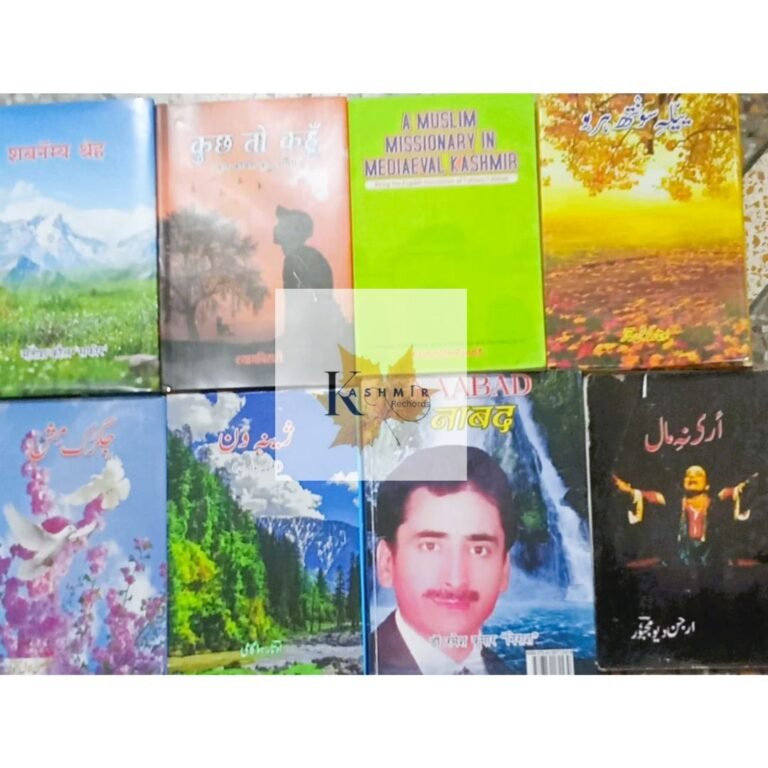
   Books written in Kashmiri by Arjan Dev Majboor, P N Shad, M L Kanwal,  Engineer Vinod Kumar and Brij Hali also hit the stands during 33 years of migration. Some of the books written by migrant Kashmiri writers could not find readers across the Jawahar Tunnel; the reason being that they were written only in the Devnagri script.,

I Was a Kashmiri Pandit— A Mukhbir!

(By: B. Revti)
Veer Munshi does not need any formal introduction. He is one such artist who is able to transform his experiences as an exiled refugee into the language of painting.
Munshi was born and brought up in the Kashmir, but like other  fellow community members was   forced to move out of Valley  in 1990 when it was no longer safe for him to stay there. This Kashmir-born renowned artist has addressed a range of subjects in his over three-decade-long career, but exile remains his most fundamental condition and preoccupation. He has used his art to reflect his anguish at the situation

I was Mukhbir—An Indian Agent!

   In one such oil painting, Munshi has depicted every Kashmiri Pandit a “Mukhbir’’…….An Indian Agent and hence faced death and destruction!
Kashmir Rechords (www.kashmir-rechords.com)  is sharing his pathos through this card, circulated by Panun Kashmir leader, Shailendra Aima two decades ago. The contents of the card in 10 lines are self-explanatory.
Pity thy all those who allowed this to happen to Kashmiri Pandits, now in 33rd  year of exile!

Kashmir, Gavaskar and Imran


By Dr. Rajesh Bhat
Legends like Sunil Gavaskar and Imran Khan are icons. It is entirely another matter while the former continues to hog limelight and is deftly active on the field in his new avatar as an internationally cherished cricket commentator, the latter for reasons best known to Pakistani Army has landed him in jail. Both have had a brilliant chemistry between them on and off the field. Even though both are heroes to the world of cricket, the fate has landed Imran Khan in dire straits despite his best intentions to take his country out of the mess it presently finds in, while Sunil Gavaskar is continuing to add value to his role as cricket legend. Both  are loved by people of Kashmir so much so in the controversy surrounding the first one day international cricket match between India and West Indies at Amar Singh Cricket Club Srinagar on 13th October, 1983, Gavaskar was deliberately shown the posters of Imran Khan!

The Day When Farooq Abdullah courted Controversy

The years 1982 and 1983 shall always be remembered in Kashmir’s  History for varied reasons! As Farooq Abdullah was just one year-old Chief Minister, his inability to assess the mood of Kashmiris (deliberately or otherwise) had landed him into a big controversy following the disruptions in the first  international cricket match Srinagar had ever hosted.  Indian Cricket Board, for the first time had allowed the international one day cricket match to be played between West Indies and India at Sheri-Kashmir International Cricket Stadium, Srinagar, Kashmir. Even though it was no stadium by any definition, but wooden planks were arranged to resemble the spectators’ stands. The outfield, though picturesque, was very short and the blizzard of sixes by West Indies batsmen up and above, beyond the road that made circumambulations around the Amar Singh Cricket ground proved it all.
Every Kashmiri loved Sunil Gavaskar and manic fans were vying to get a glimpse of their hero. The whole stadium cheered so much and welcomed him with such a frenzy the likes of which has not been witnessed since then. Nobody knows how the tide turned and booing by the crowd started. Suddenly a section of the crowd began to behave differently and the mood changed from vivacious to sullen. The pitch was allowed to be damaged and even the weather got the wind of the same and arranged dark clouds at short notice!
  Farooq Abdullah  as  Chief Minister was witness to everything that was taking place in Srinagar. In hindsight many are of the opinion that he should have done something, at least a leadership act that would not have prevented Kashmir from holding subsequent cricket contests. Alas! That was not to be. Prime Minister Indira Gandhi took this very seriously and it is here when she believed that something was not right in Kashmir and she got the impression that secessionist seeds were being sown. Known for not tolerating any nonsense, it was a matter of months before Farooq Abdullah government got the boot and was replaced by his brother- in- law Ghulam Mohammad Shah (Gull Shah).

Runs ’n Ruins

Kashmir did  host another ( the 2nd and last) One day Cricket match  on September 9, 1986 when India  played against  Australia at the same venue but that happened under President’s Rule and not under any political regime. Sunil Gavaskar  in 1984 wrote in his book  “Runs ’n Ruins’’ that “being hooted at after a defeat is understandable, but this was incredible. Moreover, there were many in the crowd shouting pro-Pakistan slogans which confounded us, because we were playing the West Indies and not Pakistan.  The team was stunned and could not understand the crowd’s reaction as India had come to the ground as the World Champions!”
The disturbances during 13th  October 1983 One Day Cricket Match played at Srinagar, had taken place soon after India had won the World-Cup played in England and Wales (June 25, 1993). Some secessionists back-home must have not digested that. That is why they tried to avenge the West Indian defeat at Lords by digging the pitch at Srinagar the same year on October 13!

Sunny Days are here again

Kashmir since then has turned an entirely new leaf and aspiring cricketers from both Jammu and Kashmir regions are making a name for themselves both in domestic as well as international cricket contests besides a visible presence in IPL and other matches. With more mature and highly educated  young people  of Jammu and Kashmir who know how to separate rice from chaff, sunny days are here again and at least Cricket Stadium at Jammu is eagerly awaiting a contest somewhere in near future. … Amen to that.
It is World-Cup time again!. Everyone in Kashmir awaits a brilliant performance from every Cricketer. But that  was not always the same!

Matric was Basic Qualification to fly with IAF

During the past over nine decades, the Indian Air Force has proved its mettle in terms of necessary skills and abilities. When IAF was officially established on October 8, 1932, it had just six Royal Air Force (RAF)-trained officers and 19 Havai Sepoys (air soldiers). It required both men and machinery, as the aircraft inventory consisted of just four Westland Wapiti IIA army co-operation biplanes. Presently, IAF is counted as the fourth largest air force in the world with so many aircraft, fighter squadrons and combat aircraft squadrons.

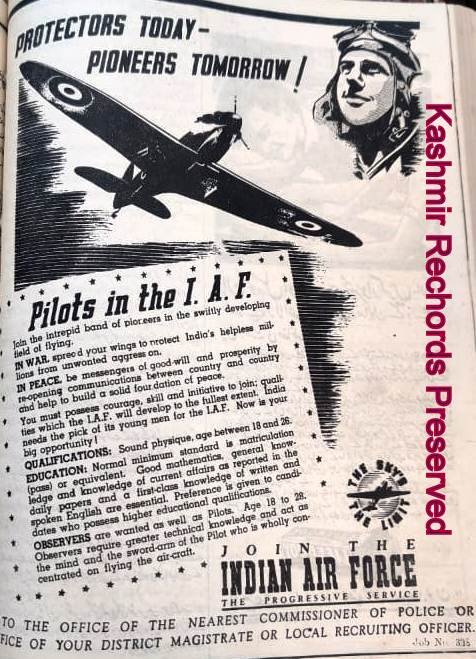
With such a meager force in the initial years, the problems concerning the defense of India were reassessed in 1939 by the Chatfield Committee. It coincided with the beginning of the World War–II during the same year. The Committee, besides other things, had proposed the induction of Pilots and Observers to strengthen the air force in India. It was during this period from 1940 to 1943 that newspapers and magazines used to carry a series of advertisements for the recruitment of Indians into IAF. Matriculation, with a sound physique, was the basic qualification to occupy the cockpit!

Kashmir Rechords is in possession of several advertisements having been printed/published in various newspapers and magazines of India between 1939 to 1943, imploring the youth to make IAF their career. Catchy and well-crated advertisements were there to catch the attention.

Fly with IAF

One such advertisement lured Indian youth aged between 18-28 to fly high up in the skies. The basic qualification for the same was a sound physique with Matriculation as the minimum qualification. Knowledge of written and spoken English was considered to be essential and candidates having higher qualifications were being given preference in the selection process.
Those who intended to join as Observers needed greater technical knowledge in order to act as “the mind and the sword-arm of the Pilot who is wholly concentrated on flying the aircraft’’.

Protectors Today—Pioneers Tomorrow

In another advertisement, those who wanted to join IAF  (The Progressive Service) as Pilots should have been good at Mathematics, General Knowledge and Current Affairs.

Candidates were required to visit the office of the nearest District Area Commander or the nearest Commissioner of Police or Technical Recruiting Officer to volunteer for flying duties. Those suited for the job of a Pilot or Observer were later required to undergo thorough training in order to fetch a Commissioned rank for themselves in IAF. The forms for joining IAF as Pilots were available from “ AG 2 (C), Recruiting Directorate, Adjutant-General’s Branch G.H.Q, New Delhi.

The Sky Is The Limit!

The recruitment of Pilots and Observers during this period must have come in handy at a time when India needed IAF soon after her  Independence in 1947. On  October 27, 1947,  (Soon after the signing of the Instrument of Accession), the No.12 Sqn was to initiate the remarkable feat of air-lifting the Ist Sikhs from Palam onto the rough and dusty Srinagar airstrip without planning or reconnaissance as the initial Indian response to the sizeable insurgent forces that were pouring across the border into Jammu and Kashmir. On October 30, 1947, the first Spitfires from the Advanced Flying School at Ambala reached Srinagar and were soon engaged in strafing the raiders beyond Pattan. The fighting continued for 15 months, with heavy IAF involvement throughout this period till the declaration of a Ceasefire in January 1949.

From Sky Is the Limit to “Touch the Sky with Glory”—- Indian Air Force has always shown its courage and resolve, both in times of Peace and War. 

Koshur—-Is it The End?

(Kashmir Rechords Exclusive)

In response to the blog dated September 21, 2023 that was carried in Kashmir Rechords regarding the need to preserve the Kashmiri language by Kashmiri Pandits who stand fragmented as part of international diasporas and who are facing the most acute, clear and present danger of their existence when they are allowing to skip conversation in the language of their forefathers to be replaced by a plethora of languages available to them in their new dwellings, we have received a quality write- up by one of the literary giants of Kashmiri language, Sh. Makhan Lal Pandita.

    This Kashmiri write-up was forwarded to www.kashmir-rechords.com in the purest Nastalique font and very urgent points have been raised therein which we believe are of immense value to the post nineties generation of Kashmiri Pandits if at all they care for the Kashmiri language.  At Kashmir Rechords, We have tried to be most authentic in translating the original manuscript forwarded to our platform and for our esteemed readers we are enclosing the same for fact checking also. Those who are acquainted with Nastaliq script can also read/download the original write-up it here:-

Here is the translated version of Shri Pandita’s Kashmiri write-up:-

“Every literate Kashmiri in daily conversations makes use of many an English word. There can be two reasons that explain the preference of incorporating English words in our daily conversations. Either one doesn’t seem to have complete mastery over the day to day Kashmiri or even if one may have the ability, one’s knowledge about the Kashmiri is shrinking due to the reduced word stock at one’s disposal on account of the same having got abandoned since the same is no longer being used any more. Whatever the situation, one’s psyche seems to have been dominated by the idea that it is fashionable to speak in English.

Enter nineties, everything changed, the ambience and the need for adjustment with the prevailing environment presented itself with the fact that something was out of tune. While in conversation many fumbles would occur. Women especially found it extremely arduous to converse in Hindi and Urdu. “Bijli Daalo” “Pani Pakdo” translation shortcuts for words like “switch on the lights please” and “Collect some water”. These words were coined as amalgams to the closest meanings of the situations as they arose.

 English and `Hindi-isation’ of Kashmiri

Vendors in order to lure the customers usually resort to the practice of giving extra green chilly as a top up to the basket of vegetables purchased by the customer. Should they forget to put these extra inducements, the ladies and the old guys alike would come up with an urgent demand “ Mujhe mirchein Daalo “ None the less a hilarious demand when translated even though the import of the demand was acquiring some extra green chilies.. A keen listener will surely come across many such words even today.

A teacher Ghulam Hassan Manto taught us English. After the customary morning prayers, his flawless lectures on diverse topics to us would be in English. We would crave for the attainment of the quality of his English and were eagerly awaiting the day when we would become proficient in English like him. The English language appeared to be full of vitality and energy and the same longing continues to this day. The village people even though they conversed in pure Kashmiri but words like ‘teacher’, ‘news’ etc. would inadvertently come up in their conversations. They also seemed to nurture the opinion that real education only meant to possess the ability to speak in English only. Even though our own generation was endowed with the natural ability and had the wherewithal to converse in native Kashmiri, we also would succumb to the habit of incorporating one or two English words compulsorily even though English had not dominated the discourse the way it has now. In the villages, whenever we tried this the listener would promptly interrupt and admonish us on the ground that while he was conversing in pure Kashmiri we were trying to act over smart by incorporating the unnecessary English words.

I had once proceeded to Delhi to buy certain items for marriage purpose. My cousin who was born and brought up at Delhi accompanied me to Chandi Chowk area to visit some shops who had acquired a certain reputation for selling quality products. Since the items had fixed prices listed on them she bade me not to open my mouth lest they will get the idea that we do not belong to this place. She told me that the shopkeepers would get the impression that we are Kashmiris and we are demanding unrealistic price cuts. The same situation persisted in Jammu. The result was that everyone including the children were forced to encounter the challenge of speaking an alien language and they fumbled a lot while conversing in Hindi. This resulted in putting in focus Hindi only. Inside their homes, these children are unable to cultivate the finenesses to speak in the native Kashmiri language and even if they try, the result is a battered conversation beyond redemption. If we force them to speak in Kashmiri, I think such an action will not yield anything. This is because they do not have the inclination and the prevailing environment is abhorrent to their longing for their native language and thus how are they supposed to converse in Kashmiri? It is believed that a child usually learns something on his own up to the age of five years. It remains embedded in his/her  consciousness and becomes his or her mother tongue. Undoubtedly, the mother tongue is the only thing that binds us to our culture. A mature analysis will reveal that those children who do not know and speak in Kashmiri are almost unaware about the Kashmiri culture also. They try to keep pace with the new environment resulting in their getting deviated from Kashmiri language and culture. Should such children somehow stand united or find the opportunity to appreciate the same, still they will never come out of their native field of language and culture.

Inability to converse in mother tongue

The inability on part of our children and others not being able to strike a conversation in the mother tongue is embedded in our consciousness and we do not want our children to face this. The children find the idea of taking up daily conversations in Kashmiri akin to the shrinking field that lacks the attraction to bind them to it. The likely reason being there is a deep connection with the culture of the place. The children including the parents want that their future should not force starvation on them and they should be successful in getting relocated to some other environment where the skills they get equipped with aid them in earning their livelihood. That’s the reason why they somehow want to get over the stage of passing (10+ 2) examination to pursue such technical courses which can provide them jobs and be able to make them earn their livelihood.

Meanwhile it so happened that these children were preferred in admissions to the technical colleges in Maharashtra and they succeeded in attaining some or the other kind of employment that would make them stand on their feet. Many among them made their way to foreign lands. Their elders were happy and in the heart of hearts were elated to explore the opportunity of visiting foreign lands themselves. This became the trend. The companies that employ these children lay emphasis on the need to cultivate a nice and smart personality coupled with excellent communication skills and it is here that the parents think that English language is the key to acquire the same in addition to the technical aptitude for the job. Such capabilities are not dependent on somebody’s goodwill. The field is wide open. The language of the new culture has incorporated Latin, Greek and French in its lingo. The third edition of Oxford Dictionary has incorporated 240 Hindi words (the figure may be more) in its repertoire. It is on account of this attribute it has become the global language. Thus, the parents invest whatever resource they have at their disposal to acquire this capability for their children. We have so far not given thought to the idea that priority should be accorded to cultivate the spirit of striking a conversation in Kashmiri because the same lies elsewhere viz, our children should not suffer hardships.

  The Global Challenge

I want to share the awkwardness I faced while speaking in the English during my visit to Canada. I was asked by my son to take my granddaughter from school. Upon reaching the school the Principal came up and very politely asked me what could she do for me? I appeared to strike a fluent conversation with the shopkeepers, milk and grocery men at malls but upon seeing her I got unnerved. Awkward words got sprouted out of my mouth,” My grandmother is a student of your school. She gave me a strangely awkward look. Pat came her reply,” What ?”. I repeated the mistake. She could not fathom anything. She called someone and asked to make out what was being said. I realized my folly. I laughed at myself. “My granddaughter is a student of your school. The world of internet has added its own technical lingo and new experimentations on social media galore. Elders like me are constantly seeking help from our young children. There has been manifold increase in world population which has brought out its own pressures. To be in constant motion to earn is the new mantra with the result that we have forgotten as to who we are. The job market is getting squeezed by the day. The limited jobs that emerge require one to be equipped with English knowing capabilities. These are some of the reasons that have been enumerated to throw light on the fact that why our children are not inclined to strike conversations in their mother tongue. I am sure it will be very hard to understand Parmanand ji or some other such Sufi poet in today’s milieu. They seem to have to do nothing with them.   

However, as one’s age advances existential questions come up. The need to go back to one’s roots overpowers the consciousness. The need to come to terms with oneself dominates every other thing. Alas! The mother tongue is not there to get one back to his or her roots. Thus, it is imperative that parents in spite of the challenges they are facing should continue to strike a rapport with their children and converse in Kashmiri. This is the only way to preserve our identity as Kashmiris.

About the Author:

Noted Kashmiri writer, Makhan Lal Pandita, also known in literary circles as `Kashmir’s Prem Chand’, has penned down several works in Kashmir language, besides has a collection of many short stories to his credit.  Some of them are Karna Phur (2000), Girdhab (2003), Rambe Ara Bathis Pyeth (2006), Poat Tshaay (2008), Barsali (2010) and Yeli Ba Canada Gowus (2011). J&K Academy of Art, Culture and Languages has awarded Sh Makhan Lal Pandita for his novel Saaz Bonen Hund. Sh Pandita has also written several  monologues and Research Papers.

Ramanujacharya’s   deep spiritual connect with Kashmir

(Kashmir Rechords Report)
Renowned 11th Century Hindu philosopher and  a social reformer from Tamil Nadu, Guru Ramanujacharya had a  deep spiritual connect with Kashmir. While composing `Sri Bhasya’, he had travelled to Kashmir to refer to Bodhayana Vritti Grantha on Brahma Sutras. When his most famous work was complete, he had again visited Kashmir to dedicate ‘Sri Bhasya’ to Maa Sharda, the goddess of Learning.
Jammu and Kashmir Lieutenant Governor Manoj Sinha  while inaugurating  a branch of the Sri Yadugiri Yathiraja Mutt in Srinagar on October 4, 2023, also talked about  Ramanujacharya’s Kashmir connection  while referring to  latters philosophy of ‘Vishishtadvaita’  which preached love, peace, compassion, universal brotherhood and social equality.

Kashmir pilgrimage for Brahma Sutras

In the 11th Century, Guru Ramanujacharya  is believed to have visited Kashmir to write “Sri Bhashya” based on Brahma Sutras which was available only in Kashmir.
 It is recoded in Tamil literature and religious texts that Guru Ramanujacharya   while once going up the Tirupati Hills to offer worship to Lord Srinivasa, remembered he had not fulfilled one of the promises he had made to his departed guru Yamuna, who had instructed him  to write a commentary on the Brahma Sutras.
For this work, Ramanujacharya  needed to consult the learned commentary on Brahma Sutras written by Bodhayana, the immediate disciple of Vedavyasa. But that great work was available only in Kashmir!
Ramanujacharya and his disciple Kooresha went on foot to Kashmir.  Upon receiving them ,the King of Kashmir and his court-scholars were astounded by Ramanuja’s profound knowledge but had expressed their reservations to even permit Ramanujacharya to make a copy of the text.
  It was after a long persuasion that Kashmir scholars, who possessed the only copy of this book in their library  had   allowed Ramanujacharya to merely thumb through the pages of the book.  Kooresha is believed to have read it aloud from cover to cover and Ramanujacharya listened in silence. Kooresha understood his master’s predicament. He had a prodigious memory as  he was able to make a copy of the whole book by a mere cursory glance at it. The happy guru and his disciple returned to Srirangam, Tamil Nadu.
   And then began the composition of Sri Bhashya, the commentary on Bramha Sutras. The guru dictated and the disciple wrote it down.  Ramanujacharya later came to be called ‘Sribhashyakara.’

Ramanujacharya’s   Second Kashmir visit

After the completion of the work, students of Ramanujacharya wanted to fulfill their teacher’s mission to visit pilgrim centers. They visited distant holy places like Dwaraka and Badari and even reached Kashmir, wherefrom he had got inspiration for the composition of Sri Bhashya.
 Here in Kashmir,  Mata Sharda– the Goddess of learning is believed to have blessed him by presenting an icon of Hayagreeva.  
 Hayagreeva is praised as the Lord of Wisdom and deep knowledge. He is believed to be the one who won ignorance and foolishness with his pure knowledge.

Revival of spiritual activities in Kashmir

The Union Territory of Jammu and Kashmir is witnessing a revival of its cultural identity and spiritual traditions which have always promoted the ideals of co-existence of almost all major religions, spiritual streams known to the humankind and gave the ideals of humanism, communal harmony and peace to the world.
The Governor also Inaugurated Jagadguru Sri Ramanujacharya Saraswathi Bhandaram Digital Library and Sri Yadugiri Yathiraja Mutt Branch, Kashmir. On the occasion, Sri Sri Yadugiri Yathiraja Narayana Ramanuja Jeeyar Swami of Sri Yadugiri Yathiraja Mutt said the establishment of the branch and library was an important milestone in Kashmir’s history.

Metric System in Jammu Kashmir: Miles to Go!

By B. Revti
There still seems to be such a consistent compulsion by the people of Jammu and Kashmir to take recourse to weighing and measuring standards of pre 1958 that it refuses to go away from the popular imagination. The terms used are Pau, Seer Mann, Chattang, Tola, Marla, Kanal  etc. This applies to increasing as well as decreasing scales also. The elders still use this in their daily business based conversations among themselves. These terms are so much ingrained in their subconscious that it refuses to go away to yield accommodation for new system of weighing and measurement introduced by Government of India way back  in  October, 1958.
  With very limited avenues for publicity of its policy and Programmes and announcements of any changes it intended to bring for information of public, the Government of India had to rely heavily on the national as well as vernacular press, besides publishing relevant and appropriate posters designed by artists.
 One such content and publicity material meant for Jammu and Kashmir and Urdu speaking areas found mention in an old document brought out by DAVP (exclusively preserved with www.Kashmir Rechords.com ) is displayed in the blog. Thus we see the recent history getting folded out in a very interesting way.
  The advantages of switching over to Metric system are also enumerated exhaustively in this poster material with tag lines like “ Switching to Metric System is Easy….”It will not only improve trading but National Integration also” etc. etc.
For the esteemed readers of our blog it may be mentioned that it became legally binding to implement Metric System in many industries and provinces of India with effect from 1958. However, the change would be admittedly gradual which explains why the old system has held many a men and women captive to this day.

History of Measurement

The history of measurement of weight implements employed in trade and business in India shows such a consistent regard for detail and observance of scrupulousness and creation of standards one cannot but stand in awe of their farsightedness and sense of quality control which they observed in day to day transactions.
With a thriving civilization that goes as far back as more than fifth millennium B.C, the standardization of weights and measures for commodity trade are said to have been decided by trade guilds, consumers and governments and all stakeholders in the most scientific manner. Mughals introduced their own changes of “Ghaz” and “Bhiga” which are still used…. So are `marla’  and `kanal’,  After that East India Company brought out the change to some degree till the adoption of Metric system of weights and measures by Government of India in December 1956 with the Standards of Weights and Measures Act which took effect on October 1, 1958.

Old Habits Die Hard

 Despite  adopting the Metric System of weights and measures, discarding Seer and Mann to measure mass, Gaz and Kos to measure distance; Anna or Chavani to count currency, some old habits die hard, as all these words have already become part of our lexicon.
While we have discarded feet for horizontal distances, restricting it to telling an individual’s physical height, when it comes to describing an area, square feet remains as popular as square meter .  We are more comfortable in purchasing a thing in an old system of `Pau’ rather than asking for the same in 250 grams. The thumb rule of addressing the weight of   gold or silver is still preferred `Tola’ over 10 grams, the fact that very few know that one Tola of gold is   approximately 11.7 grams!

Literature and Old Measurement System

Literature remains wedded to the past. “Miles to go before I sleep” will never be “kilometers to go before I sleep”. Pal Mein Tola, Pal Mein Masha or Na Nav Mann Tel Hoga  Na Radha Nache Gi are a few to  mention  here  about the usage of ancient weight measurement introduced in India and South Asia around 1833….. But we continue to use them, at least in our vocabulary and phraseology.
  Have we changed a `Rati Bhar’ all these years?

Kashmir teachers’ lonely battle since 1990!

By: Deepika Bhan
Five septuagenarian Kashmiri migrant teachers and their families have been silently and diligently fighting to get what they claim is their due — salary, gratuity and pension.
The elderly and retired teachers had almost given up on their demands, but the abrogation of Article 370 and the application of Central Laws in J&K gave them hope. The struggle, however, has not ceased, as they say the system is slow and apathetic.
With no support from any quarter, the retired teachers from a prominent public school, National High School, Karan Nagar, Srinagar, have been struggling to get their dues.
Fighting ill health, government apathy and with no civil society to take up their case, the elders have nevertheless not given up on hope. The only fear for them is not official indifference, but that their life is ticking away.

Life is ticking away

Two of their colleagues have passed away and the remaining three are now hoping that before it’s Sunset for them, justice comes their way.
Omkar Nath Ganjoo, 79, Shambu Nath Kachroo, 76 and Ashok Kumar Kaul, 69, are the three out of the five who first took up the fight. The other two included M.K. Dhar, Principal of the school when the forced exodus of Kashmiri Pandits took place, passed away in 2021 at 82; and Roshan Lal Bhat, who breathed his last in September at 74.
They were among those who were forced to flee Kashmir in 1990 when terrorism struck the valley. They were teachers at the National High School, Srinagar. All of them had put in a minimum of 25 years of service in the school and were very popular among the students. Dhar had received the J&K government’s Best Teachers Award in 1980.
As most of the teachers had received threats and were advised to leave by their good Muslim friends and neighbours, in the absence of security and administration, the Kashmiri Pandits had no option but to flee, leaving their job and property. Most of those who fled the valley were hopeful of returning soon, but the situation never improved, and days became years and then decades. The return never happened.
After the initial years of struggle for survival outside Kashmir, the teachers settled in places where their children took up jobs. In the mid-1990s as the situation improved in the valley, local students and teachers returned to National High School, but for these teachers it was never the same.
Having crossed the retirement age, the teachers started their fight for pension, which went on for some years, and finally the school management took a sympathetic view and allowed them a monthly pension out of their Provident Fund.
The amount varied from a mere Rs 700 to Rs 1,000 per month. But even this meagre amount provided the teachers a world of happiness.
It was not just money, but also an acknowledgement of their decades of hard work, which had made the National High School one of the most sought-after schools in Srinagar.
In 2018, the school was taken over by the J&K government and converted into a heritage institution owing to its nearly 100-year-old existence. The teachers had hoped that their dues would be taken care of. But nothing happened. The once-in-a-while payment of Rs 700-1000 also stopped. Letters and pleas fell on deaf ears. The administration was not listening and nobody cared.
Finally, Delhi High Court lawyer Ramesh Wangnoo took up their case and has been fighting ever since. He says, “I was so moved by their story that I decided to help them pro bono. Nobody was ready to even listen to them. I fought with the system and managed to get the administration to acknowledge the PF arrears till the time the school was taken over. They got those arrears last year. The sum was meagre, a few thousands for all of them. That’s it.
“Now I have been fighting for their salaries till superannuation and gratuity, besides a regular pension for them
“Two out of these five have passed away waiting for justice to be done. The other three are also very senior and at the sunset of their lives. I will fight as much as I can. The wives of the other two deserve family pension.”
Wangnoo emphasises that after the abrogation of Article 370, all Central laws are applicable in J&K. “How can the dues, even gratuity, be denied to them?” he asks. “The government owes them. The teachers are not demanding any favours. These are their legal and rightful dues.”
Two of the five teachers already have passed away; for the remaining three, it is a race against time.

(Courtesy:  IANS Live)

 The Indomitable Lal Bahadur Shastri


(Kashmir Rechords Exclusive)
While the Indian Nation and international peace loving organisations will be celebrating Mahatma Gandhi’s birthday on October 2 to once again rekindle hope of peace and semblance of human values in an utterly chaotic world beset with conventional and nuclear wars, terrorism, climate change challenges and general sense of despondency for the human race, the day will also be celebrated for another of India’s great son, Lal Bahadur Shastri’s birthday.
Even though the latter’s birthday gets always overshadowed by  that of the Father of the Nation, his role  as a freedom fighter and a Prime Minister  with the cleanest image  and the one who rose to the challenges of the times in an era when India’s position in terms of security related environment was precarious,  cannot be undermined.

Diminutive size, Tallest Deeds

This diminutive looking leader of the Nation may have been underestimated by the powers that be, but his focus and practical wisdom defied the perceived deficiencies by the   enemies of the Nation and won the day for him. Not only did he teach a lesson to a very well equipped enemy that launched aggression on the Nation of India but also those supporting the aggressor.
Thoroughly bred in Gandhian values, Shastri Ji carried himself with the dignity of a man filled with the need for peace and was a living example of Gandhi Ji’s teaching. His strong will was beyond the comprehension of the contemporary world leaders. He was strict as far as honesty and probity in public life was concerned. Neither did he amass wealth, nor did he extend favours to members of his immediate family or relatives. His sense of meeting the formidable challenges head on was legendary.

  Rare Photographs

Kashmir Rechords through some of its rare collection of photographs of Lal Bahadur Shastri, the times and the situations he found himself in, pays tributes to this legendary leader.
  Through these rare photographs, Kashmir Rechords presents a unique side of personality of the  former Prime Minister of India, affectionately called as “ Bharat Ke Lal’’, These photos reveal him as a family man,  at times  addressing troops, holding meetings and his last journey.

Maa Kali’s Abode at Srinagar Kashmir

( Kashmir Rechords Exclusive)
The Khankah-e-Moula mosque currently standing on the banks of river Jhelum in Srinagar Kashmir is said to have been built upon the ruins of a Hindu temple dedicated to the Mother Kali. This is not entirely without basis as relevant records and documents confirm the veracity of the same. The grand mosque which obscures any remaining remnants of the temple is believed to have been constructed above the walls of an ancient temple dedicated to goddess Kali sacred to Hindus.
Hindus, especially Kashmiri Pandits continued to perform puja at a spot well below the mosque after the desecration of what used to be a grand and magnificent Kali temple. 
There is strong documentary evidence to back this claim and even though many have taken advantage of speculative assumptions to advance their own particular narratives about the existence or non-existence of a Hindu religious site. Unfortunately, that has further complicated the issue.

 Longing of the devotees

But the fact remains that Pujas by Kashmiri Pandits continued to have been performed at this place  cannot be refuted since contemporary accounts by those who compiled their travelogues in Kashmir have documented the fact that Puja did take place and there used to be a small semblance of a temple, at least some walls draped in Sindoor existed and a token or major Pujas are reported to have been taking place even up to 1990.
  Pearce Gervis, author of “ This is Kashmir’’ ( 1954) , published by Cassell and Company Limited London, (on page 20)  mentions that  within the mosque  there is a spring which is sacred to Hindus. Beneath the mosque and right on the water-front, is a Hindu temple, which is much used. It appears to be nothing more than a splash of orange paint upon the stone wall under the water front pathway to the mosque’’.  Pearce Gervis has also published a photograph of the same site in the said book, which was clicked in the decade beginning from 1950.
 Similarly, in a painting pertaining to the year 1906 by an unknown artist, a proper functional temple is also seen existing on the side of the mosque.
Rai Mridu in her book “Hindu Rulers, Muslim Subjects: Islam, Rights, and the History of Kashmir” (2004) states that local Hindus were involved in various communal disputes and repeated altercations by 1942, agitating for the right to build a temple and lay claim to their ancient shrine at this site which was, however, not acceptable to the majority community of Kashmir.
  The Rising Kashmir in its write-up on the same subject titled ”Maha Kali temple co-exists with Khankah’’  (November 19, 2017)  also mentions about the practice of  Puja taking place  at the mosque site where a  wall marked with Sindoor  existed there.
Noted Kashmiri writer and poet, Zareef Ahmad Zareef quoting  Hasan Shah in ‘Encyclopedia of Kashmir’ says that the Brahmins who did not accept Islam were given this place to pray to their goddess Kali. Zareef  further mentions that  a  religious structure continued to exist till 1990 where   Kashmiri Pandits would  pray and mark their foreheads with Sindoor.
Similarly, Shiri Ram Bakshi, a great scholar of Indian history in one of his famous books, ‘Kashmir Valley and its Culture’ (1997) writes that the shrine of Kali had been converted into Khankah of Mir Syed Ali Hamadani or the Shah-e-Hamadan Masjid.  He writes that to this day, its custodians are exceptionally punctilious in cleaning and sweeping the floors of the spring situated within the Khankah. The Pandits, who were allotted a place outside the Khankah premises, continue to offer their worship to the goddess Kali to whom the spring was originally dedicated.

    Mother  Kali at Sopore Kashmir

While Kali Temple at Srinagar has been in focus on account of its being in the capital city, there are scores of such shrines in Kashmir where Kashmiri Pandits offered Puja on the earmarked portions of the walls of temples converted into mosques.  Similarly, a space of the size of a window existed at Shah-e-Hamdan mosque at Khankah Mohalla Sopore Kashmir on the banks of river Jhelum before the present massive structure of the mosque came up after 1990 and since no Kashmiri Pandit resides at Sopore at present, the whereabouts of the Hindu shrine of Kali Temple are not known.

The exquisite Farooq  Nazki

Kashmir Rechords Exclusive

Are laureates cultivated or do they appear on their own? Both statements can be true or false at the same time. But there appears to be a strong relationship between the environment and a tradition in the family that cultivates quality literature. One’s inclination and the output combined with prevailing creative atmosphere in the family or otherwise can many a time produce great literary figures. This appears to be true in respect of Farooq Nazki, a multi-dimensional personality who has been a witness and an active participant in the vicissitudes that have dotted his colourful life.

  His journey, we are told, has started as a cub reporter and his instincts would naturally align with what was then a pre-dominantly reconstructive socio-political movement and not less than   a silent revolution  of sorts of questioning beliefs, situations and had a streak of rebellism against obscurantism, inequalities, exploitation and corruption. Interestingly, this seemed to be a world phenomenon and was predominantly visible in societies which had just freed themselves from the clutches of imperialism. This movement dubbed as the ‘Progressive Movement’, is in fact only evolving and is said to be metamorphosing into other forms.

 Farooq Nazki associated himself with the movers and shakers of this movement and it set the direction for his future literary endeavors. His father, Ghulam Rasool Nazki may have initiated him into the world of literature but his journey was purely carried by him on his shoulders like the lone pilgrim. This pilgrim tasted the waters of all streams and imbibed the light of all thoughts (Agnostic as well as Gnostic.)

   The Blossoming

 It has been a relentless journey .The passion that essentially arises out of suffering blossoms into flowers and is the engine that drives creativity. Farooq Nazki is a poet, broadcaster,  a playwright and a noted literary figure of repute in both Urdu and Kashmiri besides proving his mettle as an administrative and political functionary also. He has donned many a hat and carried them deftly.

While much has already been written and said about Farooq Nazki, his family and his works, the trail he has left goes on projecting aspects of his colourful personality unknown to the world.

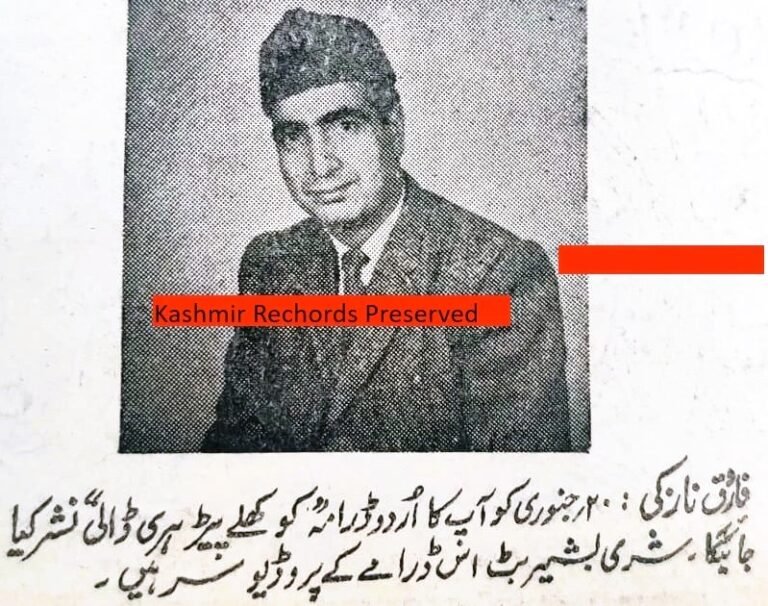
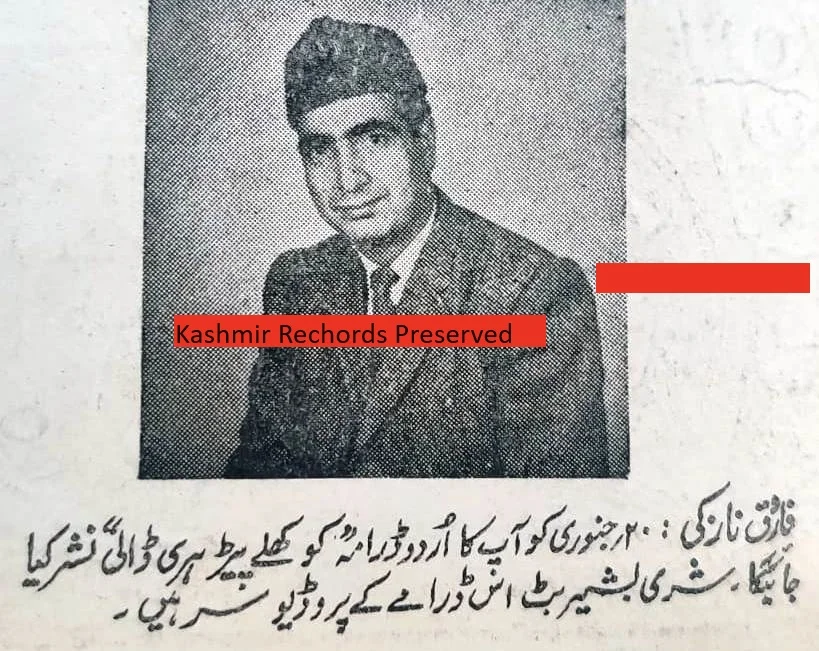
 Kashmir Rechords is in possession of very candid moments of this multi-dimensional personality’s periods of struggle, the aspects which are mainly hidden from the world. The black and white photographs of his younger life when he was growing in the shadows of his illustrious father Mir Ghulam Rasool Nazki speak for themselves about the vicissitudes, associations, agonies and the ecstasies combined with highs and lows of his life. 

Through these rare photographs, Kashmir Rechords pays a tribute to this living legend.

Kashmir’s town of Astrology

By B. Revti
The origin of Kashmiri Panchang, variously called as “ Jantari’’ or “Neshpatra’’ dates back to antiquity.   Not only was Kashmir an important centre of spiritual learning but related schools of thought also found a fertile ground to grow. 
One such related school of thought that took birth in Kashmir delivered its world class tradition of astrology. 
Though Indians have had no love for historiography, the Bhrigu Samhita, the ultimate reference book of the discipline is the testimony to the tradition of predictive astrology being followed in India and incidentally Kashmir, which produced its first historian Kalhana, also makes mentions of   a brilliant tradition of astrology prevalent in Kashmir.

 Al-Biruni’s  Accounts

Even as there are other very important historical documents which testify to the continuity of this important tradition in Kashmir, the most important historic account by a foreigner Al-Biruni in his  book “Kitab-ul-Hind” raises this to  such an exalted level pertaining to Kashmir  that we cannot remain without mentioning some of the observations made  by this great historian:-
  “ I studied the Jantari of Shaka-la (modern Sialkot) pertaining to the year 951 AD. It has come from Kashmir. This Jantari says that Sapt Rishis are staying since many years in Anirudha Moon House which exists in three and one- third degree in the constellation and extends up to 16 and two- third degrees. Saptrishis are still one full `burj’ and 20 degrees forward……. This creates a sense of wonder and no doubt anybody who does not live among Hindus of Kashmir, cannot fathom the concepts and everything they have churned out.’’
  This statement of Al- Biruni testifies   to the fact that how much learned he himself was about the intricacies of astrology—a school of thought which reached its zenith in Kashmir where Jantris were compiled, formulated and despatched across lands. Kashmiri Panchangs were considered to be the most trustworthy astrological treatises.

Kashmir Panchang’s Gandhaar Connection

Noted Kashmiri scholar and historian, Moti Lal Saqi in his famous book “Aager Neb’’ mentions that `Jantari’’ as a unique product came out of Kashmir only and it is very difficult to accord a date to its origin. Saqi further while referring to Rajtarangni, mentions that it was King Meghwahana who brought and settled Brahmins from Gandhaar and elsewhere  in Kashmir’s Bijbehara town around 5th Century AD. It is possible that many astrologers accompanied these Brahmins where they institutionalized this important feature of Kashmir and thus Kashmiri Jantari continues to be named as “Vijeshwar Panchang’’ linked to Bijbehara town. Other notable names in this regard are of Swami Aftab Kak and Shri Kanth Jyotshi, besides others.
Kashmir’s Bijbehara continues to lay its claim on the World famous Panchangs—the Kashmiri Jantaris— although they are presently published from Jammu and elsewhere.  Pt Prem Nath Shastri, the great learned Pandit and social reformer did a yeoman’s service to make it available to all and sundry when he pioneered to get it printed for distribution on a large scale some decades back.
Non-Hindus of Kashmir as well as India and the World, also make a bee line for obtaining a copy of this almanac of dates and occasions, both auspicious and otherwise, for round the clock consultations. Sh Omkar Nath Shastri, who is  presently the publisher of Vijeshwar Panchang is on record to convey that the year 2024-25 will be 341st issue of the famed Panchang in continuity .