
By: Dr Rajesh Bhat
History often survives not only in official proclamations, political speeches and government files, but also in invoices, private letters and everyday commercial transactions. Occasionally, such documents illuminate a lesser-known dimension of well-known personalities and reveal connections that conventional political narratives rarely mention.
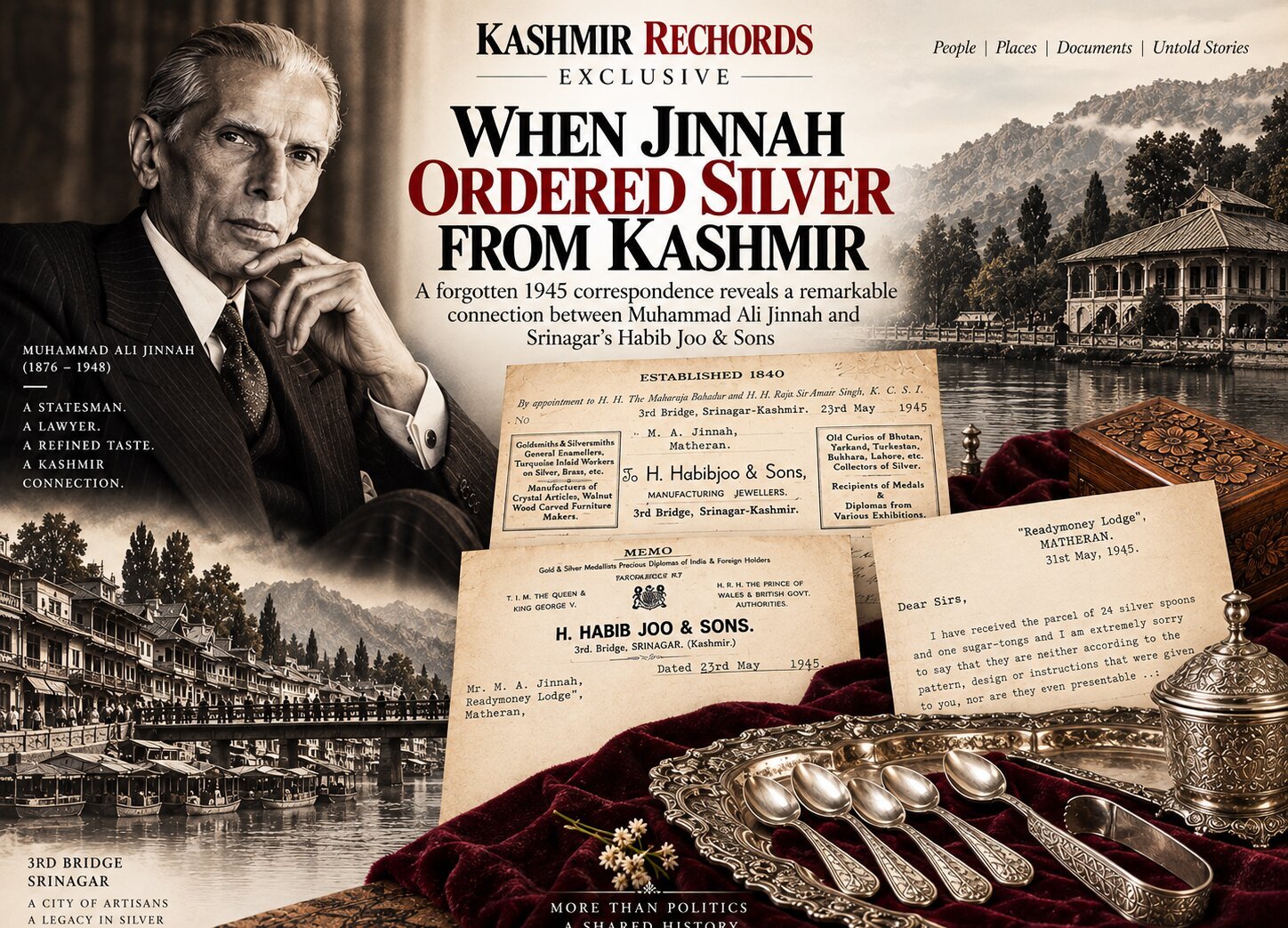
A set of archival documents from 1945, (facsimile copies of which are available with Kashmir Rechords), brings to light one such episode involving Muhammad Ali Jinnah and H. Habib Joo & Sons, a renowned manufacturing jeweller and craft establishment of Kashmir.
The correspondence concerns silver trays, coffee spoons and sugar tongs—but behind these apparently ordinary objects lies a fascinating glimpse into Kashmir’s pre-Partition commercial world, its sophisticated artisanal traditions and Jinnah’s personal dealings with a Srinagar-based firm.
Habib Joo & Sons: Srinagar’s established craft house
The letterhead of H. Habib Joo & Sons proudly records that the firm was “Established 1840.” It describes the establishment as “Manufacturing Jewellers” and notes that it functioned by appointment to His Highness the Maharaja Bahadur and His Highness Raja Sir Amar Singh, K.C.S.I., of Jammu and Kashmir State.
Its address was given as 3rd Bridge, Srinagar-Kashmir—an area associated with the commercial and artisanal life of the city.
The firm’s advertised activities extended well beyond conventional jewellery. It dealt in goldsmiths’ and silversmiths’ work, enamelling, turquoise-inlaid articles, silver and brass objects, crystal articles, carved walnut-wood furniture and old curios. It also described itself as a collector of silver, medals and diplomas.
The letterhead reflects the range and sophistication of Kashmir’s craft economy before Independence. Such establishments catered not only to local royalty and affluent residents but also to visitors, collectors and customers from different parts of British India.
Among those customers, according to the documents, was Muhammad Ali Jinnah.
The Silver Trays: A Bill from March 1945
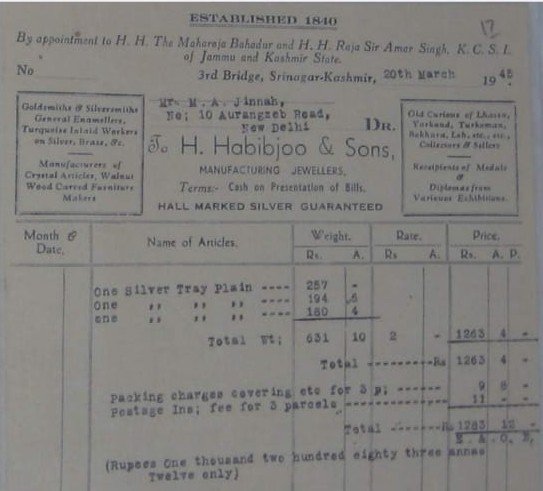
On March 20, 1945, H. Habib Joo & Sons issued a bill addressed to:
Mr M. A. Jinnah 10, Aurangzeb Road New Delhi
The bill listed three plain silver trays. The document records the weight of the articles and places the silverwork at approximately Rs. 1,263 and annas four, with additional charges for packing, postage and insurance.
The total amount came to approximately:Rs. 1,283 and annas twelve
Source: `Facsimile on Commercial and Personal Correspondence of M A Jinnah from Jinnah Archives’
The firm also included a guarantee stating that the silver was 96 per cent pure, with the remaining four per cent constituting alloy. It assured the purchaser that if the silver failed to meet the stated standard, the amount would be refunded.
Coffee Spoons, Sugar Tongs for Jinnah
The correspondence continued in May 1945.
In a memo dated May 23, 1945, Habib Joo & Sons informed Jinnah that the firm had despatched a set of ordered silver articles by Indian parcel post. These consisted of:
- Twenty-four silver coffee spoons
- One pair of sugar tongs
The memo referred to the earlier bill and placed the combined amount at approximately:Rs. 1,391 and annas twelve
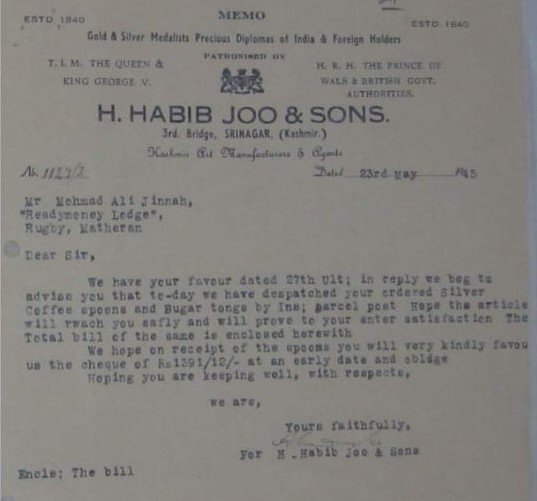
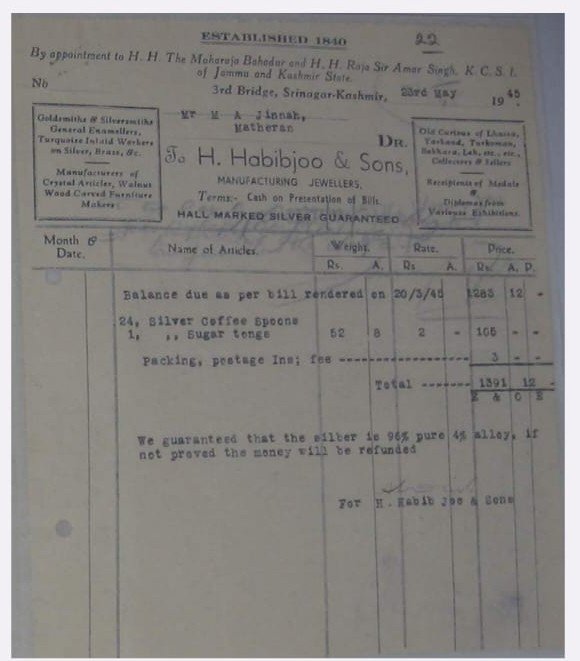
The firm requested payment by cheque.
At this stage, the transaction appeared to be a routine exchange between a customer and a specialist craft establishment. However, Jinnah’s response, dated May 31, 1945, transformed the correspondence into a revealing record of customer expectations, craftsmanship and commercial disagreement.
Jinnah’s Sharp Criticism
Writing from Readymoney Lodge, Matheran, Jinnah acknowledged receipt of the parcel containing the silver spoons and sugar tongs.
His reaction was unequivocal.
He informed the firm that the articles were not according to the pattern, design or instructions he had provided. In his view, they were not presentable. He criticised the workmanship as: “Thoroughly rough and bad.”
Jinnah stated that the articles lacked proper finish and that he was returning the spoons and sugar tongs by a separate parcel.
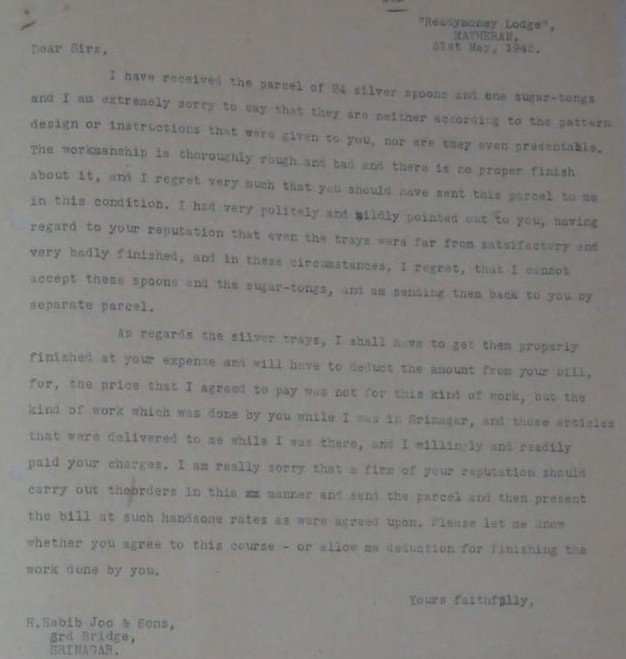
His criticism was not limited to the smaller articles. He also referred to the three silver trays supplied earlier.
Rather than returning the trays, Jinnah proposed having them properly finished at his own expense. He made it clear, however, that he intended to deduct the refinishing charges from the bill, arguing that the agreed price had not been for articles delivered in their existing condition.
The letter is noteworthy for its directness. It records Jinnah not as a political leader addressing a public issue, but as a private customer insisting upon design specifications, quality and workmanship.
It also offers a rare glimpse into the standards expected from a prominent client purchasing specialised Kashmiri craftsmanship.
Srinagar-based firm’s reply
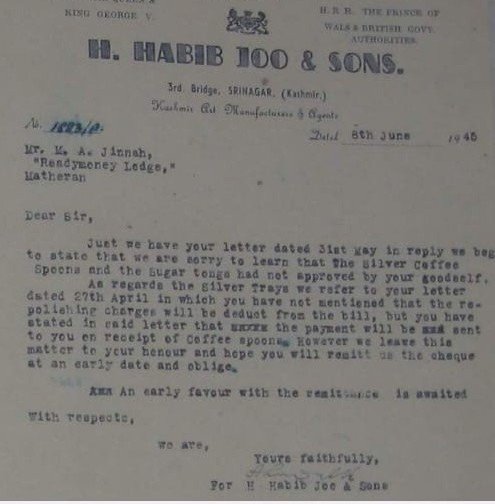
H. Habib Joo & Sons responded on June 8, 1945.
The firm expressed regret that the spoons and sugar tongs had not met Jinnah’s approval. Regarding the trays, however, it referred to an earlier letter dated April, 27, 1945 observing that Jinnah had not indicated at that time that the cost of repolishing would be deducted from the payment.
The firm further pointed out that Jinnah had stated he would send a cheque upon receipt of the coffee spoons.
The letter ended with a polite but unmistakable request for payment:
“An early favour with the remittance is awaited.”
Source: `Facsimile on Commercial and Personal Correspondence of M A Jinnah from Jinnah Archives’
The exchange remained formal and restrained. There was no public confrontation, only a disagreement over quality, finishing costs and the terms of settlement.
Yet, precisely because it was private and practical, the correspondence becomes historically valuable.
A concerned letter from Srinagar
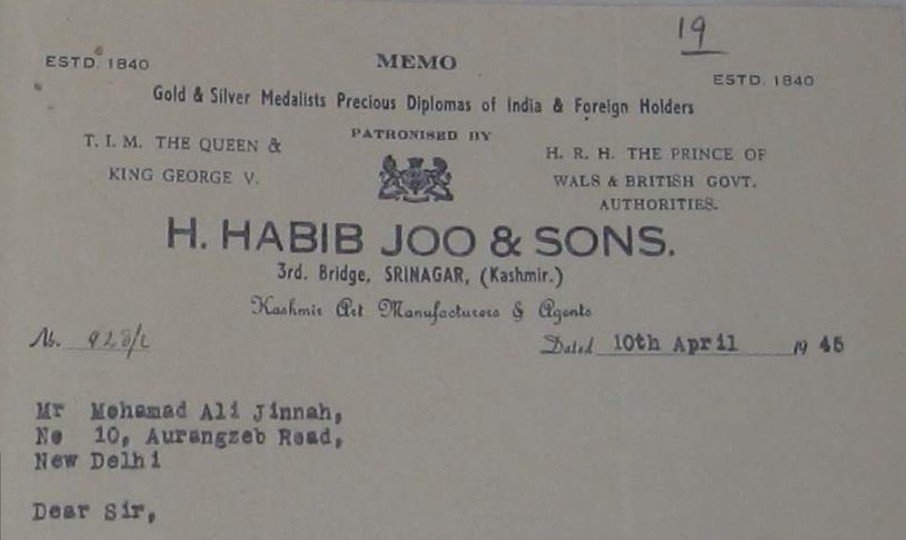
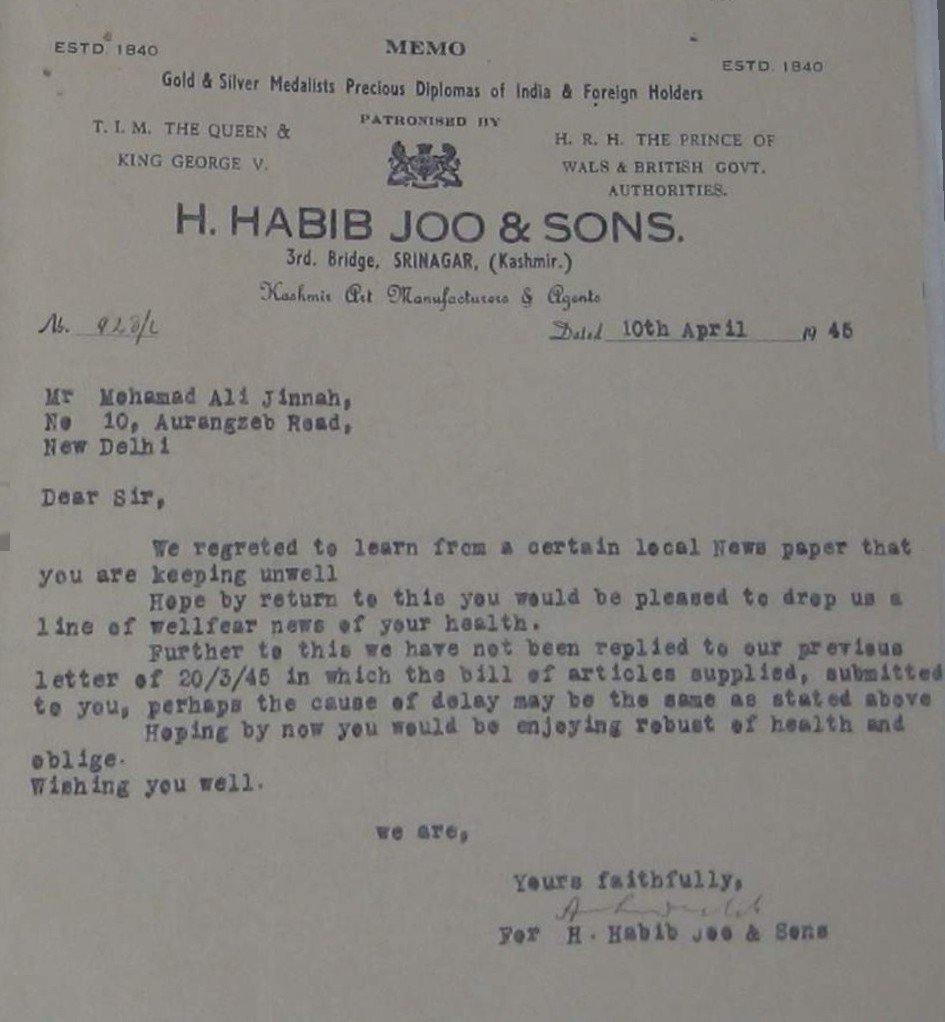
Another letter, dated April 10, 1945, reveals a more personal tone.
Addressed to Jinnah at his New Delhi residence, the firm stated that it had learned through a local newspaper that he had been unwell. It expressed concern about his health and asked about his welfare.
The letter also referred to the firm’s earlier communication of March 20, 1945, enclosing the bill and articles. It suggested that the delay in receiving a response might have been due to Jinnah’s illness.
This brief communication shows that the relationship was not confined to invoices and despatch notes. The firm was attentive to the health of its prominent customer and maintained the courteous style typical of established commercial houses of the period.
Source: `Facsimile on Commercial and Personal Correspondence of M A Jinnah from Jinnah Archives’
The historical setting
The correspondence unfolded during a decisive phase in the history of the subcontinent.
In 1945, the political future of British India was becoming increasingly uncertain. The Second World War had ended; constitutional negotiations were intensifying and political differences between the Indian National Congress and the Muslim League were deepening.
Jinnah’s political engagement with the future of India was central to these developments. Kashmir, meanwhile, was moving towards its own period of political turbulence. The Quit Kashmir movement of 1946, the end of British rule in 1947, Partition and the subsequent conflict over Jammu and Kashmir would dramatically alter the political and social landscape.
But these documents belong to an earlier moment—when Srinagar’s commercial establishments continued to serve customers across British India, when goods travelled by parcel post between Kashmir and the plains, and when personal and commercial relationships crossed the political boundaries that would soon become far more consequential.
The letters, therefore, preserve a small but significant fragment of a disappearing world.
What Happened to the Silver Articles?
The surviving correspondence establishes that:
- Three silver trays were supplied to Jinnah.
- Twenty-four silver coffee spoons and sugar tongs were dispatched later.
- Jinnah returned the spoons and sugar tongs because he considered their design and workmanship unsatisfactory.
- He proposed refinishing the trays and deducting the cost from the bill.
- Habib Joo & Sons disputed the proposed deduction and requested payment.
What remains unclear is the final outcome.
Did the firm and Jinnah eventually settle the account? Were the trays refinished? Was the payment made in full, or was a deduction accepted? What became of the silver articles after Jinnah’s death in 1948?
The documents presently available do not provide definitive answers.
Such gaps are not unusual in private commercial archives. Bills, letters and receipts are often dispersed among family collections, institutional repositories, auction records and private papers. The disappearance of a business establishment—or the disruption caused by political upheaval—can make the reconstruction of seemingly minor transactions extremely difficult.
An Archival Window into a Vanished Kashmir
The 1945 correspondence between Muhammad Ali Jinnah and H. Habib Joo & Sons does not alter the major political narrative of the subcontinent. Its value lies elsewhere.
It provides an intimate archival window into the commercial and cultural world of Kashmir before Partition—a world in which a Srinagar craft house could receive orders from a major political personality, produce silver articles according to specified designs, despatch them by parcel post and engage in a detailed discussion over finishing and payment.
The silver trays, spoons and sugar tongs may have been modest objects in the larger sweep of history. But the letters surrounding them preserve something far more valuable: evidence of personal interaction, commercial sophistication and Kashmir’s place within the interconnected life of pre-1947 India.
Archival Note
This article is based on surviving bills, memos and correspondence relating to H. Habib Joo & Sons of Srinagar and Muhammad Ali Jinnah. The final settlement of the account and the subsequent fate of the silver articles have not been established from the documents presently examined and available with a free access public library.
Dr Rajesh Bhat is a senior journalist, archivist and dedicated chronicler of Jammu & Kashmir’s history, culture and socio-cultural heritage. His work seeks to bring forgotten documents, untold stories and neglected historical narratives into public discourse through authentic archival sources and documentary evidence.
KASHMIR RECHORDS : Rare Archives,Unheard Stories.