
(By: Dr Rajesh Bhat*)
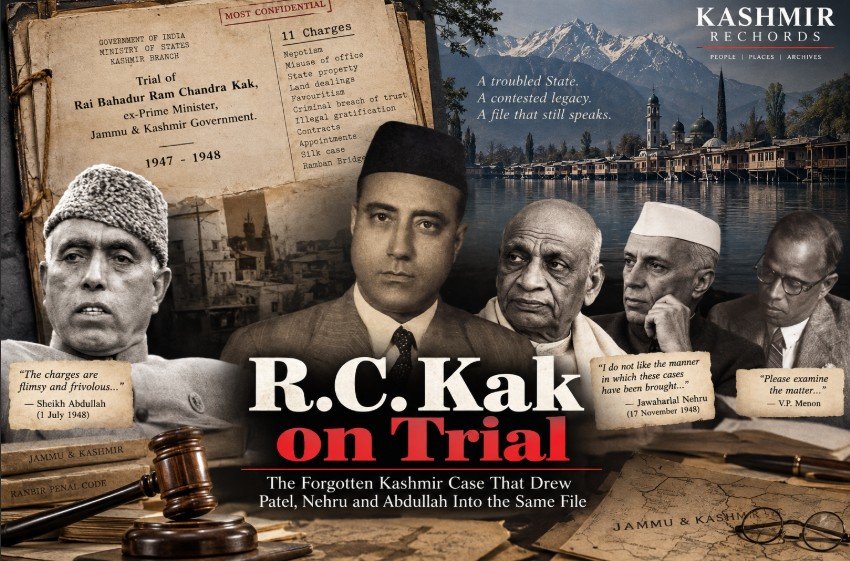
In the turbulent months after Independence, while Jammu & Kashmir was being transformed by war, accession and political upheaval, another drama was unfolding in Srinagar: the prosecution of Rai Bahadur Pandit Ram Chandra Kak, who had served as Prime Minister of Jammu & Kashmir from June 1945 until August 1947.
A 160-page file of the Ministry of States, Kashmir Branch, preserved in the National Archives of India brings together the complaints, inquiry proceedings, court arguments and correspondence that followed. It is a remarkable record of a former Prime Minister becoming the subject of a criminal prosecution at precisely the moment Kashmir was entering a new political era.
What makes the file particularly important is not merely the charges against R C Kak. It is the extraordinary correspondence surrounding the case—from Sheikh Mohammad Abdullah, Sardar Vallabhbhai Patel, Jawaharlal Nehru and V.P. Menon—and the fact that the same record preserves sharply different interpretations of what the prosecution represented.
Eleven charges after Kak left office
On August 30, 1947, the Maharaja constituted a Special Tribunal after receiving complaints against R C Kak supported by affidavits. The inquiry began soon afterwards. Kak was served notice and eventually appeared through counsel, but his written response described the charges as “baseless and frivolous” and stated that he would not participate in the proceedings.
The Tribunal framed 11 charges, divided into three broad categories.
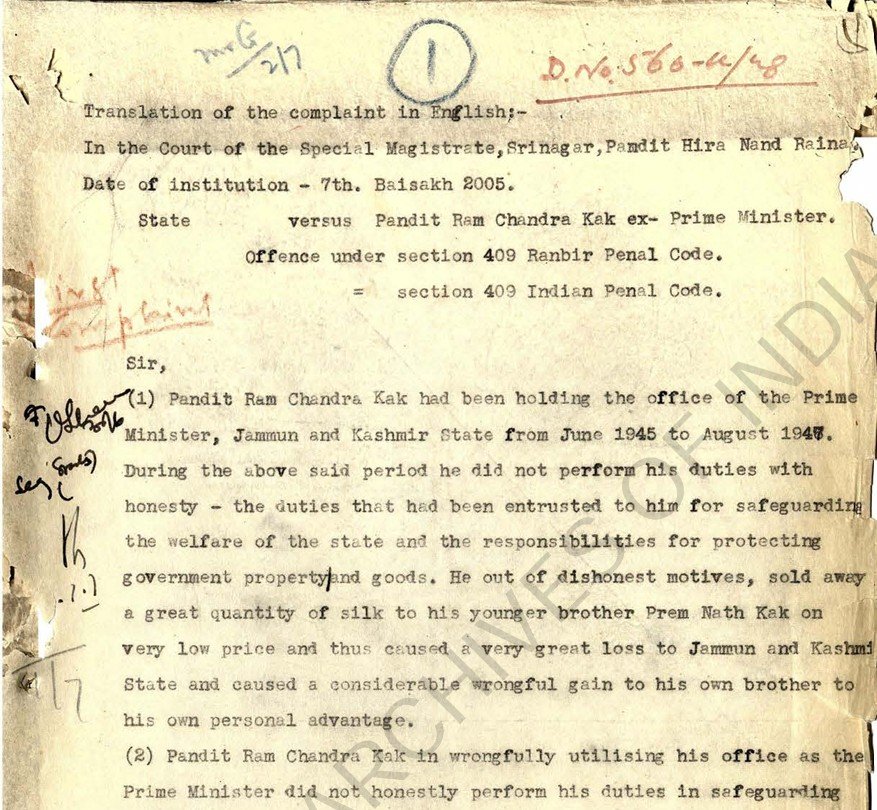
Six came under what the report termed “nepotism”, including the silk case, customs and sugar-quota matters, an appeal involving Prem Nath Kak, appointments, insurance of State buildings and an air-service contract.
Two concerned land and alleged illegal or dishonest acquisition of property, including land at Dara.
Three were classified as “favouritism”, involving controlled commodities, an appointment and reconstruction of the Ramban Bridge.
The inquiry was not a small administrative exercise. Fifty-one witnesses were examined and 130 documents were marked as exhibits, according to the Tribunal’s report.
The silk case: allegation, counter-evidence
The silk case became one of the central allegations.
The inquiry alleged that R C Kak had interfered with the disposal of government silk in order to benefit his younger brother, Prem Nath Kak, causing a substantial loss to the State. The Tribunal’s report went so far as to say that the matter appeared to go beyond ordinary nepotism.
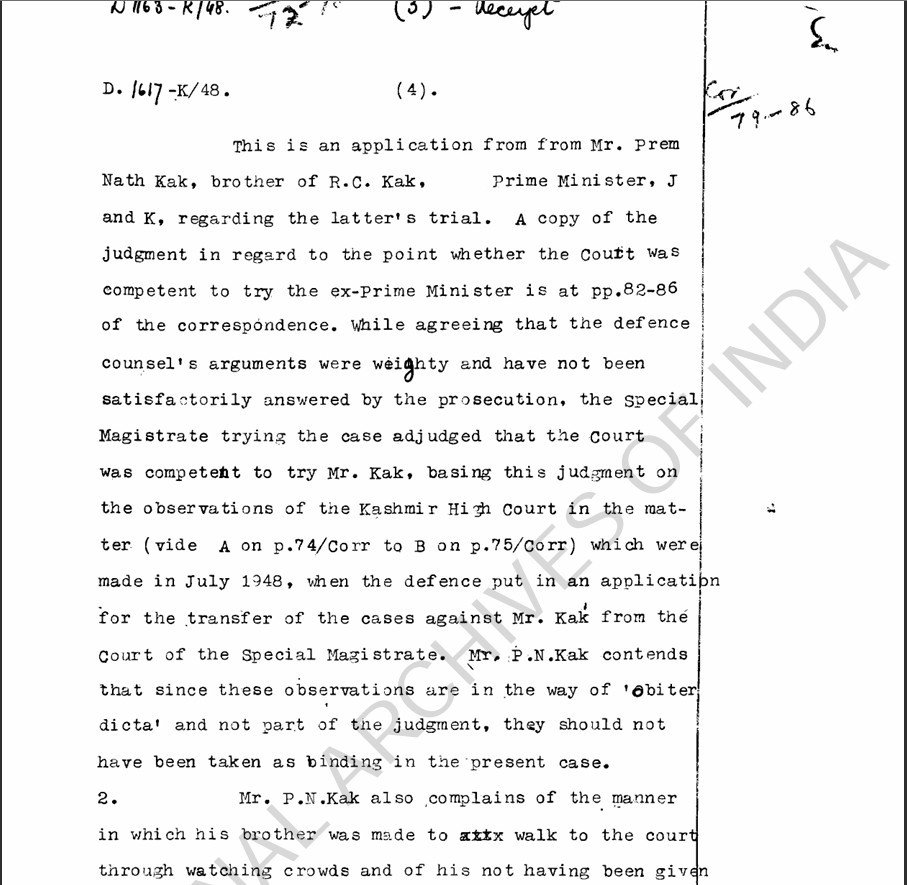
But the evidence recorded during the subsequent trial presents a more complicated picture.
The Development Minister, Mr Siddiqi, testified that tenders had been invited for surplus silk. Prem Nath Kak had been the only bidder for a particular denier. The minister said Kak had advised that, since tenders had been called, the highest tender for each denier should be accepted. Ultimately, Prem Nath Kak was allotted 2,074 pounds of that particular denier. The witness maintained that the decision had been his and that he had not been improperly influenced by Kak.
The defence went further, arguing that under the State’s constitutional arrangement the silk was under the authority of the Development Minister, not the Prime Minister. Therefore, it contended, the necessary legal element of entrustment for a criminal-breach-of-trust charge was absent.
The archival file thus preserves not one story about the silk transaction, but the allegation, the testimony and the legal argument over what the evidence actually established.
Insurance, land and problem of evidence
A second major allegation concerned the insurance of State property with the New India Assurance Company.
The prosecution alleged that the seven-year contract had been granted without tenders and that Kak’s son, who was employed by the company, benefited.
Yet testimony recorded in the trial stated that the proposal had been discussed by the Council of Ministers, with the Financial Adviser present. The company had offered to formulate a life-insurance scheme for State employees at its own expense if it obtained the State-property insurance business. One witness considered the arrangement beneficial to the State. Another testified that insurance rates for fire and related risks were centrally controlled. The trial record also notes that the prosecution did not establish that Kak’s son received an undue promotion because of the contract.
The Dara land allegation similarly encountered complications in the evidence. The prosecution alleged that Kak obtained land cheaply after promising government jobs to the seller’s sons. But the vendor testified that he had never met Kak, that negotiations had been conducted by Kak’s agent, that the land was inferior and unproductive, and that he regarded the price received as favourable.
Could Prime Minister be tried by Magistrate?
The case soon acquired another dimension: jurisdiction.
Kak’s defence argued that the Special Magistrate had no authority to try a former Prime Minister under the constitutional structure of Jammu & Kashmir. The argument was described as important because the precedent, if accepted, could affect ministers and cabinets beyond Kak’s particular case.
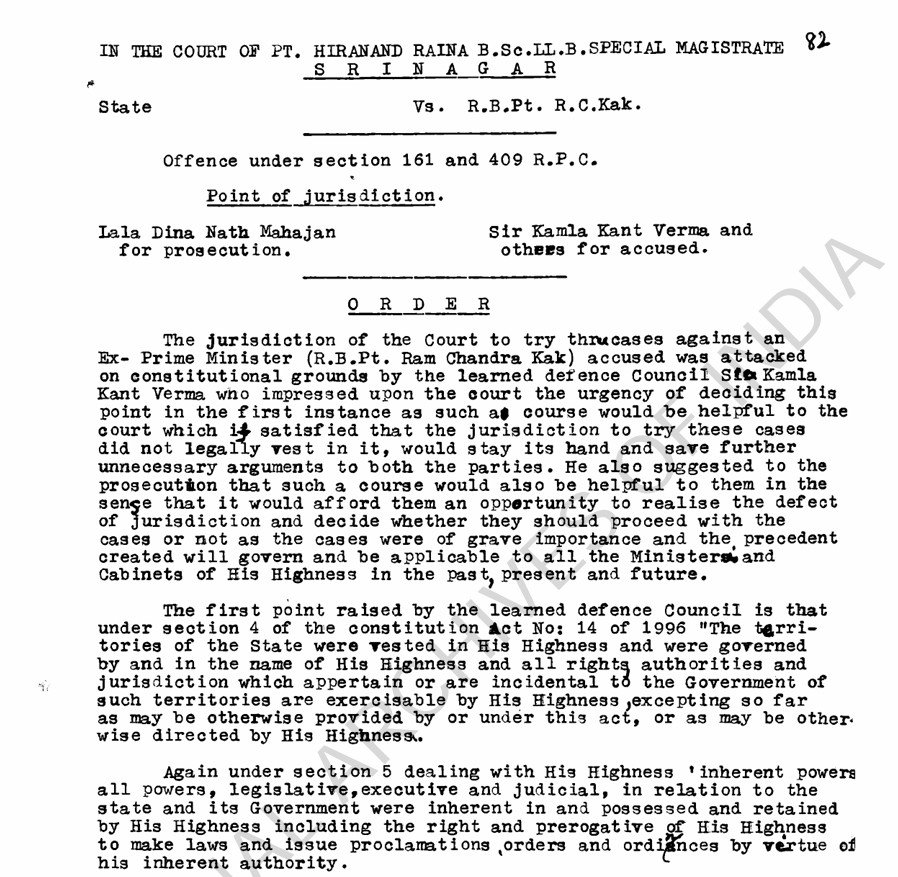
The court rejected that challenge. Its reasoning was that Kak was not being prosecuted merely for performing official functions as Prime Minister, but for alleged offences under Sections 409 and 161 of the Ranbir Penal Code—criminal breach of trust by a public servant and taking illegal gratification.
The constitutional issue, therefore, became part of a much larger question: could actions taken while occupying the highest political office be examined as ordinary criminal offences after the office-holder had left power?
By ruling that Kak was answering for alleged penal code violations rather than sovereign duties, the court effectively severed executive immunity from individual criminal accountability in the newly emerging democratic framework.
Sheikh Abdullah urged restraint
The case then travelled far beyond the courtroom.
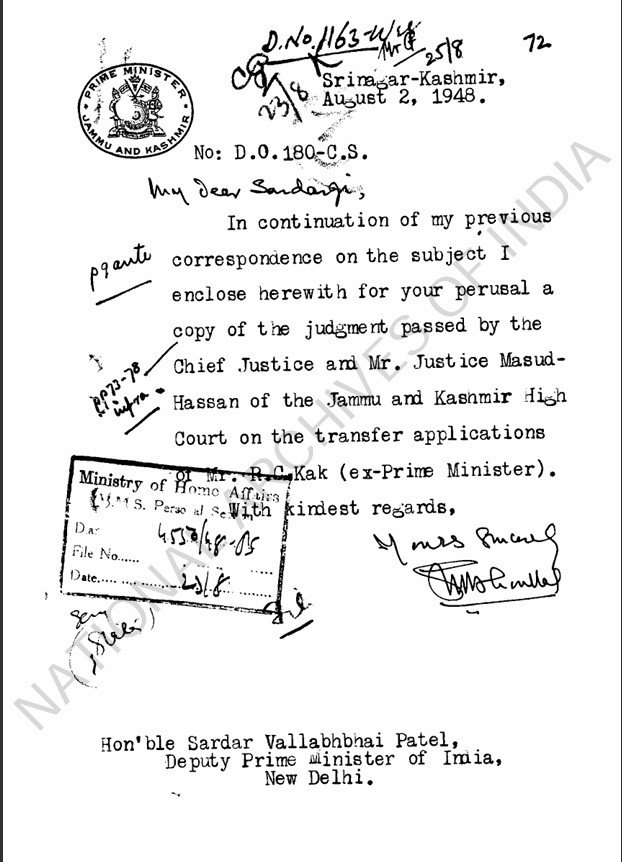
On July 1, 1948, Sheikh Mohammad Abdullah wrote to Sardar Patel after learning of V P Menon’s concern over the prosecution. Abdullah argued that he had examined the proceedings and believed Kak was being tried on the older charges. He said proceeding against a man who had occupied the State’s highest office could damage the standing of Jammu and Kashmir government and the Government of India.
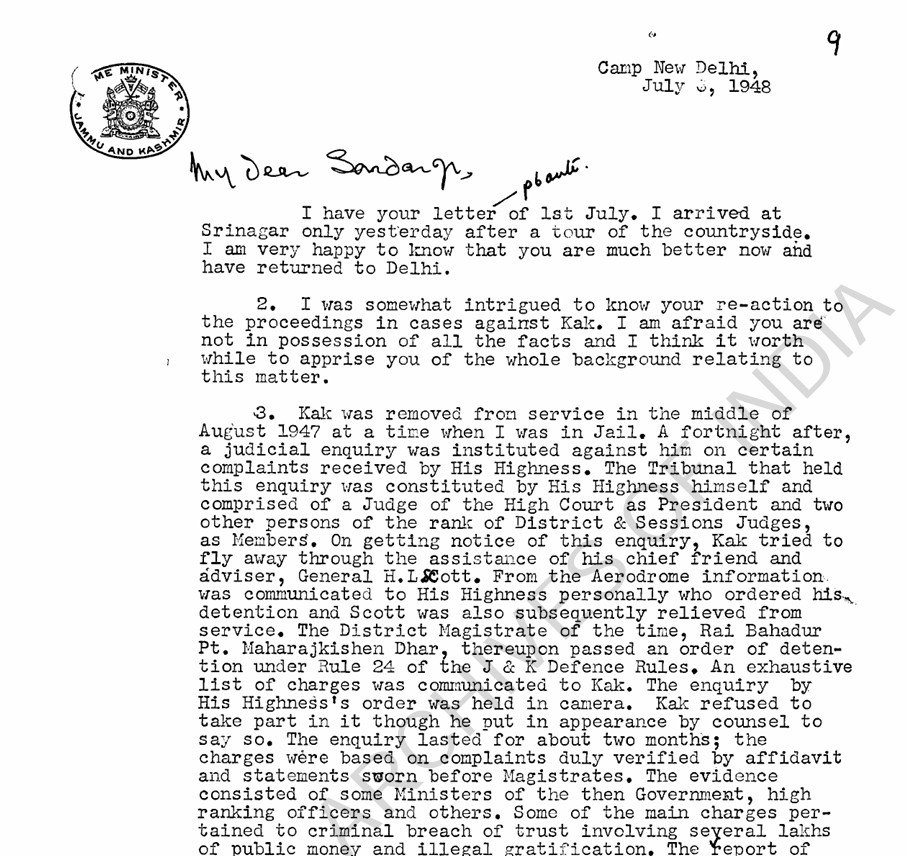
Abdullah also put Kak’s earlier political position into context. He wrote that Kak had believed, at the time, that an alliance with Jinnah was necessary to save Kashmir and that he had followed advice from Bhopal and the political officers of the period. Sheikh Abdullah argued that more serious accusations should not be attributed without evidence.
His suggestion was striking: Kak could be allowed to leave for England rather than continue the prosecution.
Patel defended letting the case proceed
Sardar Patel took a different view.
In his correspondence, Patel set out his understanding of the background. He stated that R C Kak had been removed from service in August 1947 and that an inquiry had subsequently been instituted on complaints received by the Maharaja. The Tribunal consisted of a High Court judge and two persons of District and Sessions Judge rank. Patel said the inquiry heard Ministers and senior officials and that the report was subsequently examined by Justice Mehr Chand Mahajan, who, according to Patel’s account, regarded the charges found proved by the Tribunal as proved beyond doubt.
Patel rejected the idea that the case should simply be treated as political retaliation. The prosecution, he said, had already entered the judicial process and could not simply be withdrawn.
The archive does not offer one R.C. Kak story—it preserves the allegations, the defence, the verdict, and the conflicting voices of Kashmir and New Delhi.
The file, therefore, captures a striking disagreement in emphasis: Sheikh Abdullah was concerned about the character and consequences of the prosecution; Sardar Patel stressed the inquiry and the judicial process.
When Nehru entered the picture
Another document makes the story still more remarkable.
In a November 17, 1948 letter to the Maharaja, Jawaharlal Nehru wrote that he had no high opinion of R C Kak but did not like the manner in which what he regarded as relatively trivial cases had been brought against him. Nehru said the proceedings had created an impression, rightly or wrongly, of a vendetta.
Nehru noted that Kak had been sentenced to two years’ imprisonment and a fine of Rs 10,000 in one case. He told the Maharaja that he had written to Sheikh Abdullah suggesting that Kak might be released on suitable conditions, including being allowed to leave Kashmir and not return without permission or engage in anti-government propaganda.
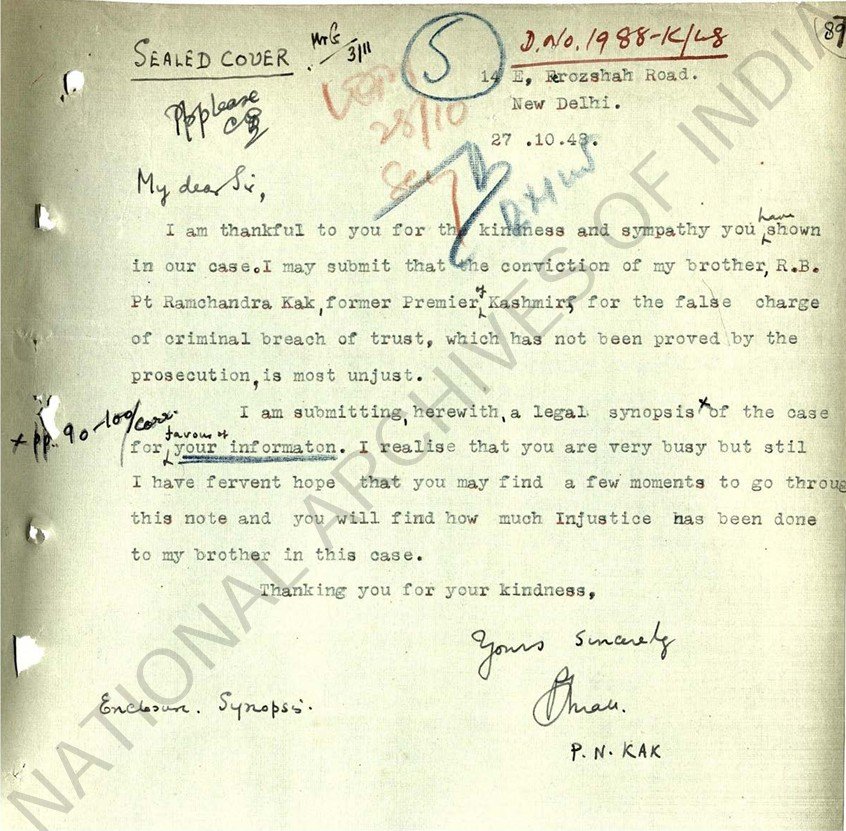
The file also preserves a later letter from Kak’s brother, Prem Nath Kak, thanking Patel for his assistance and stating that both brothers were free; Ram Chandra Kak had been released and understood to be free to leave Kashmir.
Convicted, then released
The ending of the case is perhaps its most unusual feature.
In his later representation, R C Kak stated that only six weeks after his conviction, and before the appeal period expired, his entire sentence of two years’ imprisonment and Rs 10,000 fine was remitted by executive order of the Maharaja. He was released, but at the same time served with an externment order requiring him to leave the State after a week.
The Ministry of States’ own subsequent note likewise records the sentence and its being kept in abeyance following intervention by the Prime Minister of India and the Ministry of States, after which Kak was permitted to leave the State.
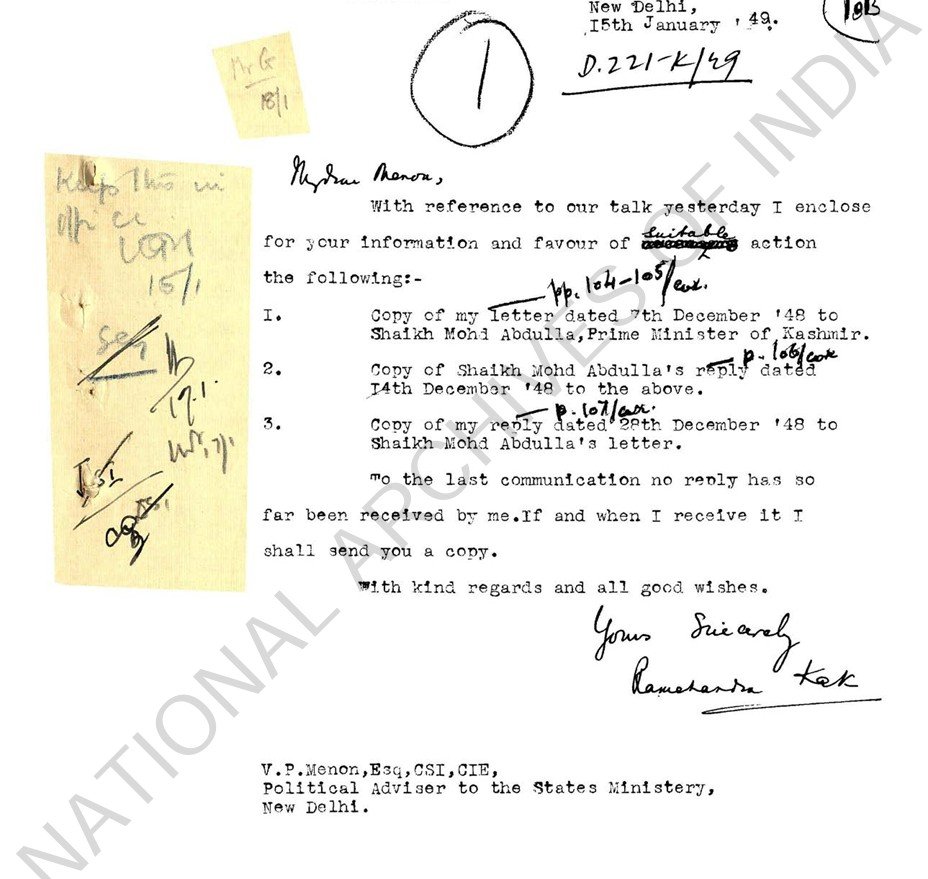
Kak nevertheless continued to contest the case. In December 1948, he asked Sheikh Abdullah that his appeal be heard by an authority outside Jammu and Kashmir administration and suggested the Chief Justice of India as one possible choice. In January 1949, he submitted the synopsis of his case to V P menon.
A file that refuses a simple verdict
The importance of this archival record lies precisely in its contradictions.
The Tribunal recorded 11 charges, based on 51 witnesses and 130 exhibits. The prosecution alleged misuse of office, favouritism and improper dealings. The defence challenged both the evidence and the court’s jurisdiction. Kak was convicted on at least one charge while, according to his brother’s representation, being acquitted on two others.
Meanwhile, Sheikh Abdullah questioned the prosecution’s necessity, Patel defended the judicial process, and Nehru pressed for Kak’s release under conditions.
The file does not leave history with an easy answer. Instead, it leaves behind something more valuable for an archival journal: the original paper trail of a contested chapter in Kashmir’s transition from princely-state politics to the new order of 1947–48.
And somewhere in that paper trail lies the story of a former Prime Minister who went from occupying the highest political office in Jammu & Kashmir to facing an 11-count inquiry, a criminal trial, a two-year sentence, executive remission and eventual exile from the State—all while the new political leadership of Kashmir and New Delhi argued, in writing, over what should happen to him.
Ultimately, the file stands as a testament to a fractured transition—where legal retribution, political expediency and the nascent friction between Srinagar and New Delhi collided over the fate of one man.
Archival Source
Ministry of States, Government of India, Kashmir Branch — “Trial of Rai Bahadur Pt. Ram Chandra Kak, ex-Prime Minister, Jammu & Kashmir Government,” National Archives of India, 160-page file.
About the Author
Dr Rajesh Bhat is an archival researcher, writer and media professional with a PhD in Journalism and Mass Communication. Formerly associated with Daily Excelsior, The Tribune and Prasar Bharati, he has worked extensively with media archives and historical records. He writes on history, archives, media and the socio-cultural heritage of Jammu & Kashmir.