
(Kashmir Rechords Exclusive)
There are places where rumours travel fast. And then there is Kashmir.
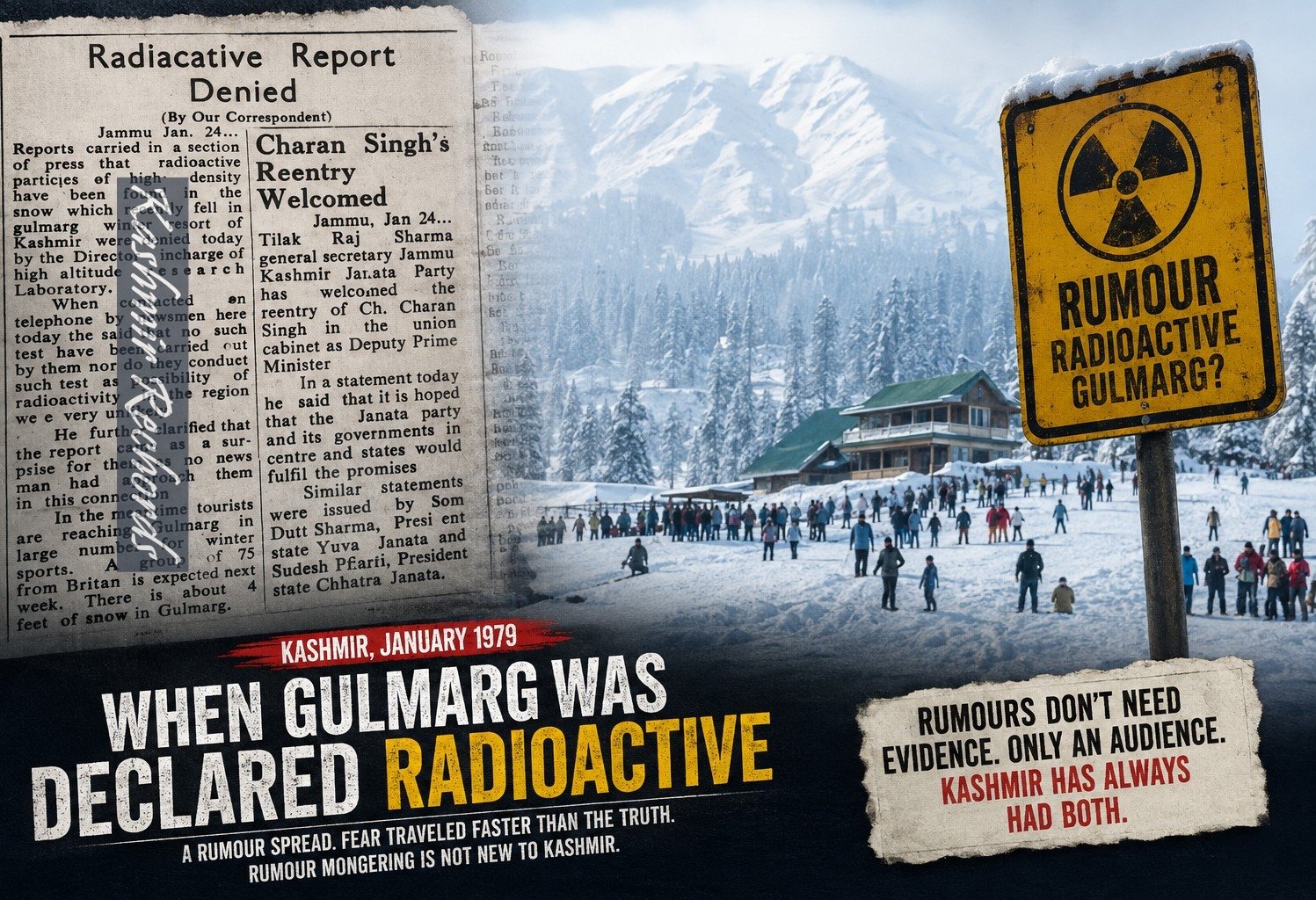
In January 1979, a bizarre rumour began circulating in the Valley: Gulmarg was witnessing the presence of radioactive substances. Snow that had recently fallen over the famed winter resort was said to possess “radioactive properties”. The story was alarming enough to find its way into sections of the press, creating apprehension at a time when Gulmarg was drawing tourists for its winter sports.
The scare became serious enough for the authorities to issue a denial.
A preserved Kashmir Rechords newspaper report dated January 24, 1979, headlined “Radioactive Report Denied,” recorded that reports had appeared claiming that radioactive properties had recently been found in the snow at Gulmarg. The report said the matter had been referred to the Director of the High Altitude Research Laboratory.
But when journalists contacted the authorities, the claim was dismissed.The possibility of radioactivity, they were told, was “ridiculous” and “very unlikely”.
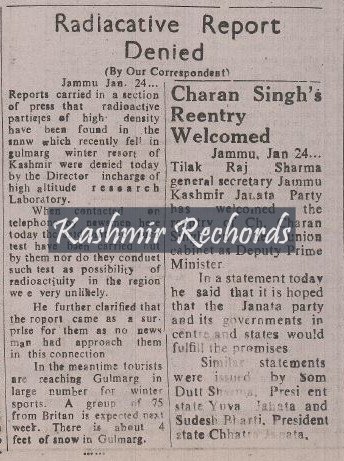
There was, however, an inconvenient reality for the rumour: Gulmarg was teeming with tourists. Winter visitors were arriving in large numbers, and a British group of about 75 tourists was reportedly expected the following week.
A radioactive Gulmarg was hardly the kind of news anyone in the tourism business would welcome. Yet rumours rarely wait for laboratory reports. They run ahead of facts.
From a whisper to a panic
The Gulmarg episode was not an isolated curiosity. It belonged to a much older Kashmiri tradition in which information—real, distorted or entirely fabricated—has often travelled through informal networks faster than it could be verified.
The phenomenon has been recorded by chroniclers, travellers and historians for centuries.
Historian Khalid Bashir, in Kashmir: Looking Back in Time, writes about what he describes as the Kashmiri tendency to romanticise rumours and exaggeration. The phenomenon is not simply about telling tall tales. At various points in Kashmir’s history, rumour has also functioned as a political instrument—something capable of creating fear, influencing public opinion and pushing a particular narrative.
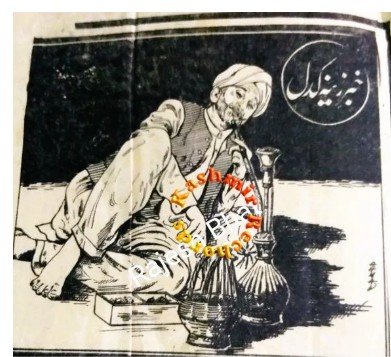
The old Kashmiri expression “Khabar Zaina Kadal” itself became almost synonymous with unreliable news.
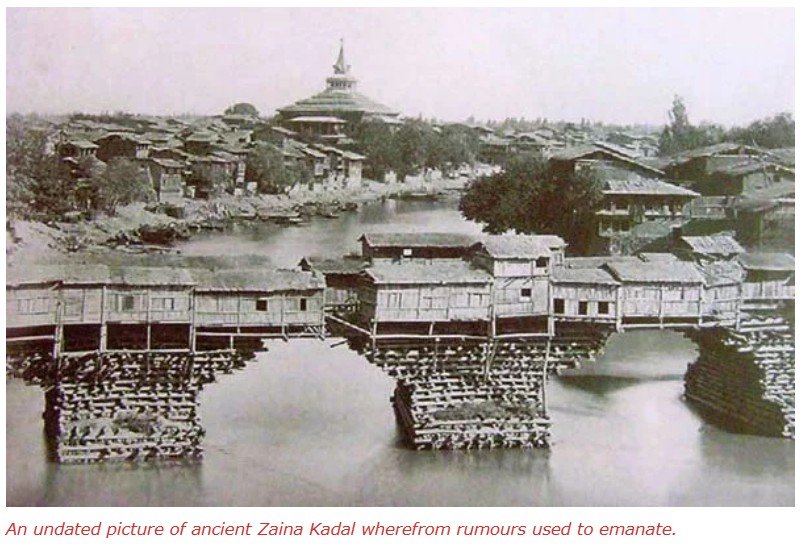
Zaina Kadal, the fourth bridge over the Jhelum in Srinagar, was traditionally regarded as a place where news and rumours were exchanged and embellished. As the saying went, information could emerge there and acquire a life of its own before anyone had bothered to establish whether it was true.
Sir Walter Roper Lawrence, the British settlement officer who spent years in Kashmir, wrote about this phenomenon in The Valley of Kashmir. He noted that although the wise knew that the reports emanating from Zaina Kadal were false, many others believed them—and that such reports caused considerable misery in the countryside.
In other words, fake news was not born with social media.Kashmir had its own version of it long before newspapers, radio, television and smartphones.
The rumour that made people flee a hill
One of the more remarkable examples came in 1935, when a newspaper reportedly carried a story attributed to a supposedly eminent geologist named Robert Macfield warning that Shankaracharya Hill would erupt between July 15 and August 15.
There was just one problem. The celebrated geologist apparently did not exist. The report nevertheless created panic. People began leaving their homes for safer places until another newspaper exposed the story as a cruel joke. The rumour had achieved its purpose before the truth caught up.
The same pattern appears repeatedly in Kashmir’s history: a whisper, an embellishment, fear—and finally a scramble for verification.
Even a ‘frightful creature’ lived in the Jhelum
British missionary and educationist Tyndale Biscoe encountered another extraordinary example. A rumour had spread that a “frightful creature” inhabited the Jhelum. People became frightened and stopped bathing in the river or carrying out their normal activities along its banks.
Biscoe did not respond with a philosophical lecture on misinformation. He made his students confront the rumour. He reportedly took his 130 students into the Jhelum and made them swim.The creature, needless to say, did not surface.
‘Tarr’: when rumour becomes a political weapon
The Kashmiri word “tarr”, used for fabrication or the spreading of news and rumour, acquires a more serious significance when placed in the political history of the Valley.
Rumours were not always born out of innocence, amusement or ignorance. They could be deliberately manufactured. That makes the 1979 Gulmarg episode particularly interesting. It may have been nothing more than an absurd piece of rumour-mongering.
But it demonstrated the extraordinary power of an unverified claim: snow could suddenly become radioactive, a tourist destination could become dangerous and ordinary people could be transformed into carriers of a story whose origin nobody could identify.
The ghosts, the polio drops,the food packets
Kashmir would witness many more episodes of rumour-driven anxiety.
In 1990, during the turmoil, Governor Jagmohan wrote in My Frozen Turbulence in Kashmir about rumours being used to undermine and frustrate the administration.
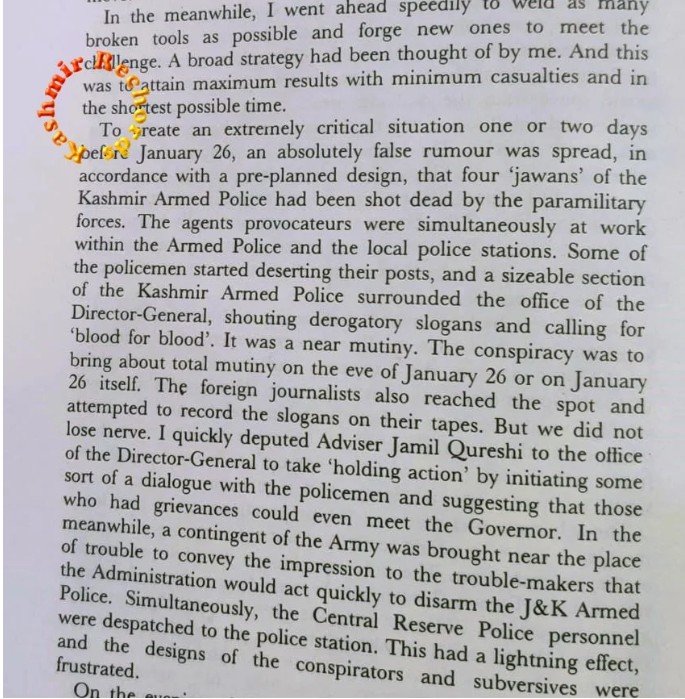
At one point, rumours circulated that food packets being distributed by the Army contained material that would cause frigidity among women and impotence among men, supposedly as part of a conspiracy to reduce the Muslim population.
The administration was compelled to counter the rumour in a rather extraordinary fashion: police and paramilitary personnel were instructed to eat the food and drink the water themselves to demonstrate that it was safe.
Then came the “Balaie” scare of 1993—ghost-like entities were said to be attacking people.
There had been similar scares before, including the 1977 rumour about “Naar-e-Tschour” and stories that members of the Jan Sangh were moving around and setting houses on fire.
And decades later, on January 17, 2016, another rumour caused widespread alarm when parents rushed their children to hospitals after being told that polio drops administered earlier that day were lethal.
Different decades. Different rumours.The same psychology.
Kalhana had seen it coming
Perhaps the most fascinating part of this story is that Kashmir’s romance with rumours is not a modern phenomenon.
References to the Valley’s propensity for circulating and believing rumours can be traced back centuries.
The historian Kalhana, writing his Rajatarangini, recorded the importance of rumour in Kashmir’s social and political life. Later scholars also noticed the same characteristic.
James P. Ferguson, in Kashmir: An Historical Introduction, while referring to Kalhana, noted how easily rumours in Kashmir could be manufactured and spread—from bathhouses along the river, shops and places of worship.
The locations changed. The mechanism did not. Once it was the riverbank, the shop, the mosque, the temple or Zaina Kadal.
Today it may be a WhatsApp group or social-media post. The rumour simply travels faster.
Kashmir and the politics of fear
There is, however, a danger in treating all such episodes merely as amusing examples of Kashmiri folklore.
Rumours can be harmless. They can also be devastating. They can empty streets, send people fleeing, destroy reputations, deepen communal suspicion, undermine institutions and create panic where none existed before.
That is why the history of rumour in Kashmir deserves to be studied not merely as a curiosity but as a social and political phenomenon.
The Gulmarg scare of 1979 reminds us that long before the age of viral videos and social-media forwards, fear itself could go viral.
A rumour needed no laboratory. No evidence. No author. It only needed people willing to repeat it. And Kashmir, for centuries, has supplied the perfect ecosystem for the whispered word to become accepted wisdom.
Perhaps that explains the perennial Kashmiri refrain:
“Khabar kya chuk karun?” — Who knows what they are planning?
Sometimes, the answer was simple. Sometimes, it was a lie. And sometimes, by the time the truth arrived, the rumour had already done its work.
Also Read: https://kashmir-rechords.com/january-19-1990-rumour-to-terrorise-kashmiris/