
(Based on Kashmir Rechords’ Archives)
Kashmir, August 1953. The political drama surrounding Jammu & Kashmir in 1953 was not confined to the larger questions of accession, autonomy and the struggle for political power. Beneath the grand political rhetoric lay another story—one of appointments, promotions, influence and alleged patronage.
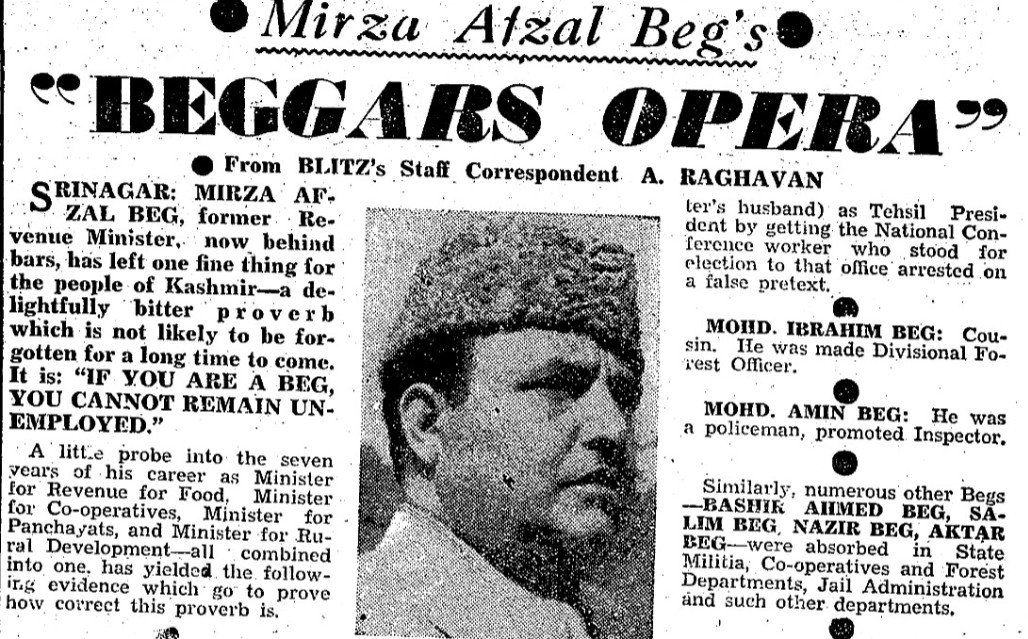
A remarkable report published in the Blitz issue of 22 August 1953, under the provocative headline “Beggar’s Opera”, turned its attention to the alleged influence of the family and associates of Mirza Afzal Beg, then a prominent Minister in Sheikh Abdullah’s government.
The report opened with a bitter proverb attributed to the situation:‘If you are a Beg, you cannot remain unemployed’
It was clearly written as satire. But behind the sarcasm was a serious allegation: that government employment and positions of influence had allegedly become accessible to people because of their family connection with a powerful political figure.
Mirza Afzal Beg’s family tree in the Administration
The Blitz veteran correspondent, A. Raghavan, claimed that a closer examination of the careers of people described as relatives or associates of Mirza Afzal Beg revealed a striking pattern.
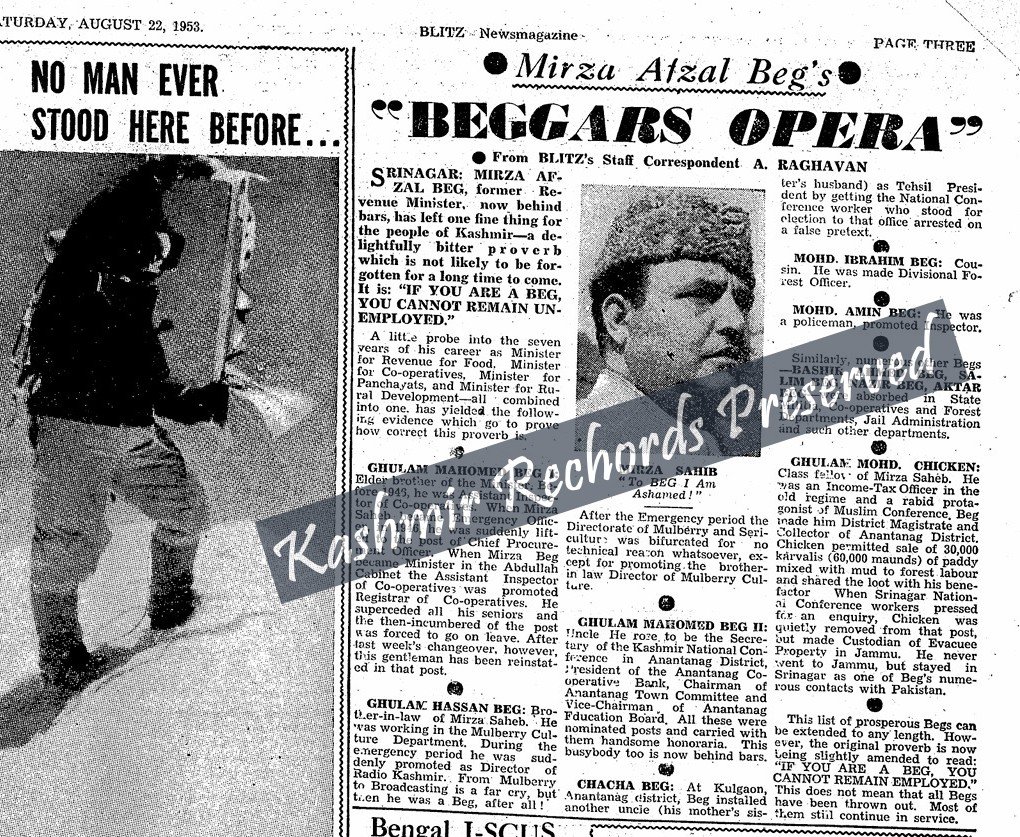
One of the examples cited was Ghulam Mohamed Beg, described as the Minister’s elder brother. According to the report, he had been an Assistant Inspector of Cooperatives before the political changes of the late 1940s. The newspaper alleged that he subsequently rose to the position of Chief Procurement Officer and later became Registrar of Cooperatives, allegedly superseding senior officers.
From Mulberry to Broadcasting
Another relative, Ghulam Hassan Beg, described as Beg’s brother-in-law, was said to have been working in the Mulberry Culture Department. The report claimed that during the Emergency period he was promoted as Director of Radio Kashmir.
The newspaper’s sarcasm was unmistakable:“From Mulberry to Broadcasting is a far cry, but then he was a Beg, after all!”
The point was not merely that a person had changed departments. The allegation was that political proximity could make otherwise unlikely career movements possible.
The uncle who held several positions
The report then turned to Ghulam Mohamed Beg II, identified as an uncle.
According to the article, he occupied or was associated with a remarkable collection of positions in Anantnag. The list included the secretaryship of the Kashmir National Conference in the Anantnag district, presidency of the Anantnag Cooperative Bank, chairmanship of the Anantnag Town Committee and vice-chairmanship of the Anantnag Education Board.
The Blitz alleged that these were nominated positions and that the individual received honoraria from them.
Once such a system takes root, merit becomes secondary to connection
In other words, the newspaper was portraying something more consequential than one questionable appointment. It was suggesting the creation of a network of political influence, stretching from the party organisation into cooperative institutions, local bodies and educational administration.
Relatives spread across the machinery of Govt
The report continued with a catalogue of people carrying the surname Beg.
Mohd. Ibrahim Beg, described as a cousin, was said to have been made a Divisional Forest Officer.
Mohd. Amin Beg, according to the report, had been a policeman who was subsequently promoted to Inspector.
It further named Bashir Ahmed Beg, Salim Beg, Nazir Beg and Akhtar Beg, alleging that they had found positions in institutions and departments including the State Militia, Cooperatives, Forest Department and Jail Administration.
Whether every allegation made by the newspaper was correct is a matter for archival verification. But the very existence of such a detailed contemporary report is historically significant. It shows that allegations of nepotism and political patronage were already being publicly discussed in Jammu & Kashmir in 1953.
Political and family power
The most disturbing aspect of the report was that it did not stop with government employment. It alleged that political influence could also be used to control local political competition.
The article referred to another relative in connection with the National Conference organisation and alleged that a rival worker who stood for election to a party position was arrested on what the newspaper described as a false pretext.
This allegation, if corroborated through official records, would demonstrate something much larger than ordinary nepotism: the alleged use of state or political machinery to protect a local patronage network.
That is why this forgotten clipping deserves attention today.
Ghulam Mohammad Chicken episode
The newspaper also singled out Ghulam Mohammad Chicken, described as a class fellow of Mirza Sahib.
According to the report, Chicken had been an Income-Tax officer during the earlier regime and was portrayed as a strong opponent of the Muslim Conference. The Blitz alleged that he subsequently became District Magistrate and Collector of Anantnag.
The report made serious allegations concerning the disposal of paddy and the sharing of proceeds with forest labour, claiming that National Conference workers eventually pressed for an enquiry and that Chicken was removed from the post.
It further alleged that he was subsequently made Custodian of Evacuee Property in Jammu but remained in Srinagar.
These are particularly serious accusations and should be treated strictly as claims made by the 1953 newspaper, not as established facts unless supported by administrative records, enquiry reports or other independent contemporary sources.
The bigger question: what happened to merit?
The real historical significance of the Blitz article lies beyond the individual names.
The emerging political order in Jammu & Kashmir had promised ordinary people a new beginning. The old feudal and autocratic structures were supposed to give way to a system based on popular representation, equality and social justice.
But the newspaper was asking an uncomfortable question:
What happens when the people who come to power in the name of the common man begin creating their own circles of privilege?
The accusation was that political power had allegedly begun reproducing itself through relatives, friends, party workers and loyalists.
A government office could become a source of patronage.
A cooperative institution could become a political base.
A nominated local position could become a source of influence.
A departmental promotion could become a reward for proximity.
And once such a system takes root, merit becomes secondary to connection.
The irony of 1953
The timing makes the article even more fascinating.
The report appeared on August 22, 1953, only thirteen days after Sheikh Abdullah was removed from the premiership. Mirza Afzal Beg, the central figure in the article, had been Sheikh Abdullah’s Revenue Minister. Contemporary records confirm that Beg was a prominent member of Abdullah’s government.
The political crisis of August 1953 was therefore unfolding simultaneously with a public debate about the functioning of the administration itself. Contemporary correspondence preserved in the Nehru Archive also records serious internal conflicts within the Jammu & Kashmir government during this period.
This makes the Blitz clipping more than an amusing old newspaper cutting.
It is a contemporary window into how politics and administration were being perceived at the time.
Lesson for today’s generation
For today’s generation, the lesson is not that every person named in the article was guilty of nepotism. Nor should an old newspaper allegation be transformed into historical fact merely because it fits a modern political argument.
The lesson is more fundamental.
Political slogans can promise revolution, equality and empowerment. But institutions are ultimately judged by what happens to jobs, promotions, public money and administrative power.
The history of Jammu & Kashmir should, therefore, not be remembered only through speeches, political movements and competing narratives about India, Pakistan or independence.
It should also be examined through the mundane records of government—who was appointed, who was promoted, who received nominated positions, who was removed, who benefited and whose relatives entered the system.
That is where political rhetoric meets ordinary life.
And the Blitz report of August 22, 1953 leaves behind a particularly uncomfortable question:
Did the people of Jammu & Kashmir replace one system of privilege with another—or did the new political class genuinely create the merit-based, democratic administration it had promised?
More than seven decades later, that question deserves to be answered not through political speeches, but through the archives.
Editorial Disclaimer
Kashmir Rechords is reproducing and presenting this story solely as an archival record of a report published in Blitz on August 22,1953, with the intention of bringing a little-known historical document to the notice of readers who may not have been aware of it. Kashmir Rechords does not independently vouch for the truth or accuracy of the allegations contained in the original report, nor does its publication imply endorsement of, or attribution of any motive to, any individual or organisation mentioned therein. Readers are encouraged to view the material in the historical and journalistic context of the period in which it was originally published.