

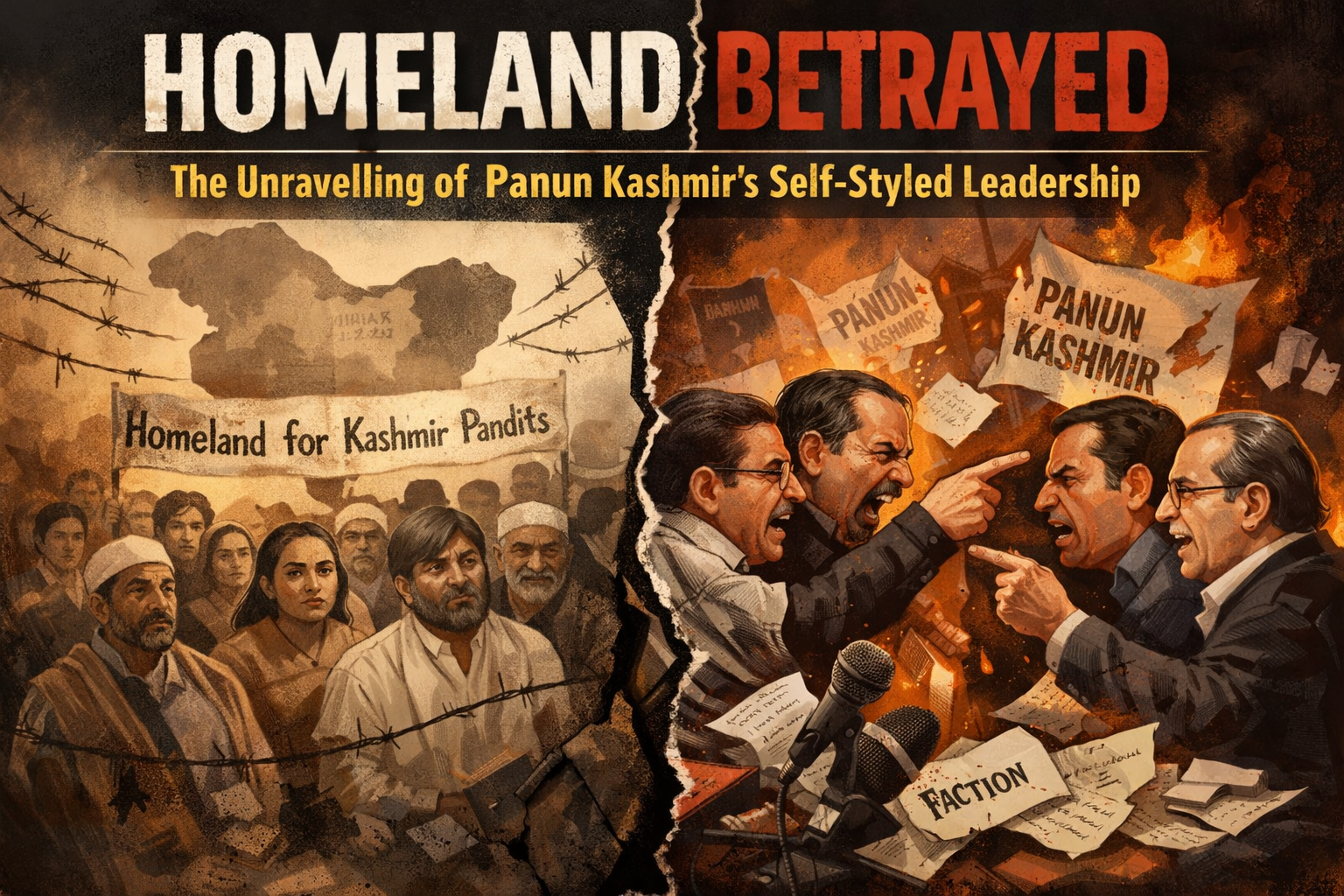
From a people’s movement to a theatre of egos, how opportunism hollowed out one of the most emotive causes of displaced Kashmiri Pandits
What began as a collective cry for dignity and return has, over the decades, been reduced to factional infighting, self-promotion and public mudslinging. The latest war of words within Panun Kashmir is not an aberration—it is the inevitable outcome of a long history of internal decay.
(Kashmir Rechords Exclusive)
The recent spectacle of charges and counter-charges among the so-called “leadership” of Panun Kashmir should surprise no one who has witnessed the organisation’s journey from within. This is not a sudden fall from grace—it is a slow, predictable collapse rooted in the very origins of its leadership structure.
The idea of a separate homeland for Kashmiri Pandits was not conceived by power-seekers. It was born in the bleak aftermath of the 1990 exodus—shaped by the fears, aspirations and survival instinct of an uprooted community. It was raw, organic and deeply collective. But before it could crystallize into a credible movement, it was appropriated—captured by individuals who saw in it not a mission, but an opportunity.
What followed was the systematic conversion of a sacred cause into a platform for personal ascendancy.
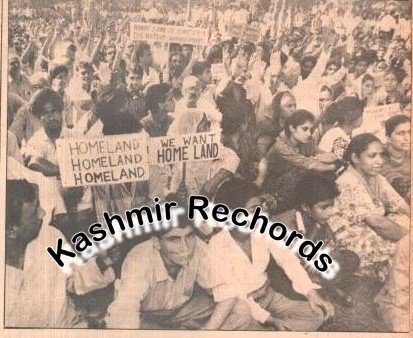
For the ordinary Kashmiri Pandit, the idea of homeland remains an article of faith. But for sections of its self-appointed lifetime leadership, it became a ladder—one climbed through titles, factions and perpetual reinvention. Over the years, the movement has witnessed cycle of splits and reunifications, permutations and combinations of self-styled Chairmen, Conveners and Core Groups—each claiming legitimacy, each undermining the other.
Kashmir Rechords has, over time, gathered substantial documentary evidence—press statements, press coverages, advertisements, posters—that point to an inconvenient truth: the cracks within Panun Kashmir’s leadership were present even before the much-cited Margdarshan of December 28, 1991. That event, often projected as a moment of unity, in fact deepened internal rivalries. The presence of Balraj Madhok did little to bridge differences; if anything, it exposed competing ambitions.
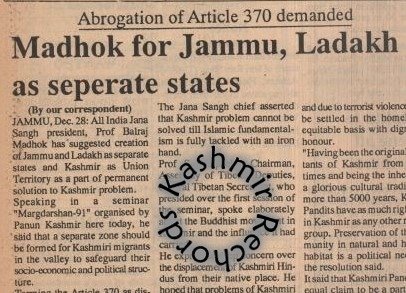
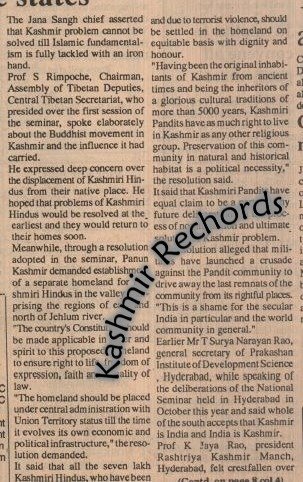
The fragmentation that followed was both swift and farcical. Multiple factions emerged, each branding itself differently—Movement, Moment and other semantic inventions—more invested in optics than outcomes. The diaspora, particularly non-resident Kashmiri Pandits, were drawn into this confusion, emotionally invested but strategically misled.
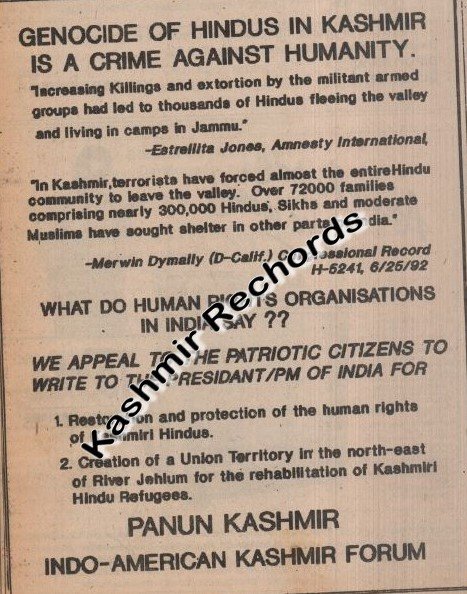
Symbolism replaced substance. Heads were tonsured in camps to signal sacrifice. Conferences were staged under grand titles. Newspaper was launched with fanfare and quietly abandoned. Its Editors changed multiple times.These acts, far from strengthening the cause, reduced it to episodic performances.
With time, the leadership’s contradictions became impossible to conceal. Allegations gave way to counter-allegations. Parallel protests, parallel offices and parallel claims to authority became the norm. What was once a unified demand splintered into competing narratives—each louder, none credible.
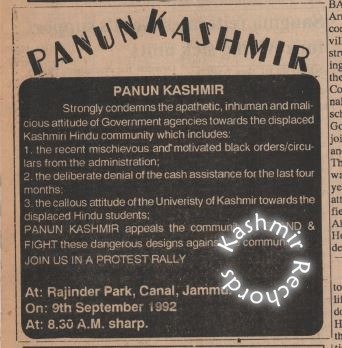
Half-baked slogans like “Ikjutt” with Jammu and Ladakh leadership surfaced periodically, only to collapse under the weight of mistrust. The movement, if it could still be called one, degenerated into a collection of factions—its leaders increasingly resembling keyboard warriors engaged in public feuds.
The latest episode, where one faction has branded another “anti-national,” is not merely unfortunate—it is revealing. It reflects a moral descent where the language of patriotism itself is weaponized for intra-group rivalry. This is the lowest ebb.
And yet, it is also a moment of clarity.
For what stands exposed today is not just the failure of individuals, but the betrayal of an idea. A cause rooted in pain, displacement and civilizational continuity was reduced to a battleground of egos and ambitions.
The tragedy of Panun Kashmir is not that it faced opposition from outside. It is that it was hollowed out from within.