

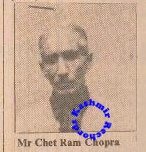
A lawyer, administrator, sportsman and patriot, Lala Chet Ram Chopra governed Jammu during the turbulent months of Partition and the tribal invasion of 1947, yet his remarkable life remains largely absent from public memory.
(Kashmir Rechords Exclusive)
History often remembers the loudest names but quietly forgets those who stood firm in moments of crisis. Among such overlooked figures is Lala Chet Ram Chopra, the last Governor of Jammu under the princely rule of Maharaja Hari Singh — a man whose life spanned law, administration, sports, public service and wartime sacrifice.
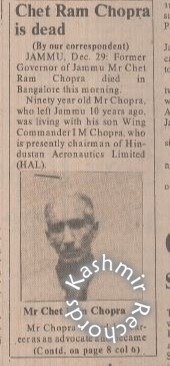
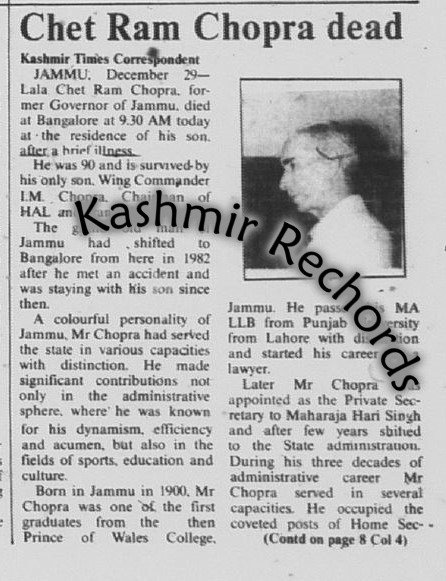
Despite holding one of the most crucial positions during the most turbulent period in Jammu and Kashmir’s history, very little about him survives in the public domain today, except an obituary, which was published in two local dailies of Jammu at the time of his death in December 1990. His legacy remains overshadowed by the political controversies of 1947, often reducing a complex life to selective accusations while ignoring decades of public service.
Yet archival records and contemporary reports dug up by Kashmir Rechords portray Mr Chopra as a multi-dimensional personality — an able lawyer, a tough administrator, a sportsman, a public intellectual and a devoted patriot.
From Jammu’s Classrooms to Lahore’s Law Halls
Born in Jammu in 1900, Chet Ram Chopra belonged to a generation that witnessed the transition of Jammu and Kashmir from a princely State into a region caught in the vortex of Partition.
He was among the first graduates of the historic Prince of Wales College, Jammu . After completing his graduation, he proceeded to Lahore where he obtained his Master of Laws (MLB) from Punjab University, graduating with distinction.
Armed with legal training and intellectual discipline, Chopra had begun his career as a lawyer, but destiny soon drew him into public administration.
A Trusted Hand in the Dogra Administration
Mr Chopra’s administrative abilities quickly caught the attention of the State leadership. He was appointed Private Secretary to Maharaja Hari Singh, placing him at the heart of the Dogra administration.
Over the next three decades, he had served the State in several important positions, gaining a reputation for efficiency, discipline and administrative acumen.
Among the key posts he held were:
- Home Secretary of the State
- Development Secretary
- Wazir Wazarat (Deputy Commissioner) of Poonch
- Wazir Wazarat of Mirpur
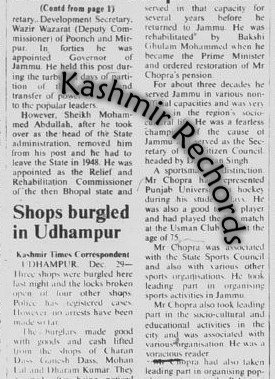
His administrative career culminated in 1946, when he was appointed Governor of Jammu — one of the most powerful positions in the State administration at a time when political tensions were rapidly escalating across the subcontinent.
Governor During the Storm of 1947
As Governor, Chet Ram Chopra found himself governing Jammu during one of the most volatile periods in the region’s history.
The year 1947 brought the trauma of Partition and soon after the tribal invasion of Jammu and Kashmir backed by Pakistan in October 1947, which ultimately led to the historic accession of the state to India under Maharaja Hari Singh.
During this chaotic period, Jammu witnessed widespread violence and demographic upheaval. Like many officials involved in administering the region during those tumultuous months, Chopra became a controversial figure in later narratives of the period.
Certain groups accused him of playing a controversial role in the Jammu disturbances of 1947, including allegations that he had signed “forced migration orders.” However, these accusations were often found politically motivated and unsupported by conclusive documentary evidence. But he had to pay price for these accusations.
When Sheikh Mohammad Abdullah assumed power as head of the State administration, Chopra was removed from his post and eventually left Jammu and Kashmir in 1948.
Years Away: Service in Bhopal
Despite the setback, Mr Chopra continued his public service outside the State.
He was appointed Relief and Rehabilitation Commissioner in the erstwhile Bhopal State, where he worked for several years helping manage the enormous humanitarian crisis created by Partition.
His administrative experience proved valuable in handling the challenges of refugee rehabilitation — one of the most pressing issues of newly independent India.
Return to Jammu and Public Life
Mr Chopra eventually returned to Jammu after intervention by Bakshi Ghulam Mohammad, who ordered the restoration of his pension and rehabilitation.For nearly three decades thereafter, he remained deeply involved in Jammu’s civic life.
He served as Secretary of the Citizen Council, an influential body headed by Dr. Karan Singh, and emerged as a fearless advocate of Jammu’s public causes.
The Sportsman and the Scholar
Beyond administration, Chet Ram Chopra was also known for his passion for sports and intellectual pursuits. During his student days, he had represented Punjab University in hockey and later became an accomplished tennis player.
In a remarkable testament to his lifelong love for sport, he reportedly played his last tennis match at the Usman Club in Jammu at the age of 75.He also remained associated with the State Sports Council and several other sports organisations, playing a significant role in promoting sporting culture in Jammu.
At home, he was known as a voracious reader and a deeply thoughtful man with wide intellectual interests.
A Family of Soldiers
Mr Chopra’s patriotism was not merely rhetorical.
He actively encouraged his sons to join the Indian Army, a decision that came at a profound personal cost.
His second son, Major M. M. Chopra, laid down his life in the 1965 Indo-Pak War, becoming one of the many soldiers from Jammu who sacrificed their lives defending the country.
Even in his later years, Mr Chopra remained actively involved in mobilising public support during the wars of 1965 and 1971, helping organise assistance for soldiers and families of war heroes.
The Final Years
After suffering an accident in 1982, the ageing administrator had moved from Jammu to Bengaluru to live with his son, Wing Commander I. M. Chopra, who was then Chairman of the Hindustan Aeronautics Limited (HAL).
The grand old man of Jammu passed away quietly at Bengaluru on December 29, 1990, at the age of 90.
A Life Waiting to Be Reassessed
Lala Chet Ram Chopra’s life reflects the complexities of Jammu and Kashmir’s transition from princely rule to modern politics.
He was administrator, sportsman, civic leader, father of soldiers and Governor during one of the most turbulent chapters in the region’s history.
Yet today, he remains largely absent from mainstream historical narratives.
Perhaps the time has come for historians and scholars, especially of Jammu and Kashmir to revisit the life of this forgotten administrator — not through the narrow prism of political accusations, but through a balanced examination of his long and multi-dimensional public service.
For history is rarely as simple as its most repeated stories. And sometimes, the most important figures are the ones quietly forgotten.
great writeup
great writeup