
(Kashmir Rechords Exclusive)
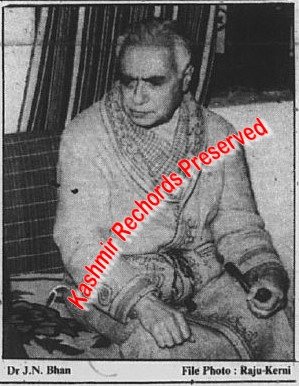
In an age when institutions were shaped not by committees but by conviction, Dr J N Bhan stood tall as a rare, multi-dimensional intellectual. Today’s generation of teachers and students may scarcely know his name, yet for those who witnessed his era, he was the very definition of an ideal academic: a revered teacher, a profound economist, a visionary administrator and a principled public intellectual.
He was the first Vice-Chancellor of the University of Jammu, appointed in 1969, and one of the principal architects of higher education in the region. His life’s journey—from pre-Partition Kashmir classrooms to London’s academic corridors, and finally to institution-building in Jammu—reads like a quiet epic of dedication.
Roots in Kashmir, Values for Life
Born in 1915 into a conservative Kashmiri Pandit family, Dr Bhan was raised in the traditions, discipline and cultural ethos of the time. His early education at SP High School Srinagar laid a strong foundation, after which he joined SP College Srinagar, graduating in 1936.
Even as a student, he was far from cloistered in books alone. He actively participated in the anti-communalism movement led by Kashyap Bandhu, reflecting an early moral clarity that would define his life. This engagement also brought him close to thinkers such as Prem Nath Bazaz, placing him firmly within the progressive intellectual currents of pre-Partition Kashmir.
The Making of a Scholar
Dr Bhan pursued his post-graduation in Economics in Delhi, earning distinction and later expanded his academic breadth with postgraduate degrees in History and Political Science—a rare interdisciplinary depth for his time.
Returning to Kashmir, he joined SP College Srinagar as a Lecturer in Economics and History, serving from 1938 to 1946. His classroom reputation grew quickly: lucid, rigorous and inspiring; he was already being spoken of as a teacher who shaped minds, not merely syllabi.
London Years: Academia and Diplomacy
In 1946, Dr Bhan travelled to London to pursue his doctorate in Economics. These years proved formative in more ways than one. Alongside academic work, he served as Assistant Press Attaché to the Indian High Commission in the UK, gaining first-hand exposure to diplomacy and international affairs.
During this period, he came into close contact with P. N. Haksar and Khushwant Singh, relationships that broadened his intellectual horizons and deepened his understanding of India’s place in the world.
Return to J&K: Scholar-Administrator Emerges
In 1951, Dr Bhan was recalled by the government led by Sheikh Mohammad Abdullah and appointed Professor and Head, Department of Economics at GGM Science College Jammu.
A brief but telling episode followed in 1953, when he was asked to succeed J. N. Zutshi as Director General of Information and Broadcasting. Disillusioned by internal squabbles, Dr Bhan chose principle over position, returning to academia by joining the Education Department as Secretary—a decision that revealed his deep aversion to politicised dysfunction.
A University Builder, Not Just a Vice-Chancellor
In September 1957, Dr Bhan joined the University of Jammu & Kashmir as Professor and Head, Department of Economics. His administrative acumen soon became evident, as in 1963, he was appointed Pro-Vice-Chancellor and in 1969, became the first Vice-Chancellor of the newly established University of Jammu.
He famously described the creation of the University as the “fulfilment of a genuine demand of the people of Jammu.” To him, it was not merely an institution—but a promise to future generations.
Dr Bhan’s love for the University of Jammu was profound and personal. He nurtured it in its infancy—laying academic standards, shaping departments, and fostering a culture of integrity and scholarship.
Beyond administration, he remained a hands-on academic. University archives and PhD bibliographies record him as a research supervisor, underscoring his commitment to mentoring young scholars and strengthening research-led teaching in Jammu & Kashmir.
A brilliant orator, a measured thinker and a man of unwavering values, Dr Bhan commanded respect without demanding it. Students admired his clarity, colleagues trusted his judgment and the academic community recognised his quiet authority.
After retirement, he continued public service as a member of the State Planning Board, bringing economic insight to policy formulation.
The Day Jammu Stood Still
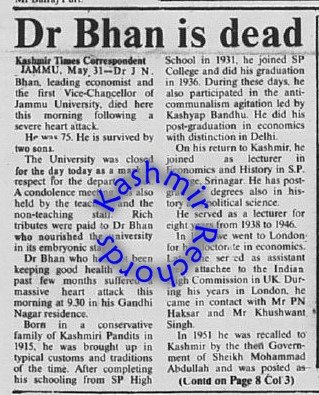
On May 31, 1990, Dr J. N. Bhan passed away at his Gandhi Nagar residence in Jammu, following a massive heart attack. He was 75 and had been in fragile health for several months.
Such was the esteem in which he was held that the University of Jammu closed for the day—a rare institutional tribute—honouring the man who had built it brick by brick, principle by principle.
Dr Bhan’s legacy did not fade with time. In September 2012, the University of Jammu instituted the Prof. J. N. Bhan Memorial Lecture Series in Economics—a formal recognition of his foundational role in shaping economic thought and higher education in the region.
Dr J. N. Bhan’s life stands as a reminder that universities are not merely built by funds or files, but by vision, scholarship, and character. He remains remembered as a nation-builder in the classroom, a statesman in administration, a mentor to generations and a man who served without noise, ambition or compromise.
In nurturing the University of Jammu in its earliest days, Dr Bhan ensured that his own life would become inseparable from the institution’s history—a legacy that continues to inspire, quietly yet enduringly.