

(Kashmir Rechords Report)
The archival newspaper clipping dated May 30–31, 1984 challenges one of the most frequently repeated narratives about the origins of the Kashmir conflict. A common perception is that Kashmir’s troubles began with the 1987 Assembly elections, followed by the rise of militancy and, ultimately, the forced exodus of the Kashmiri Pandit community in 1990. However, archival evidence indicates that communal targeting and violence against the minority community predated 1987.
The report explicitly mentions that Kashmiri Pandit temples were attacked and that attempts were made to set them on fire. It states that the All State Kashmir Pandit Association protested these attacks and referred to assaults on temples and other religious places. The report also records widespread violence across Srinagar, Anantnag, Baramulla and other areas, curfews, police firing, destruction of property, and attacks on public transport. These developments occurred three years before the 1987 elections.
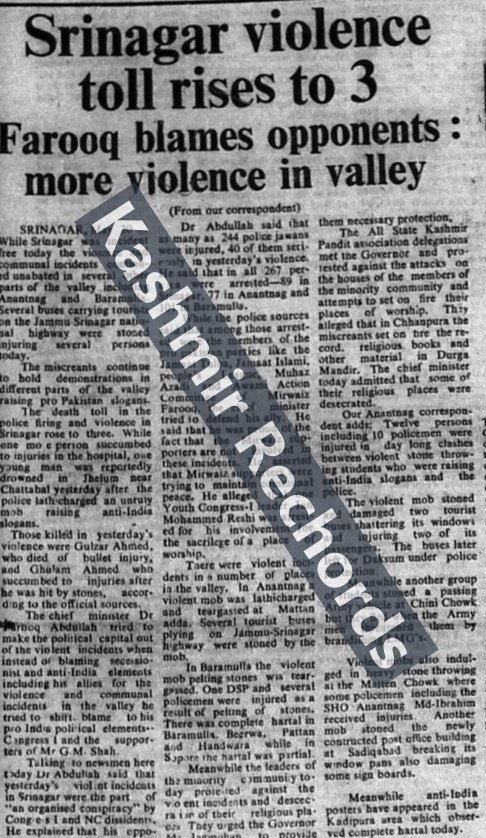
This archival evidence should not be interpreted as proving a single cause for the later insurgency, but it does demonstrate that communal intimidation and attacks on Kashmiri Pandit religious sites were already taking place in 1984. The subsequent 1986 Anantnag riots, during which numerous temples and Hindu properties were attacked, further deepened the sense of insecurity among the minority community. Yet, despite these repeated incidents, Kashmiri Pandits largely remained in the Valley, hoping that the situation would improve.
The crisis reached its tragic culmination only in 1990, when escalating militancy, targeted killings, intimidation, and threats triggered the mass exodus of the Kashmiri Pandit community from their ancestral homeland.
In other words, the archival record suggests a more complex chronology than the simplified narrative that everything began in 1987. The sequence reflected in contemporary reports is:
- 1984: Attacks on Kashmiri Pandit temples and growing communal violence, as documented in contemporary newspapers.
- 1986: The Anantnag riots and widespread attacks on temples and minority properties.
- 1987: A disputed election, followed by a rapid escalation of armed militancy.
- 1990: The mass exodus of Kashmiri Pandits.
These archival records underscore that the vulnerability of the Kashmiri Pandit community was evident years before the 1990 exodus, and that understanding the conflict requires examining the full historical sequence rather than reducing it to a single turning point.