
By:Dr. Rajesh Bhat*
History is often remembered through wars fought on one’s own soil. Yet Kashmir witnessed another phenomenon—equally tragic but far less documented. For decades, international political and religious events repeatedly ignited protests in the Valley, even when those events had no direct connection with Jammu and Kashmir. The emotional response was immediate; the consequences were local.
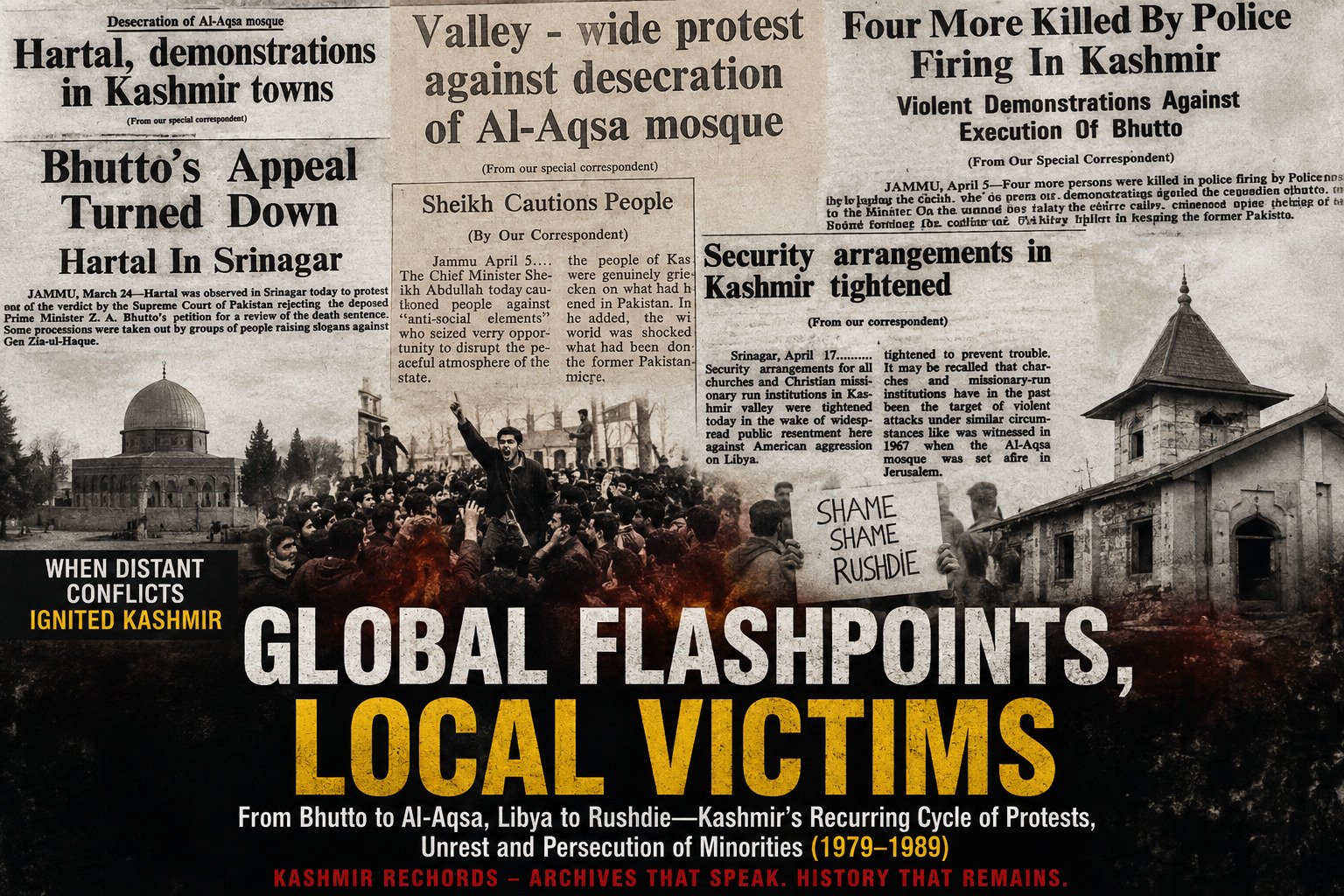
An extensive examination of contemporary newspaper archives by Kashmir Rechords reveals a striking historical pattern. From the execution of Pakistan’s former Prime Minister Zulfikar Ali Bhutto in 1979 to the desecration of Jerusalem’s Al-Aqsa Mosque in 1986, from the American bombing of Libya to the Salman Rushdie controversy in 1989, Kashmir repeatedly became a theatre where distant events played out violently. In many cases, it was the Valley’s minorities—Kashmiri Pandits and Christians in particular—who paid the price for conflicts and controversies in which they had no role.
1979: Kashmir Reacts to Pakistan’s Internal Crisis
The first major example emerged in March-April 1979, when Pakistan’s former Prime Minister Zulfikar Ali Bhutto exhausted his legal remedies after the Supreme Court of Pakistan upheld his death sentence.Even before Bhutto’s execution, Kashmir witnessed protests.
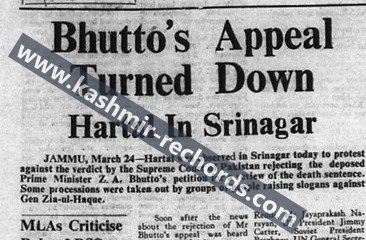
An archival report dated March 25, 1979 records a hartal in Srinagar following the rejection of Bhutto’s review petition. Protesters took to the streets against General Zia-ul-Haq‘s military regime despite the fact that the controversy concerned Pakistan’s internal judicial process.The situation worsened after Bhutto was executed on 4 April 1979.
A newspaper dated 6 April 1979 carried the alarming headline:
“Four More Killed By Police Firing In Kashmir – Violent Demonstrations Against Execution of Bhutto.”
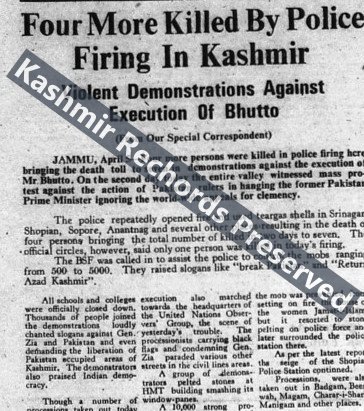
According to the report, police firing across Kashmir raised the death toll to seven persons within two days. Massive demonstrations paralysed Srinagar, Shopian, Sopore, Anantnag and several other towns.
The archives describe:violent clashes with police;attacks on government buildings;road blockades;extensive stone-pelting;attempts to storm public offices;widespread shutdowns.
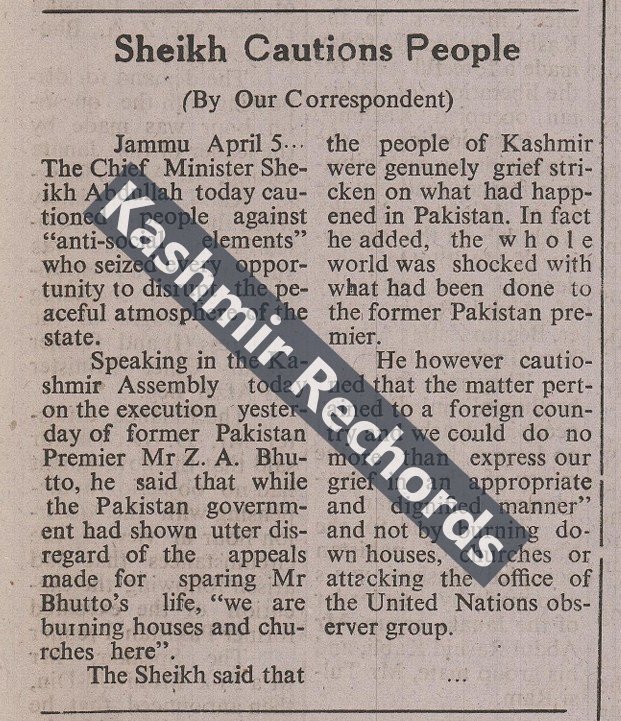
Most significantly, the report records that shops and business establishments belonging to sections of the Muslim community perceived to support General Zia or the Jamaat-e-Islami were attacked and looted. Their only perceived offence was ideological association with Pakistan’s ruling establishment.The Valley had erupted—not over a local issue—but over Pakistan’s domestic politics. Even Christian Community of Kashmir was targetted , forcing Sheikh Abdullah to say that while Pakistan took an ugly decision, why are we burning houses and Churches here?
1986: Jerusalem Burns, Kashmir Shuts Down
Seven years later, another international event triggered a similar reaction.Reports of the desecration of the Al-Aqsa Mosque in Jerusalem in February 1986 produced one of the largest protest movements witnessed in Kashmir during that decade.
Archival newspapers carried headlines including:
- “Hartal, Demonstrations in Kashmir Towns.”
- “Valley-wide Protest Against Desecration of Al-Aqsa Mosque.”
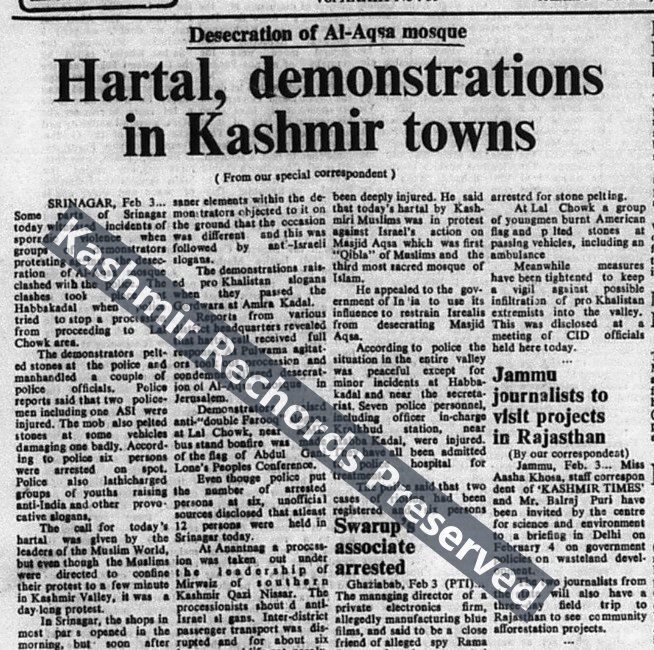
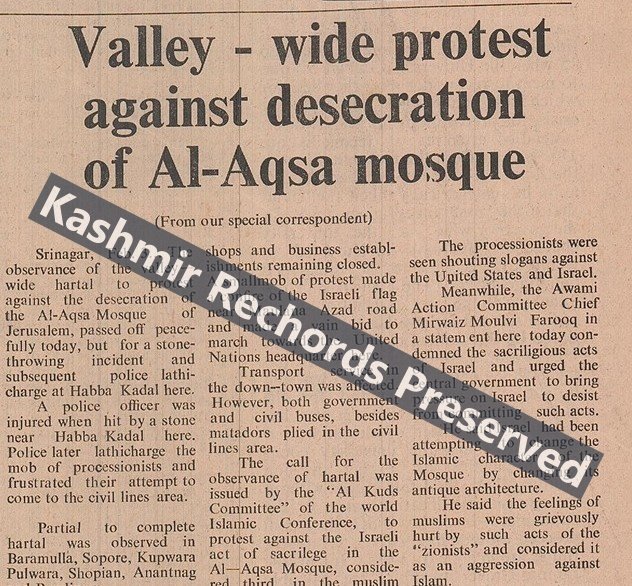
Entire towns observed shutdowns. Demonstrations spread through Srinagar, Baramulla, Sopore, Kupwara, Pulwama, Shopian, Anantnag and Handwara.
Crowds shouted slogans against Israel and the United States while clashes with police left several personnel injured.
For many Kashmiris, Al-Aqsa represented not merely a mosque but an emotional symbol of the Islamic world.Yet the repercussions did not stop with protest marches.
An Already Explosive Atmosphere
The Al-Aqsa demonstrations unfolded against the backdrop of mounting communal tension inside Kashmir.
Within days, the Valley witnessed the Anantnag riots of February 1986, during which numerous temples, houses and commercial establishments belonging to Kashmiri Pandits were attacked.
Although historians attribute those riots to a combination of political, communal and local factors, the archival timeline demonstrates how international religious developments further inflamed an already combustible atmosphere.Once again, the victims were local.
Libya Bombed, Christians in Kashmir Guarded
Barely two months later, another international conflict reverberated through Kashmir. Following the United States’ bombing of Libya in April 1986, newspapers reported that security across Kashmir had been substantially tightened.
The report specifically stated that police protection had been reinforced around:churches,Christian missionary institutions and educational establishments run by missionaries.
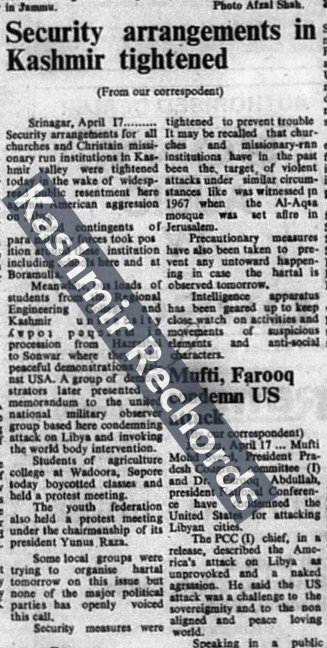
The administration feared that anger directed against the United States could spill over onto local Christian institutions.
The irony could hardly have been greater. Kashmir’s Christians had absolutely no connection with Washington’s foreign policy.
Yet they required police protection because events unfolding in North Africa were expected to provoke unrest in Kashmir.
The newspaper itself recalled that similar precautionary measures had earlier been necessary during the Al-Aqsa protests.
1988: Mourning General Zia
History then produced another paradox.When General Zia-ul-Haq, the very military ruler blamed by protesters for Bhutto’s execution, died in an air crash on August 17, 1988, parts of Kashmir again witnessed mourning processions and demonstrations.
The same Valley that had erupted against him nine years earlier now observed public grief over his death.
The episode illustrated how political developments across the border continued to evoke powerful emotional responses inside Kashmir, often resulting in law-and-order challenges requiring heavy deployment of security forces.
1989: Salman Rushdie and Local Backlash
The publication of Salman Rushdie’s The Satanic Verses triggered protests across much of the Muslim world.Kashmir was no exception.
During demonstrations in February 1989, two ancient temples belonging to the Kashmiri Pandit community—one at Fateh Kadal and another at Ganpatyar in Srinagar—were attacked.Neither the temples nor the Kashmiri Pandit community had any connection with the author or the publication.
Nevertheless, local minorities once again became targets during protests over an international controversy.
A Disturbing Historical Pattern
Viewed together, these archival reports reveal an unmistakable pattern.
Whenever a major political or religious event occurred abroad:Pakistan executed Bhutto or Jerusalem witnessed controversy over Al-Aqsa 0r America bombed Libya or Salman Rushdie published a controversial novel, Kashmir often responded with: shutdowns,demonstrations,violent confrontations,attacks on public property,heightened communal tension and the deployment of additional security around minority places of worship.
The emotional geography of Kashmir frequently extended far beyond its physical borders. Unfortunately, the consequences often fell upon neighbours who had nothing whatsoever to do with those distant events.
Pattern Has Not Entirely Disappeared
The archives also resonate with more recent developments.Following the escalation of tensions involving Iran, sections of Kashmir again organised demonstrations expressing solidarity with the country. Public reports documented campaigns collecting humanitarian assistance, including cash as well as donations of gold and silver, intended for relief efforts associated with Iran.
Expressions of solidarity with international causes have long formed part of Kashmir’s political culture. The historical record, however, also serves as a reminder of the dangers of allowing distant conflicts to translate into local intimidation or communal polarisation.
The Forgotten Lesson of the Archives
The newspaper clippings preserved by Kashmir Rechords tell a story that extends beyond individual protests.
They document a recurring historical phenomenon in which international events repeatedly shaped Kashmir’s internal social and political climate. They also reveal a sobering truth: the burden of those distant conflicts was often borne by innocent local communities.
Whether it was Kashmiri Pandits whose temples came under attack after the Rushdie controversy, Christians whose churches required police protection after the bombing of Libya, or ordinary citizens caught in violence following Bhutto’s execution, the archives show that international passions frequently translated into local insecurity.
Understanding this history does not diminish the right of people to express solidarity with causes beyond their borders. Rather, it highlights the importance of ensuring that such expressions never become a pretext for violence against fellow citizens who bear no responsibility for events unfolding thousands of kilometres away.
As these forgotten newspaper reports remind us, history’s most enduring lesson is that when global conflicts are imported into local society, it is often the innocent who pay the highest price.
About the Author
Dr. Rajesh Bhat is a veteran journalist, broadcaster, author, media archivist and independent researcher with over three decades of experience in Journalism and Public Broadcasting. He holds a Ph.D. in Journalism and Mass Communication and began his career in print journalism, serving with the Kashmir Times before joining Daily Excelsior as a Special Correspondent, where he headed the newspaper’s Kashmir Desk during the peak years of militancy in the Valley. During the same period, he also contributed extensively on art, cultureand heritage to The Tribune.
He later transitioned to electronic media, serving in Prasar Bharati in various broadcasting capacities. Dr. Bhat is the co-founder of the Kashmir Rechords Foundation, a registered non-profit organization dedicated to preserving the archival, cultural and socio-political history of Jammu and Kashmir. His research draws extensively on contemporary newspaper archives, official records and other primary historical sources to document forgotten narratives and present evidence-based accounts of Kashmir’s past.