
(Kashmir Rechords Exclusive Research Report)
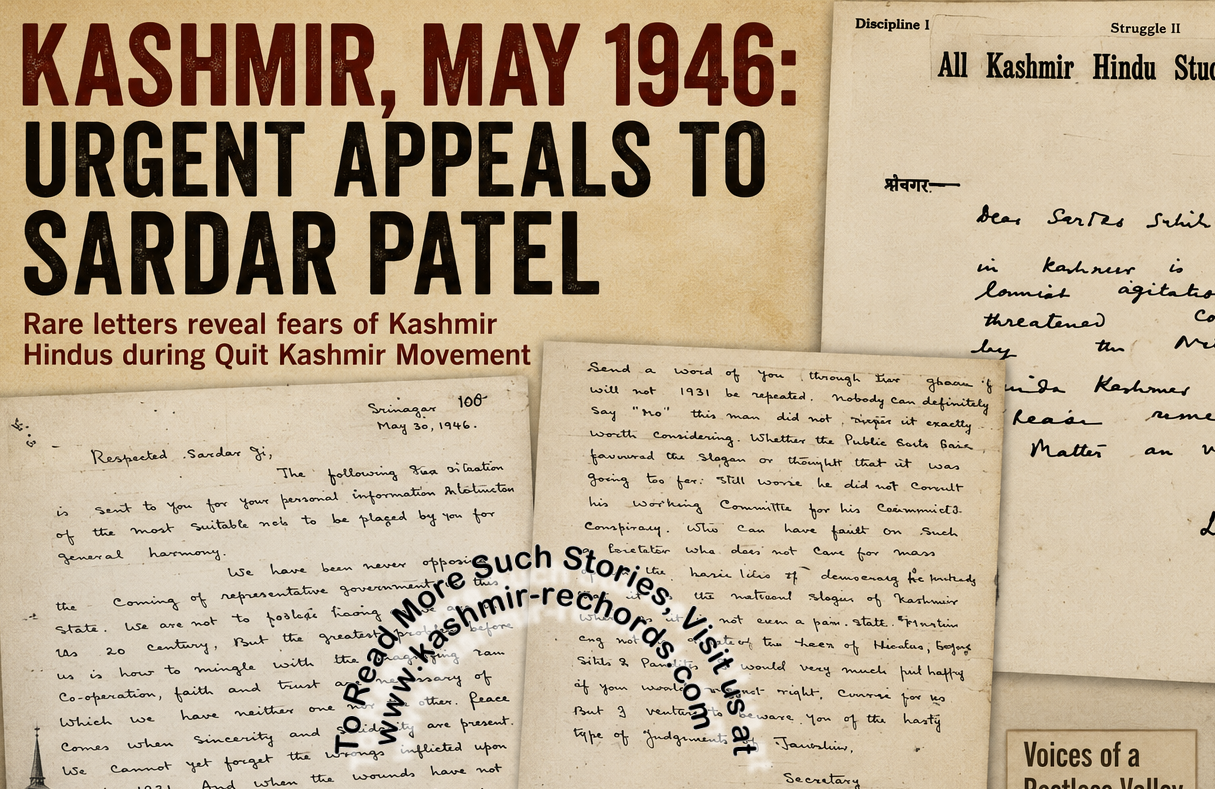
Two rare handwritten letters preserved in the National Archives of India have brought to light a largely forgotten chapter in the political history of pre-Independence Kashmir. Written on 29 and 30 May 1946, at the height of Sheikh Mohammad Abdullah’s Quit Kashmir Movement, the letters reveal the growing apprehensions of sections of the Kashmiri Hindu community and their desperate appeals to Sardar Vallabhbhai Patel for guidance and intervention.
Penned just a day apart by two separate organisations in Srinagar, the documents demonstrate that concern over the political developments in Kashmir was not confined to a handful of individuals but was shared by organised sections of Kashmiri Hindu society. One appeal came from the All Kashmir Hindu Students Federation Sharika Bhawan, Shital Nath Srinagar, while the other was submitted by the Hindu Youths Association, Purshyar, Srinagar.
Together, these documents, assessed by Kashmir Rechords, offer an invaluable primary source for understanding how sections of the minority community viewed the rapidly unfolding events in Kashmir months before India’s Independence and Partition.
Urgent Appeal from Kashmiri Students
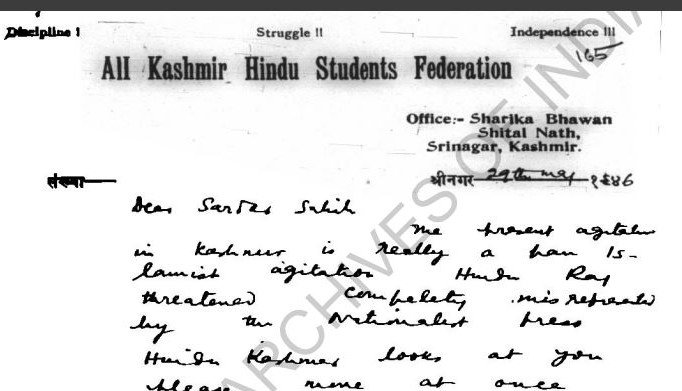
The first letter, dated 29 May 1946, was written on the official letterhead of the All Kashmir Hindu Students Federation, functioning from Sharika Bhawan, Shital Nath, Srinagar. Bearing the motto “Discipline – Struggle – Independence,” the letter was signed by Lachmi Narayan Dhar, President of the Federation.
Please come at once. Matter is very serious” — All Kashmir Hindu Students Federation, May 29, 1946
Addressed to Sardar Vallabhbhai Patel, as “ Dear Sardar Saheb’’, the brief communication paints a grim picture of the prevailing atmosphere in Kashmir.
The student leader describes the agitation in Kashmir as having assumed alarming proportions and alleges that the situation was being misrepresented by sections of the nationalist press. He warns that the Hindu community had come under threat and implores Patel to intervene personally.
The concluding sentence captures the urgency of the moment:-‘Please come at once. Matter is very serious‘
The appeal reflects the confidence that young Kashmiri Hindus placed in Patel’s leadership during one of the most volatile periods in the State’s political history.
‘We Are Not Foolish’
The very next day, on 30 May 1946, another communication reached Patel.
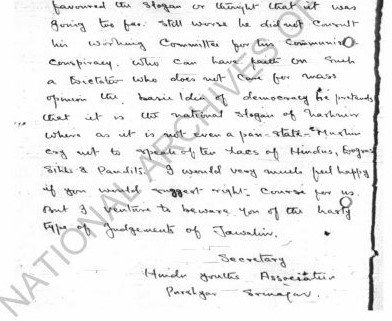
This far more detailed memorandum was submitted by the Secretary, Hindu Youths Association, Purshyar, Srinagar.
Unlike the students’ appeal, the memorandum attempts to explain the political thinking of the Kashmiri Hindu community. It emphatically states that the community was not opposed to representative government.
In one of its most striking observations, the writers declare that they were “not foolish” and were living in the twentieth century, fully aware of democratic ideals and political progress. Their concern, they explain, was not democracy itself but the absence of safeguards for a vulnerable minority in a communally sensitive environment.
The memorandum, therefore, asks Patel to suggest the “right course of action” for Kashmiri Hindus and other minorities at a time when the State’s political future appeared increasingly uncertain.
The Shadow of 1931
A recurring theme in the memorandum is the memory of the communal disturbances of 1931.
The writers remind Patel that the minority community had suffered during those events and assert that the wounds had not yet healed. They argue that those experiences could not simply be ignored while discussing constitutional reforms or representative government.
For the authors, the events of 1931 remained a living political reality rather than a closed chapter of history.
This reference is particularly significant because it demonstrates how deeply those events continued to influence the political outlook of Kashmiri Hindus fifteen years later.
Strong Reservations About Sheikh Abdullah
The memorandum also contains unusually candid remarks about Sheikh Mohammad Abdullah, then leading the Quit Kashmir Movement against Maharaja Hari Singh’s government.
The writers describe Abdullah as a “colour changing man,” expressing distrust of what they perceived as his shifting political positions. They warn Patel that slogans of revolution and popular mobilisation should not obscure the legitimate concerns of minorities.
Whether historians agree with these assessments or not, the document provides a rare insight into how sections of Kashmiri Hindus perceived Sheikh Abdullah at a crucial moment in Kashmir’s political evolution.
A Reference to Jawaharlal Nehru
Equally noteworthy is May 30, 1946 memorandum’s reference to Jawaharlal Nehru.
The writers caution Patel about what they describe as the “hasty type of judgments of Jawahar.”
Although the memorandum does not elaborate, the remark appears to reflect the differing perceptions within sections of Kashmiri Hindu society regarding Nehru’s support for Sheikh Abdullah during the Quit Kashmir agitation.
Why Patel?
Both organisations chose to write not to the British authorities or the Maharaja’s administration but directly to Sardar Vallabhbhai Patel.
This choice itself is revealing.
It suggests that these organisations regarded Patel as a leader capable of understanding their anxieties and offering impartial advice during a period of political uncertainty. This also mean that the student leaders’ might have also been in touch with Sardar Patel earlier also.Their appeals were not merely complaints; they were requests for guidance from a national leader in whom they reposed considerable trust.
The Silence of History
Perhaps the most intriguing aspect of these documents is what they do not reveal.
The archival material presently available in the National Archives of India does not indicate what action, if any, Sardar Patel took after receiving these appeals. Nor does it reveal whether he visited Kashmir in response to the repeated requests or communicated his views to the organisations concerned.
Windows into a Forgotten Moment
These letters are neither retrospective memoirs nor political commentaries written years after the event. They are contemporary communications, written in real time by individuals living through one of the most consequential periods in Kashmir’s modern history.
Their significance lies not in establishing the correctness of any political position but in presenting the contemporary perceptions, fears and aspirations of a section of Kashmiri society at a pivotal historical moment.
As primary sources, they enrich our understanding of the political climate surrounding the Quit Kashmir Movement and remind us that the debate over Kashmir’s future involved multiple voices, many of which have remained unheard in mainstream historical narratives.
Nearly eight decades later, these fragile handwritten appeals continue to speak across time—not because they settle historical debates, but because they illuminate the concerns of those who feared that their voices might otherwise be lost to history.
Editor’s Note
The documents reproduced in this article are preserved in the National Archives of India. The views expressed in these letters are those of their authors and are presented here as historical primary source material. Kashmir Rechords reproduces archival documents to facilitate research and encourage a fuller understanding of Jammu and Kashmir’s complex historical record.