
(Kashmir Rechords Exclusive Report)
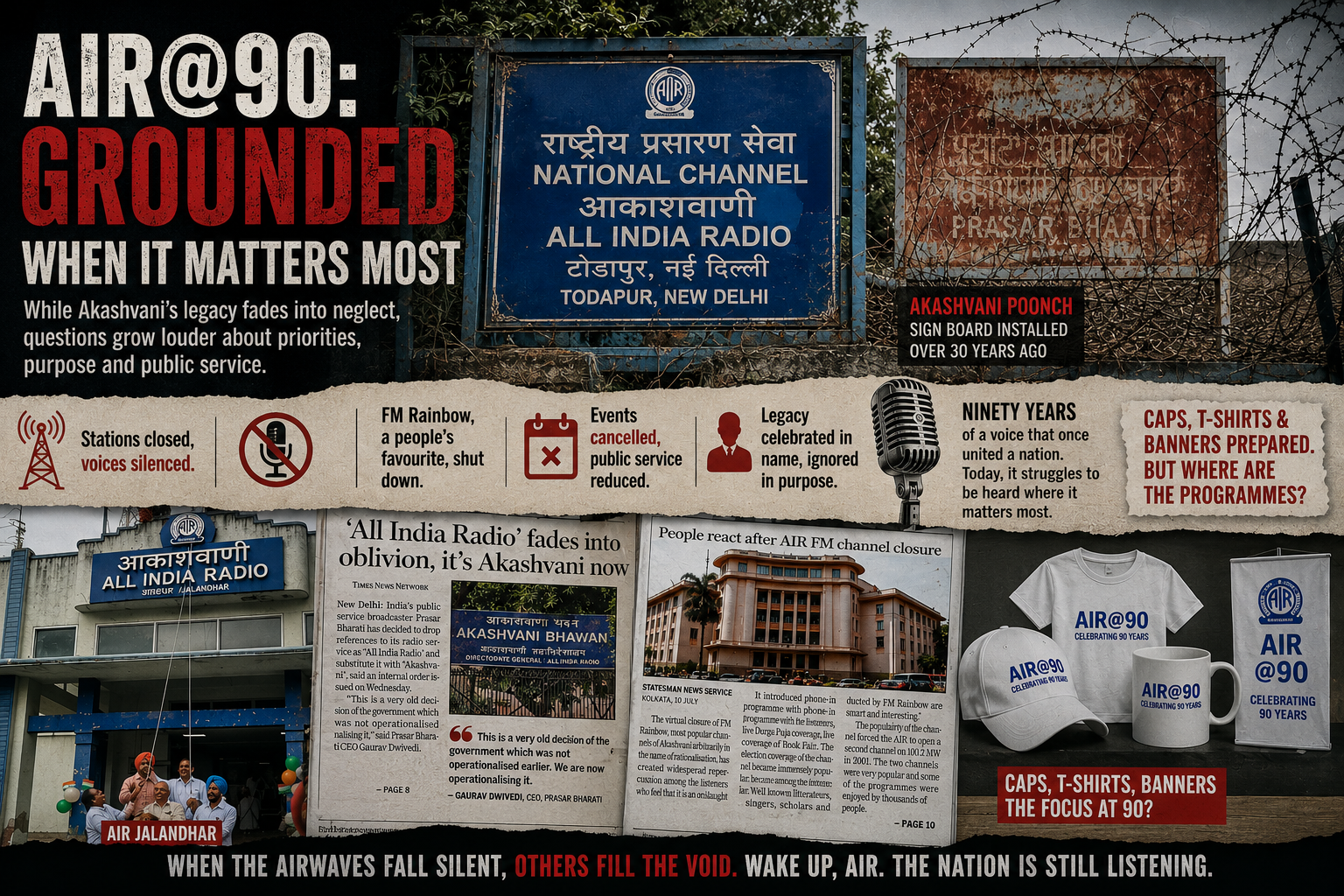
As All India Radio marks ninety years of its journey, the occasion ought to have been one of celebration, reflection and renewed commitment to national service. For decades, AIR was not merely a broadcaster; it was the voice of India’s conscience, culture and sovereignty. From war bulletins during 1965 and 1971 to educational programming, patriotic music and grassroots outreach, AIR once served as a strategic bridge between the Indian State and its people, especially in sensitive border regions.
Yet, at a time when Information Warfare has become one of the most potent tools in modern conflict, a disturbing reality stares the Nation in the face: India’s own public broadcaster appears to have systematically weakened itself in the very regions where its presence was most crucial.
The tragedy is not merely administrative decline. It is the collapse of strategic vision.
The Vacuum Along the Borders
Over the past several years, major relay centres and transmission units of AIR in border areas have either been shut down, weakened or rendered ineffective. Many stations that once served remote and strategically sensitive populations in Jammu and Kashmir, Punjab, North-East or Western border gradually lost manpower, local programming capacity and institutional importance.
This retreat has occurred precisely when hostile propaganda machinery across the border has intensified.
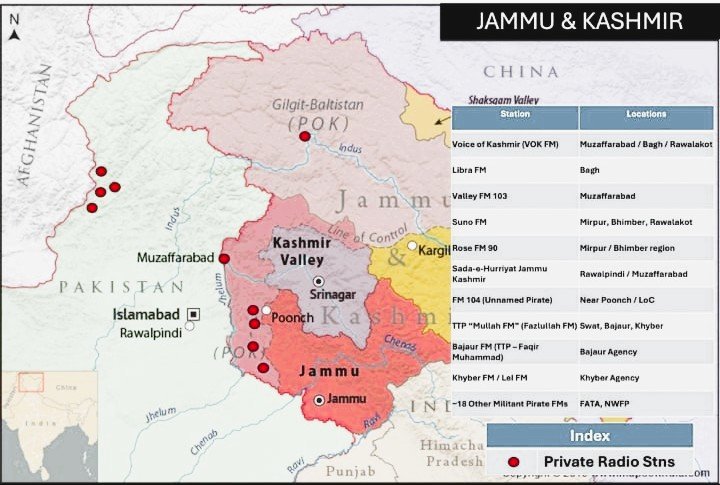
Pakistan, understanding the continuing relevance of radio in mountainous and border terrains, has aggressively expanded its broadcasting footprint in areas, particularly facing Jammu and Kashmir. Reports and monitoring by listeners in frontier belts indicate that more than twenty FM and medium-wave stations are actively functioning across the border, relentlessly transmitting anti-India narratives, communal rhetoric, psychological warfare content and political propaganda directed at Indian listeners.
These broadcasts frequently target India’s democratic institutions, security forces, and leadership, including Prime Minister Narendra Modi. The intent is unmistakable: influence minds, create alienation and sustain psychological pressure in sensitive regions. On the other hand, India has just two radio Stations at Poonch and Kathua, with no Programme Staff to counter enemy propaganda!
The alarming question is: where is India’s counter-voice?
Silence from the Indian Side
There was a time when AIR’s border stations acted as a cultural and psychological shield. Through local languages, regional music, development-oriented discussions, patriotic programming and credible news bulletins, AIR countered misinformation organically and effectively.
Today, many of these stations function without even permanent content staff. In all border areas, skeletal staffing patterns have reduced stations to mere transmission units rather than vibrant public communication centres. Ironically, there is either a single or not a single Content Creator posted in Stations falling in border areas of Jammu and Kashmir, Punjab, Rajasthan and India’s North-East.
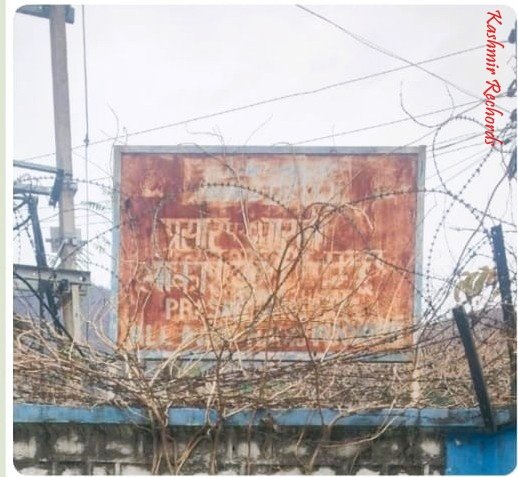
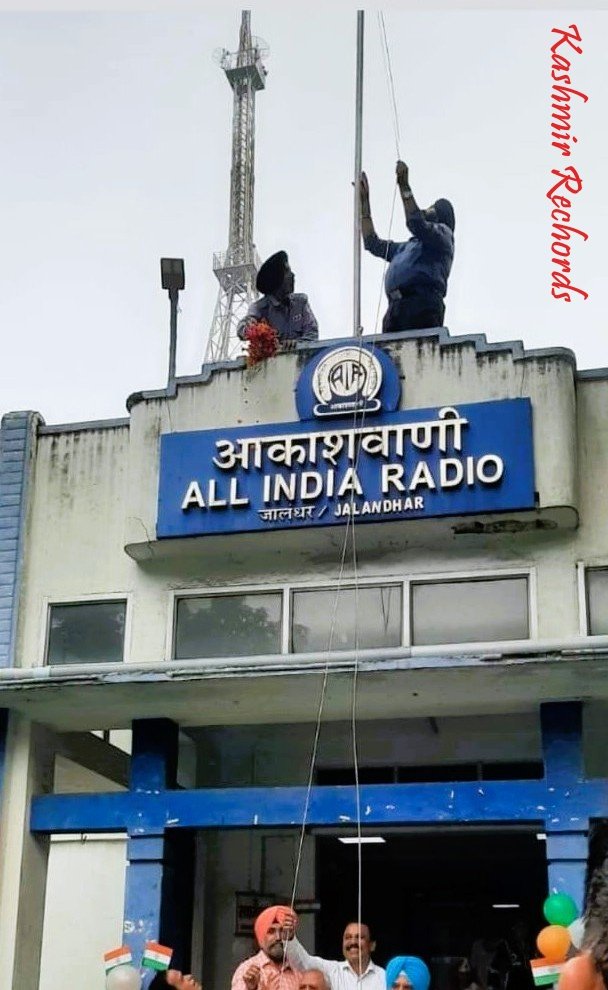
This institutional hollowing-out has created a dangerous vacuum.
``In strategic communication, silence is never neutral. When one side withdraws, the other side occupies the space”.
The result is visible in border belts where foreign broadcasts are often received more clearly and more consistently than Indian public broadcasting. This is not merely a broadcasting failure; it is a national security concern.
AIR@90: Caps, Banners, T-Shirts Instead of Content!
Ironically, at a time when the institution should have been introspecting over its shrinking reach and declining strategic relevance, the focus appears to have shifted towards optics and ceremonial branding.
Instead of debating how to restore transmission strength in border regions, revive local programming, recruit permanent programme staff, or counter hostile propaganda, enormous energy is visibly being spent on anniversary symbolism — caps, T-shirts, banners, logos, slogans, stage-managed events and publicity exercises under the AIR@90 banner.
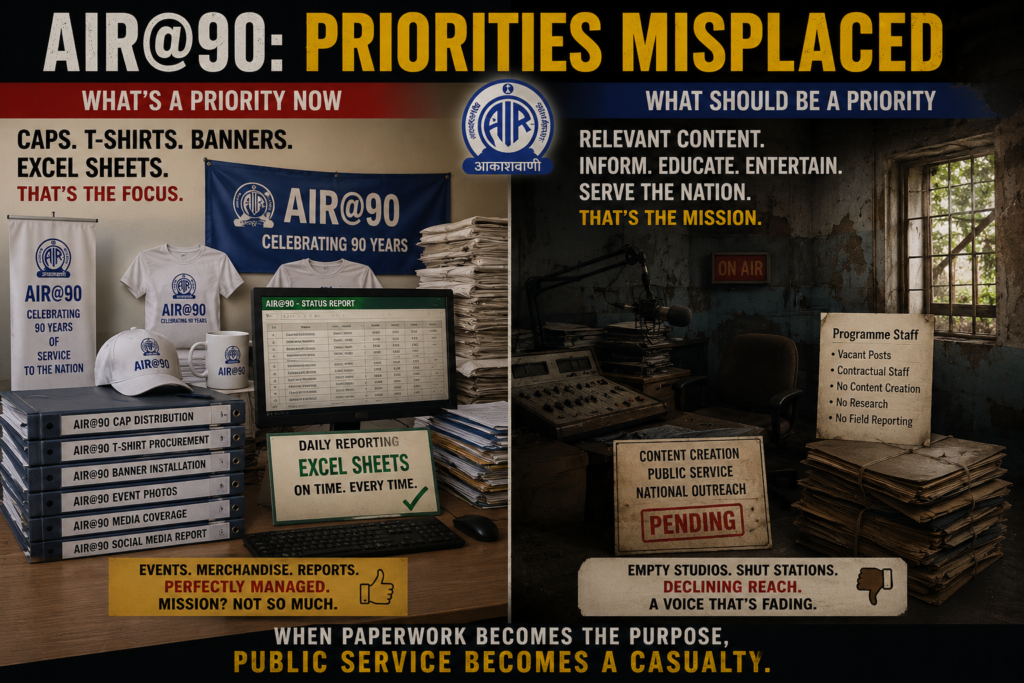
The contradiction is glaring.
A broadcaster facing perhaps the gravest credibility and relevance crisis in its history appears more occupied with merchandise than mission.
The tragedy is not that AIR is celebrating ninety years; it deserves to. The tragedy is that the celebrations appear disconnected from the existential challenges confronting public broadcasting in India.
For listeners in border belts who can hear hostile broadcasts more clearly than India’s own national voice, commemorative banners offer little reassurance.
For understaffed stations struggling without content creators, producers, or field correspondents, anniversary caps cannot substitute institutional revival.
And for citizens concerned about narrative warfare against India, symbolic branding exercises without strategic broadcasting reforms appear painfully hollow.
The Closure of the National Channel
Among the most controversial decisions was the shutting down of AIR’s iconic National Channel — once a powerful nighttime service that connected distant parts of India through news, culture, music and national integration programming.
The National Channel had immense strategic value. Its long-range transmission reached border populations, remote villages, truck drivers, soldiers and listeners in areas where private FM networks had little or no presence. It carried the emotional and cultural pulse of India into regions vulnerable to external propaganda.
Its closure raised serious questions among broadcasting veterans and observers.
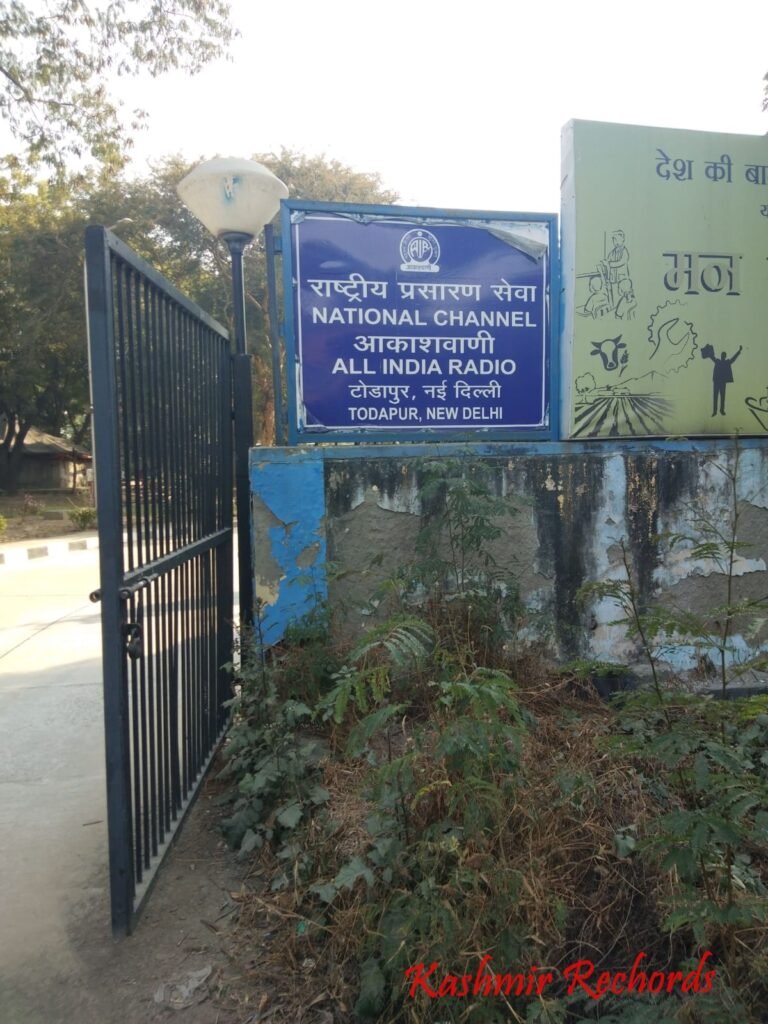
At a time when adversarial nations are investing heavily in narrative warfare, dismantling one of India’s strongest audio platforms appeared not merely shortsighted but deeply self-defeating. Critics argue that the decision reflected a dangerous disconnect between bureaucratic management and geopolitical realities.
Many former AIR professionals believe the National Channel could have been modernized, digitized and strategically repurposed instead of being discontinued.
Public Broadcasting Reduced to Corporate Logic
The deeper problem lies in the transformation of public broadcasting philosophy itself.
AIR was never meant to function solely through commercial metrics or urban entertainment standards. Its mandate was national service. Border broadcasting, rural outreach, linguistic diversity and strategic communication were not profit-making exercises; they were investments in national cohesion.
However, under increasingly centralized and corporatized management structures within Prasar Bharati, decisions often appeared driven by cost-cutting calculations rather than long-term strategic necessity.
Transmission infrastructure was viewed as expenditure rather than strategic capital.
Experienced staff retired without replacement. Contractualization replaced institutional continuity. Local content creation weakened. Regional expertise diminished. Ground realities were ignored.
The consequences are now unfolding in silence across frontier regions.
Radio Still Matters
One of the greatest misconceptions of modern policymakers is the belief that radio has become irrelevant in the digital age.
Border realities prove otherwise.
In difficult terrains, during bad weather, power disruptions, communication blackouts and emergency situations, radio remains the most resilient and accessible medium. Unlike internet-based platforms, radio crosses mountains, reaches isolated communities and functions during crises.
That is precisely why countries engaged in geopolitical conflicts continue to invest heavily in international and border broadcasting.
Pakistan understands this. China understands this!Even global powers continue to maintain strategic radio infrastructure.
Ironically, India, despite having one of the world’s richest public broadcasting legacies, appears to be retreating from this space.
A Question of Accountability
The decline of AIR’s strategic role cannot simply be dismissed as modernization or restructuring. It raises uncomfortable questions about institutional accountability and policy intent.
Why were strategically important services weakened without adequate alternatives?
Why were border stations allowed to become extremely understaffed?
Why was institutional expertise neglected?
Why was the National Channel discontinued despite its unique reach and relevance?
Why are resources being visibly spent on ceremonial branding while core broadcasting infrastructure continues to erode?
And most importantly, who benefits when India voluntarily surrenders its communication space in sensitive regions?
These questions deserve parliamentary scrutiny, national debate and independent review.
The Need for Revival
AIR at 90 should not merely celebrate its glorious past. It must confront its troubled present. India urgently needs a revival plan for strategic public broadcasting, particularly in border and conflict-sensitive areas.The battle for territory today is also a battle for narratives.
A Nation that loses its voice along the borders risks losing much more than frequencies.
Ninety years of AIR represent a monumental chapter in India’s democratic and cultural journey. But anniversaries become meaningful only when institutions possess the courage for introspection.
The real tribute to AIR’s legacy would not be ceremonial slogans, printed caps, promotional T-shirts or oversized banners. It would be the restoration of its original mission: to serve as the authentic voice of India — especially where that voice is needed the most.
For when India’s own airwaves fall silent along the borders, hostile voices do not wait. They take over!.