
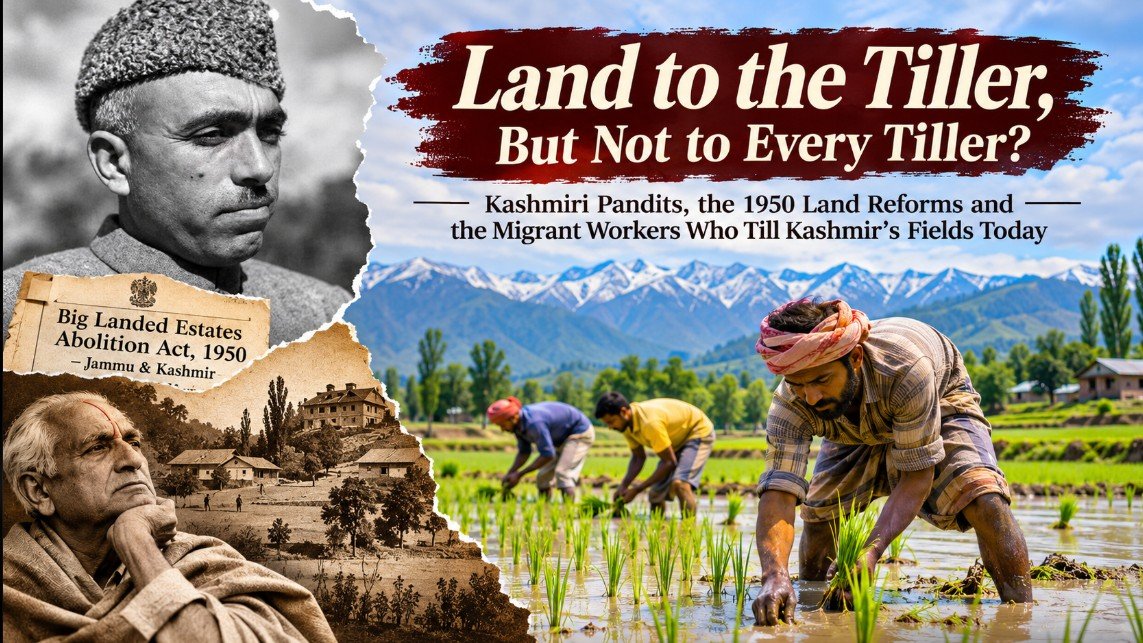
(Kashmir Rechords Exclusive)
Kashmir’s political history is marked by slogans that transformed the course of its society. Few were as consequential as “Land to the Tiller”, the rallying cry that accompanied Sheikh Mohammad Abdullah’s agrarian revolution in the early 1950s.
The slogan promised liberation to cultivators who had worked the land for without owning it. It dismantled an entrenched landlord system and fundamentally altered the Valley’s rural economy.
Yet, more than seven decades later, the slogan invites a question that deserves serious historical and political examination.
If the principle was that the person who cultivated the land should own it, why did agricultural land pass into the ownership of eligible tillers in the 1950s, while hundreds of migrant agricultural workers from Bihar, Jharkhand and Chhattisgarh, who have been cultivating Kashmir’s fields for years, particularly after 1990, continue to work as labourers without acquiring ownership?
The comparison is not a claim that the legal circumstances of the two periods are identical. It is a question about the principle behind a historic political slogan, the selective application of its moral logic and the changing meaning of landownership in Kashmir.
For Kashmiri Pandits, the question also opens a larger debate about their historical landholding, the consequences of agrarian redistribution and the community’s continuing relationship with its ancestral homeland.
Before the revolution: Who owned Kashmir’s land?
Before the 1950 reforms, Kashmir’s agricultural economy was characterised by unequal landownership and tenancy.
A substantial section of the peasantry cultivated land belonging to proprietors and intermediaries. Agrarian grievances had become an important component of political mobilisation during the final decades of Dogra rule.
The National Conference’s Naya Kashmir manifesto of pre-Independent India envisaged a fundamental restructuring of the agrarian system.
Following the political developments of 1947, this promise became government policy.
One historical claim frequently cited in discussions of pre-reform Kashmir is that Kashmiri Pandits owned approximately 30 per cent of the agricultural land in the Valley.
The claim has appeared in historical accounts, including those associated with Prem Nath Bazaz, and in subsequent secondary literature.
However, a community-wise official landownership census conclusively establishing this figure has not yet been identified.
The estimate must, therefore, be treated cautiously.
It is necessary to distinguish the landholdings of prominent Pandit proprietors from the ownership pattern of the community as a whole. Kashmiri Pandits were not a uniformly wealthy landowning community; they included government employees, artisans, traders, cultivators and economically modest households.
The historical question is not whether some Pandit proprietors owned substantial agricultural holdings. It is how much land they owned collectively, how much was affected by the reforms and what the redistribution meant for individual families.
These questions remain open to archival investigation.
1950: When the tiller became the owner
The Big Landed Estates Abolition Act of 1950 marked a turning point in Kashmir’s history.
The legislation imposed a ceiling of 22.75 acres and provided for the transfer of surplus agricultural land to eligible tillers, subject to the statutory provisions.
The reform was radical by the standards of its time. It weakened landlordism, redistributed ownership and transformed the economic position of cultivators.
The government’s stated objective was to eliminate intermediaries between the tiller and the State and to transfer land to those who actually cultivated it.
The consequences were profound.
For a cultivator who had spent years working another person’s land, ownership represented economic independence, dignity and a new social position.
But for the proprietor whose land was transferred, it meant the extinguishment of ownership rights in the land covered by the legislation.
Kashmiri Pandit proprietors were among those affected. So were proprietors belonging to other communities.
The law was not formally a religious redistribution programme. Its stated basis was agrarian ownership and cultivation.
Nevertheless, the community-wise consequences deserve examination, particularly because the historical claim of substantial Pandit landownership continues to circulate.
The important point is that land was transferred to eligible tillers under a law that sought to restructure ownership.
The question of whether the redistribution affected different communities disproportionately remains a matter for detailed research.
Migrant workers in Kashmir’s fields: A different kind of tiller?
Walk through Kashmir’s agricultural countryside during the sowing or harvesting season and one encounters workers from Bihar, Jharkhand, Chhattisgarh and other parts of India.
They transplant paddy, harvest crops, undertake seasonal agricultural labour and perform work that is essential to the Valley’s farming economy.
Some return season after season. Others have spent considerable periods working in Kashmir, more so after 1990.
They cultivate land, but they do not ordinarily acquire ownership of the fields they work on.
If the historical justification for redistribution was that cultivators deserved ownership because they worked the land, should the underlying principle be understood as universal?
Their relationship with the land is generally that of wage labourers or seasonal agricultural workers, rather than legally recognised proprietors or statutory tillers.
And this is where the historical comparison becomes uncomfortable.
In the 1950s, the political leadership of Jammu Kashmir argued that the person cultivating the land should not remain subordinate to the landlord.
Today, agricultural workers from outside Kashmir perform similar physical labour, often under difficult conditions, but their work does not ordinarily translate into ownership.
The apparent contradiction is striking.
The historical slogan celebrated the transfer of land to the cultivator. The contemporary agricultural economy relies on cultivators and agricultural workers who do not acquire the land they cultivate.
This raises a question that goes beyond the legal technicalities of landownership.
Was “Land to the Tiller” fundamentally a principle of economic justice, or was it a historically specific redistribution intended to benefit a particular class of cultivators within Kashmir’s then-existing legal and political framework?
The answer matters.
Why did historical tiller receive land, but not the migrant workers ?
There is an important legal distinction that cannot be ignored.
The 1950 legislation did not grant ownership to every person who happened to work on agricultural land.
It operated through defined categories of proprietors, eligible tillers, possession and statutory conditions. The legislation also contained restrictions concerning transfers to non-State Subjects.
The subsequent Jammu and Kashmir Agrarian Reforms Act, 1976, introduced another framework for land transfers and agrarian restructuring.
The 1950 Act was repealed in 2020, while the government stated that the 1976 Agrarian Reforms Act continued to provide for transfer of land to tillers.
Thus, migrant agricultural workers today cannot simply claim ownership because they have worked on a field for years.
Their status as wage labourers is legally different from that of a recognised tiller under the historical agrarian reform legislation.
But this legal distinction does not make the larger question irrelevant.
If the historical justification for redistribution was that cultivators deserved ownership because they worked the land, should the underlying principle be understood as universal?
Or was it intended to operate only within the framework of the landholding system, citizenship and political circumstances of the time?
The historical slogan was sweeping. The legal mechanism was not.
That distinction deserves greater scrutiny.
The uncomfortable question of consistency
The comparison between Kashmiri Pandit proprietors in 1950 and migrant agricultural labourers today should not be reduced to an accusation against one community.
Nor should it suggest that the historical agrarian reform was illegitimate.
The reform addressed a genuine injustice faced by cultivators who had little control over their livelihoods.
But the comparison exposes a broader contradiction in the way land and labour are discussed in Kashmir.
When land was transferred from proprietors to tillers, the reform was celebrated as a triumph of social justice.
Today, migrant workers from rest of India contribute to agricultural production but remain wage earners without ownership rights.
The question is not whether these workers should automatically receive land under a repealed law.
The question is whether the moral principle of the historical reform has been selectively remembered.
If the principle was economic justice for those who cultivate the soil, then the present agricultural workforce deserves recognition, dignity, fair wages, legal protection and humane working conditions.
If the principle was specifically about ending landlordism within the historical agrarian structure of Kashmir, then it should be described honestly as such.
The two interpretations are not identical.
The distinction between them is precisely what makes this debate worth having.
The Kashmiri Pandit question: Land, ownership,historical memory
For Kashmiri Pandits, the land debate has acquired an additional dimension since the displacement of 1989–90.
The community’s historical relationship with Kashmir’s land cannot be reduced to agricultural ownership alone.
It encompasses ancestral homes, orchards, residential property, temples, neighbourhoods, village connections and family histories.
The land reforms of 1950 and the displacement of 1990 were separate historical events. The former was a state-led agrarian redistribution; the latter was a mass displacement associated with militancy, targeted killings, threats and the breakdown of security.
They must not be conflated.
Yet, for families whose connection with ancestral property was subsequently disrupted, the earlier land reforms remain part of a longer history of changing economic circumstances.
The restoration of abandoned or damaged property is a different legal and moral question from reversing the agrarian reforms.
The rights of displaced families must be examined through property records, inheritance, occupation, compensation and applicable law.
Historical ownership claims deserve documentary scrutiny, not political dismissal.
The changing politics of land
The repeal of the Big Landed Estates Abolition Act in 2020 reopened the debate over Kashmir’s land laws.
The government maintained that the 1976 Agrarian Reforms Act continued to provide for transfer of land to tillers.
At the same time, the removal of several earlier land protections generated political debate about landownership, local rights and the possibility of land transfers to non-residents.
This produced a striking historical contrast.
The political system that once celebrated the redistribution of land from proprietors to cultivators now operates within a different legal and economic framework.
Meanwhile, migrant workers who contribute to Kashmir’s agricultural economy remain primarily labourers.
The issue is not simply whether land should be transferred to them.
It is whether the history of land reform is being invoked consistently, or selectively, depending on the political context.
What the archives must establish
Kashmir Rechords believes that this debate requires a documentary investigation rather than an ideological verdict.
The following questions deserve answers:
- How much agricultural land did Kashmiri Pandits own before 1950?
- How much land was transferred from Pandit proprietors under the Big Landed Estates Abolition Act?
- How much land was transferred from Muslim, Dogra and other proprietors?
- What proportion of the land was transferred to eligible tillers?
- How did the 1976 Agrarian Reforms Act further change landownership?
- What is the present legal status of agricultural workers from Bihar, Jharkhand and Chhattisgarh who cultivate land in Kashmir?
- What protections do these workers enjoy concerning wages, tenancy, housing and occupational security?
- How are ancestral agricultural properties belonging to displaced Kashmiri Pandits recorded and protected today?
These are not merely academic questions.
They concern land, labour, citizenship, historical memory and the meaning of social justice.
If the tiller was once considered deserving of ownership because he cultivated the land, what does that principle mean today, when the agricultural workforce includes thousands of people who cultivate Kashmir’s soil but remain outsiders to its ownership?
And if the historical land reforms are celebrated as a model of justice, should their underlying principles be examined consistently, rather than selectively?