
(An Exclusive Kashmir Rechords’ Archival Investigation)
Based on rare newspaper archives, Parliamentary records and contemporaneous reports.
History has an extraordinary way of resurfacing.Sometimes it emerges from forgotten government files. Sometimes from fading photographs. And sometimes, from yellowing newspaper pages that continue to ask uncomfortable questions long after the headlines have disappeared.
One such forgotten chapter lies buried in the archives of 1984, when Jammu & Kashmir witnessed one of the most sensational political controversies of its time—a controversy centred on the alleged links between the then Chief Minister Dr. Farooq Abdullah and leaders of the Kashmir Liberation Front (KLF), the organisation that later came to be widely known as the Jammu & Kashmir Liberation Front (JKLF) and was eventually banned in India under the Unlawful Activities (Prevention) Act.
What transformed those allegations into a national political storm was not an intelligence report, nor a judicial inquiry.It was the persistence of a newspaper.
For nearly five months, Kashmir Times, the then most read and trusted newspaper, pursued the story with uncommon determination. Beginning with a categorical denial by Dr. Farooq Abdullah that he had ever met Amanullah Khan, one of the principal leaders of the ‘Kashmir Liberation Front’, the newspaper responded with a succession of reports, rare photographs, published captions, and documentary references that it said contradicted the Chief Minister’s public stand.
Every denial was followed by another publication. Every explanation invited another question. Every photograph intensified the controversy.
Within weeks, what had begun as a newspaper investigation had travelled beyond the editorial pages of Jammu to the floor of the Indian Parliament, where members sought answers from the Union Government regarding the reports then circulating in the public domain.
More than four decades later, many of those very newspaper pages and photographs continue to survive in archives, private collections and research repositories.
For the first time, Kashmir Rechords reconstructs this extraordinary episode through the original reports that shaped one of the defining political controversies of 1984.
The Denial
The controversy began with an unequivocal public denial.
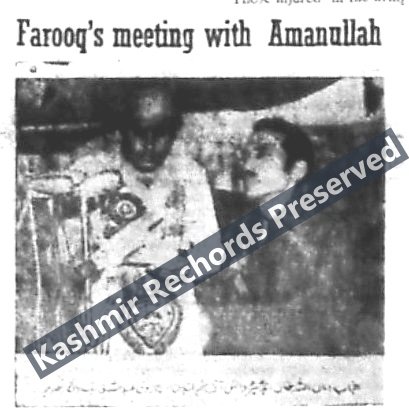
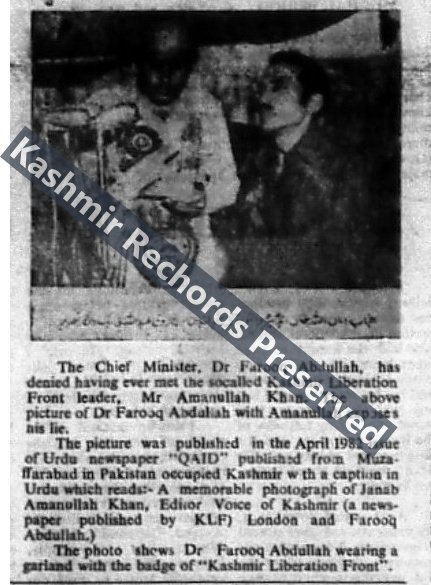
According to contemporaneous newspaper reports, Chief Minister Dr. Farooq Abdullah denied having ever met Amanullah Khan, described in the reports as the leader of the ‘Kashmir Liberation Front’.
Ordinarily, such a denial might have ended the matter.Instead, it became the beginning of one of the most remarkable investigative campaigns undertaken by a regional newspaper.
Rather than accepting the denial at face value, Kashmir Times turned to documentary material which it said had already appeared in newspapers published from Pakistan-occupied Kashmir.
The Photograph That Changed the Story
The newspaper’s first major report reproduced a photograph which, according to Kashmir Times, had originally appeared in the April 1982 issue of the Urdu newspaper Qaid, reportedly published from Muzaffarabad, Pakistan Occupied Kashmir.The accompanying report stated that the Urdu caption identified the image as “a memorable photograph” of Amanullah Khan, described as Editor of Voice of Kashmir.
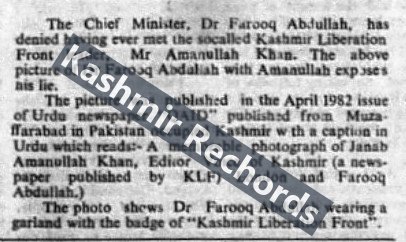
More significantly, the report asserted that the photograph showed Dr. Farooq Abdullah wearing a garland carrying the badge of the Kashmir Liberation Front.The newspaper argued that the photograph directly challenged the Chief Minister’s denial that he had ever met Amanullah Khan. For Kashmir Times, the story had only begun.
One Photograph Became Many
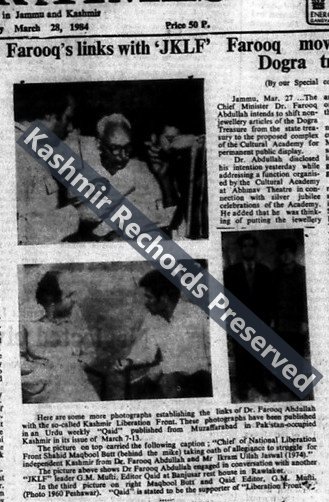
Far from retreating after publishing the first image, Kashmir Times continued its investigation. In subsequent editions, the newspaper reproduced additional photographs which it claimed had also appeared in publications from Pakistan-occupied Kashmir.
One report claimed that the photographs established what it described as Dr. Farooq Abdullah’s links with the ‘Kashmir Liberation Front’. The accompanying caption made even more serious assertions.
According to the report, one of the photographs showed Dr. Abdullah taking an oath of allegiance to the “struggle for independence of Kashmir” before leaders of the Kashmir Liberation Front during a visit to Pakistan-occupied Kashmir.
The report identified those present as including Amanullah Khan and G.M. Mir, identified as Editor of Qaid, which the report described as a supporter of the ‘Liberation Front’.
These were extraordinary claims, prominently published by the newspaper and presented as evidence that, according to Kashmir Times, contradicted the Chief Minister’s public denials.
The Controversy Deepens
As the reports multiplied, so did the political controversy.
Kashmir Times published another strongly worded report under the headline “A Lie Has No Legs,” arguing that the Chief Minister’s explanations regarding the photographs and his visit had changed over time.
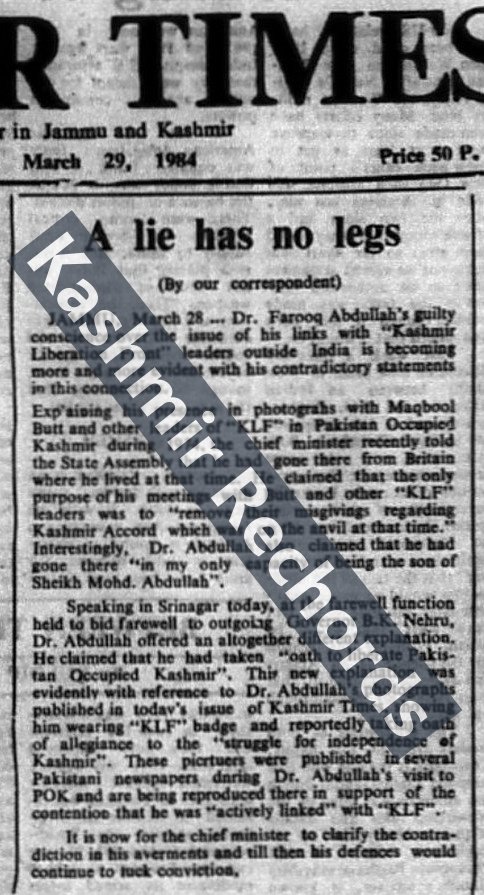
The newspaper juxtaposed those explanations with the documentary material it had reproduced, contending that the contradictions themselves had become a matter of public concern.
The controversy was no longer confined to newspaper columns.It had become a national political issue.
From the Newsroom to Parliament
On 24 February 1984, the alleged Farooq Abdullah–KLF connection reached the Rajya Sabha.
Members questioned the Union Government regarding reports of Dr. Abdullah’s alleged contacts with leaders of the Kashmir Liberation Front during his stay in the United Kingdom.
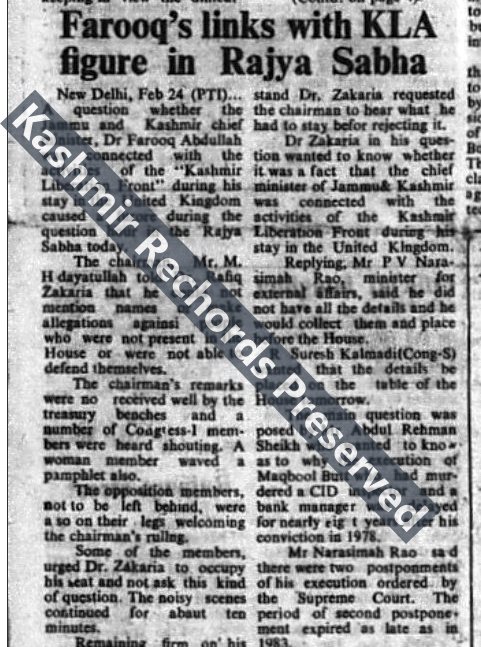
What had begun as a newspaper investigation had now entered the official proceedings of India’s Parliament.The issue was no longer merely political speculation.It had become a matter of national debate.
The Centre Enters the Picture
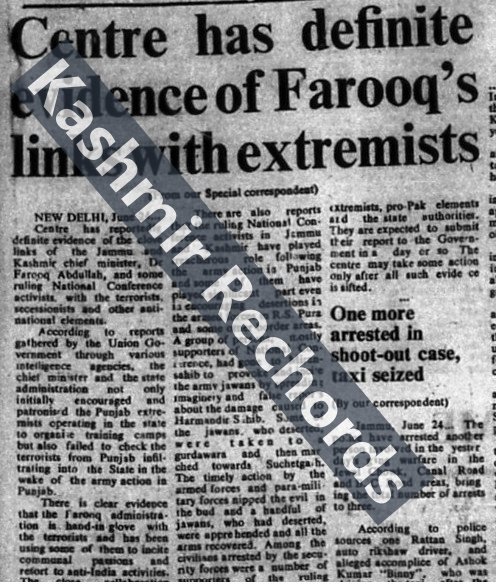
The controversy intensified further in June 1984.Reports quoting Central Government sources claimed that New Delhi possessed “definite evidence” relating to alleged links between Dr. Farooq Abdullah and extremist or pro-Pakistan elements.
Whether those claims were ultimately substantiated remains part of the larger historical debate. What is beyond dispute is that they reflected the rapidly deteriorating relationship between the Centre and the National Conference government in the months preceding the dramatic political developments of July 1984.
A Newspaper That Refused to Retreat
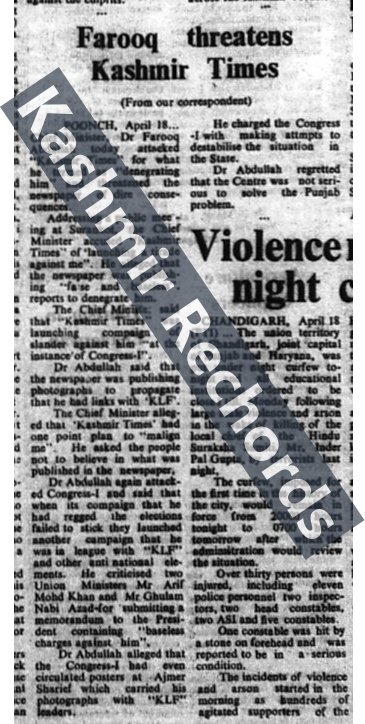
As pressure mounted, Dr. Farooq Abdullah accused Kashmir Times of conducting a campaign against him.The newspaper stood by its reports.
Maintaining that it was reproducing documentary material already available in published sources, it continued to publish further reports, photographs and questions relating to the controversy.
The confrontation became more than a dispute over photographs. It evolved into a defining contest between political authority and investigative journalism.
A Forgotten Chapter Revisited
Forty years later, the controversy has largely disappeared from public memory. The newspaper pages have yellowed. Many of the photographs survive only in fragile archives. Yet they continue to exist. They remain part of the documentary record of one of the most fiercely contested political episodes in the history of Jammu & Kashmir.
Whether one agrees with the conclusions drawn at the time or not, the reports, photographs, Parliamentary proceedings and official responses together form an important archival trail that deserves careful historical examination.
That is precisely what this Kashmir Rechords investigation sets out to do.
The Investigation Continues…
This is only the opening chapter of a comprehensive archival investigation.The complete dossier includes:
- The original Kashmir Times reports published between February and June 1984.
- Rare photographs reproduced during the controversy.
- The complete chronology of the alleged Farooq Abdullah–KLF/JKLF controversy.
- The original Qaid references and published captions.
- The Rajya Sabha proceedings and Parliamentary questions.
- The Centre’s “definite evidence” claim in context.
- The political fallout that culminated in the events of July 1984.
- High-resolution reproductions of rare newspaper pages with detailed historical analysis.
Support History. Preserve Archives
Investigations like these require months of locating forgotten newspapers, preserving fragile archives, verifying sources and reconstructing historical events from original documents.
Kashmir Rechords Foundation is committed to preserving this documentary heritage for future generations.If you value serious archival research—grounded in original sources rather than AI-generated narratives—and wish to support investigations that uncover forgotten histories, please consider making a contribution.Your support helps preserve history that might otherwise be lost forever. Contributors will receive access to the complete archival investigation, including all chapters, rare photographs and high-resolution newspaper reproductions.
If you found this investigation valuable, please consider making a contribution. Every contribution, no matter how small, helps preserve history for future generations. You may use our QR Code for the smallest contribution, you would like to make:

EDITORIAL DISCLAIMER
This investigation is an archival reconstruction based on contemporaneous newspaper reports, published photographs, Parliamentary proceedings and other historical records available in the public domain.
Kashmir Rechords reproduces and analyses these materials solely for historical, journalistic, educational and research purposes.
The reports, captions, photographs, statements and allegations discussed herein are presented as they were reported or published at the relevant time in 1984 and should be understood in their historical context. Their inclusion in this investigation should not be construed as an endorsement, verification or independent confirmation of every allegation or claim contained in those contemporaneous sources.This report seeks to document and preserve an important chapter of Jammu & Kashmir’s political history rather than to pronounce upon legal liability or historical guilt.
Copyright Notice
© Kashmir Rechords Foundation
All original research, compilation, chronology, annotations, editorial analysis, layouts and presentation are the intellectual property of Kashmir Rechords Foundation. Original newspaper pages remain subject to the rights, if any, of their respective publishers and are reproduced, as preserved, only for purposes of historical documentation, research, commentary and public interest in accordance with applicable law.
Unauthorized commercial reproduction of Kashmir Rechords’ original research, annotations, compilations and editorial work is prohibited without prior written permission.