

(Kashmir Rechords Research Desk)
For generations, July 13, 1931 has been commemorated in Kashmir largely through a single narrative—that of those killed outside the Central Jail in Srinagar. Yet, hidden beneath political slogans and official commemorations lies another story, one preserved in contemporary documents, official correspondence and one remarkable book published within months of the disturbances.
That story belongs to the Kashmiri Pandits and other Hindu minorities who became victims of one of the first large-scale communal attacks in twentieth-century Kashmir.
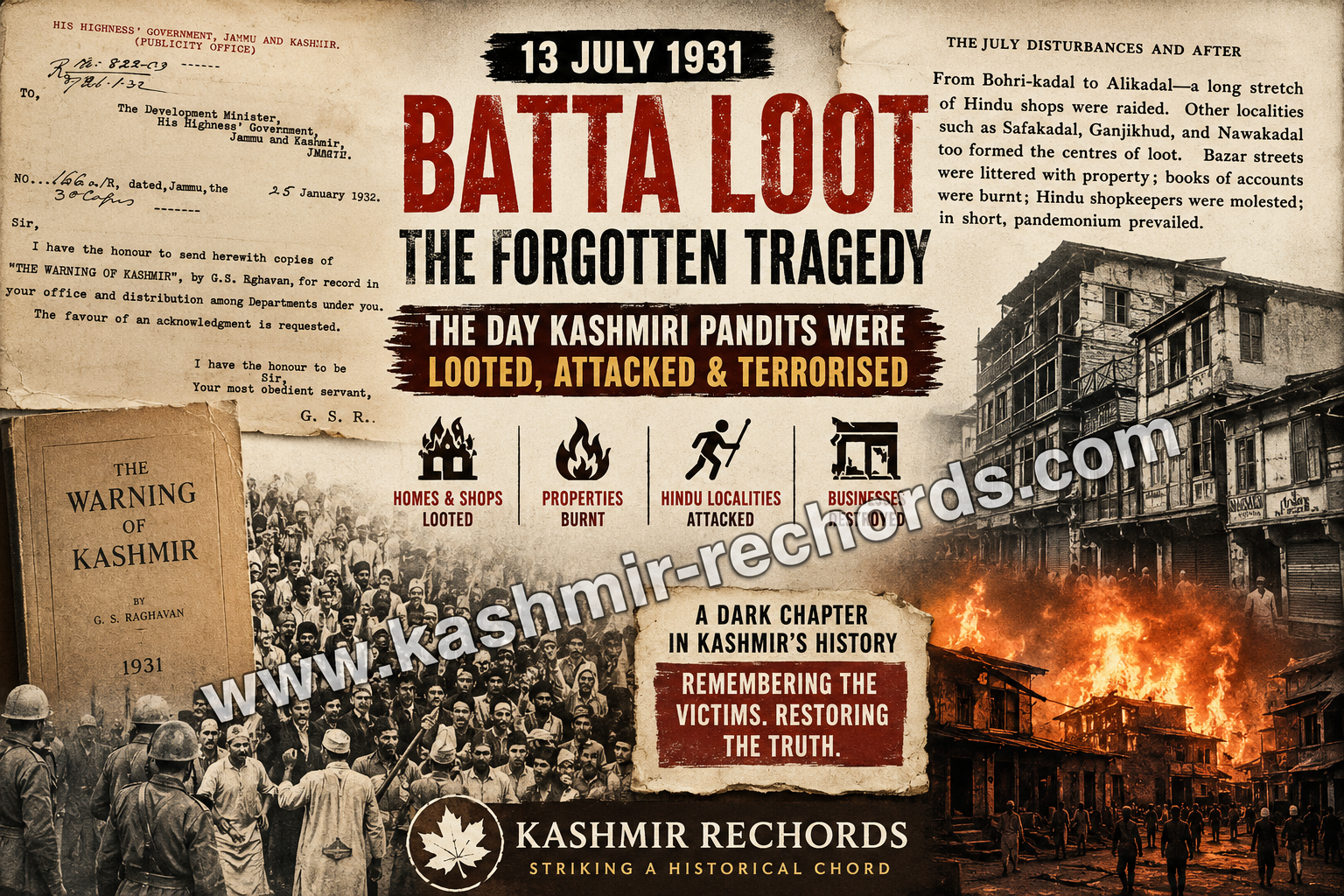
Among Kashmiri Pandits, the day came to be remembered not merely as the day of jail firing, but as ” Batta Loot”—the day when Pandit homes, shops, temples and livelihoods were systematically looted and destroyed.The expression itself is significant.
In Kashmiri, “Batta” means Kashmiri Pandit, while “Loot” literally means plunder. Thus, ‘Batta Loot‘ became the community’s own remembrance of a day marked by violence, fear and dispossession rather than martyrdom.
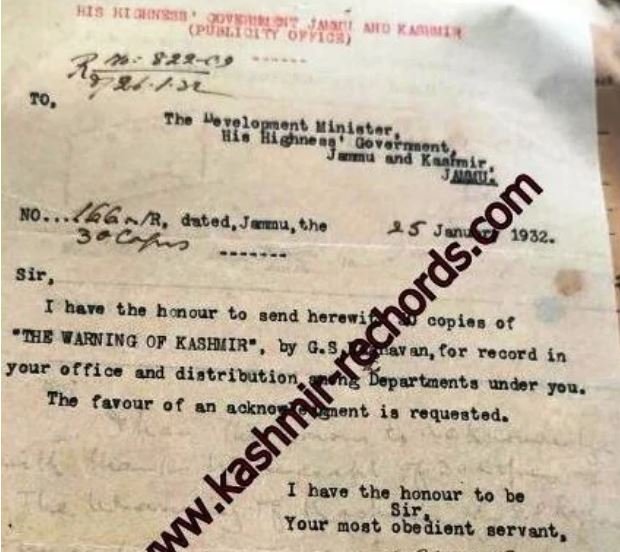
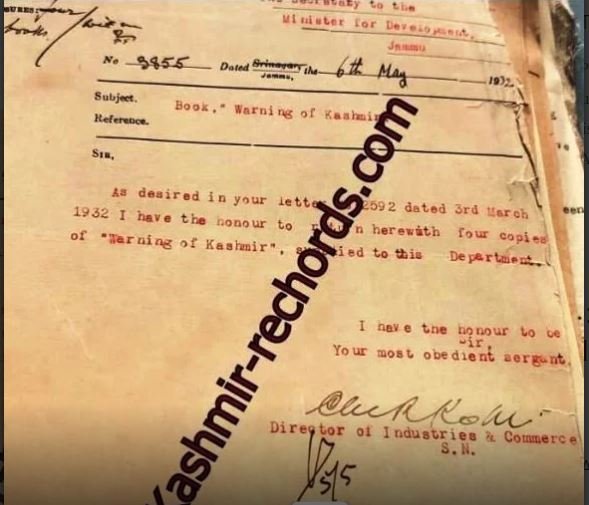
This forgotten chapter finds detailed documentation in G.S. Raghavan’s 1931 book Warning of Kashmir, a work that was not only circulated officially by the Jammu & Kashmir Government but was also distributed among various departments for record and reference. Official correspondence dated January, 25 1932 and May 6,1932, now preserved in archival records, shows that the Government itself considered the publication important enough to circulate among departments.
A Crisis Months in the Making
The disturbances of July 1931 did not emerge overnight.Throughout early 1931, communal tensions had steadily risen. Political grievances increasingly acquired a religious character, and inflammatory speeches began mobilising large crowds.
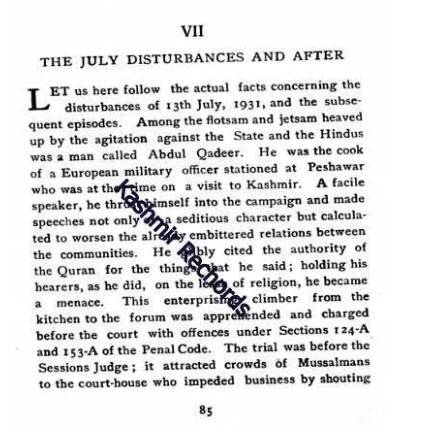
According to Raghavan, one figure assumed unusual prominence during this period—Abdul Qadeer, a cook attached to a European military officer visiting Kashmir from Peshawar.
Rather than being a native political leader of Kashmir, Qadeer became known through speeches which, according to contemporary accounts, openly challenged the authority of the Dogra State and invoked religious sentiment to mobilise crowds.
His arrest under Sections 124-A (sedition) and 153-A (promoting communal hatred) of the Indian Penal Code became the immediate trigger for subsequent events.
July 13, 1931: The Jail Turns into a Flashpoint
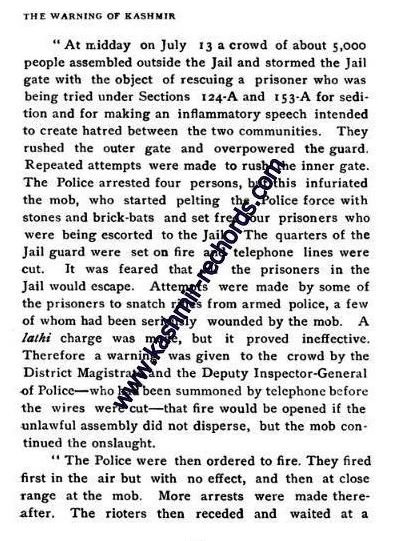
Raghavan in his 1932 edition of the book mentions that on July 13, 1931, thousands assembled outside the Central Jail in Srinagar where Abdul Qadeer’s trial was being held.
According to his Warning of Kashmir, the gathering rapidly transformed into a violent assault. The crowd attempted to force entry into the prison. Police personnel were attacked with stones. Telephone lines were cut. Attempts were made to overpower the jail guards.
Warnings issued by the District Magistrate failed. Only after repeated attempts to disperse the gathering did police resort to firing. The official firing resulted in casualties among the protesters.
For decades, public memory largely stopped at this point.
Kashmir’s Hindu Localities Under Attack
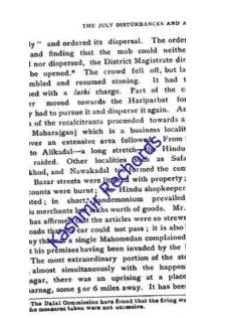
One of the most striking aspects of Warning of Kashmir is its detailed description of what happened after the firing. Instead of dispersing, sections of the crowd moved into Srinagar’s commercial and residential Hindu localities.
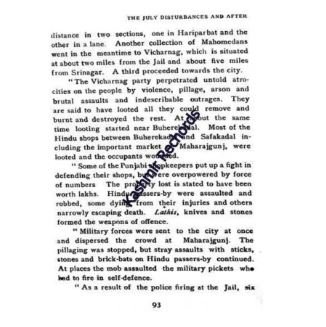
Raghavan records that Maharaj Gunj, one of the Valley’s principal commercial centres dominated by Hindu traders, became a primary target.The violence spread from Bohri Kadal to Alikadal, continuing through Safakadal, Ganpatyar, and Nawakadal.
These were not isolated incidents. According to the contemporary account, the Hindu-owned shops were systematically looted. Books of account were burnt. Merchants were assaulted. Property worth lakhs of rupees was destroyed. Streets remained littered with looted goods and entire commercial establishments were devastated.
The author notes that not a single Muslim property owner reportedly approached the authorities with complaints of being looted, whereas Hindu commercial losses were extensive.This observation forms one of the strongest contemporary indicators that the violence assumed a distinctly communal character.
History need not choose one victim over another… a complete understanding of July 1931 requires acknowledging both the jail firing and the communal violence that followed.
Why Kashmiri Pandits Remember It as ‘Batta Loot’
Within the Pandit community, the events acquired an entirely different name.Batta Loot, the phrase did not emerge from political literature.It emerged from lived memory. Families remembered not speeches outside the jail, but flames engulfing their neighbourhoods.They remembered commercial establishments reduced to ashes.They remembered women and children hiding indoors.They remembered centuries-old businesses disappearing within hours.
For Kashmiri Pandits, July 13 became synonymous with organised plunder. The memory passed orally through generations long before it found renewed attention in archival research only recently.
Vicharnag: A Parallel Tragedy
While much attention centred upon Srinagar city, another horrific episode unfolded in Vicharnag, about six miles away.
According to noted author Raghavan, some organised groups entered the locality and committed widespread atrocities. The houses were looted, property destroyed, buildings burnt and residents were assaulted. Military intervention eventually dispersed the attackers, but only after significant damage had already occurred.
This demonstrates that the disturbances extended well beyond spontaneous rioting and affected multiple Hindu settlements across the Valley.
The economic consequences proved devastating. Unlike ordinary theft, the burning of account books destroyed commercial memory itself—debts, credits and business relationships accumulated over decades vanished overnight.For many traders, rebuilding became nearly impossible.
Political Agitation and External Mobilisation
Raghavan further argues that the disturbances quickly became part of a wider political campaign.
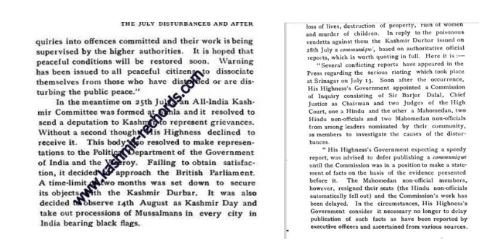
Within days, All India Kashmir Muslim Committee emerged to mobilise opinion across British India .Public meetings were organised. Resolutions were passed. “Kashmir Day” was observed elsewhere.
While political mobilisation expanded nationally, the suffering of the Hindu victims inside Kashmir gradually disappeared from wider discussion.
The narrative shifted almost entirely towards those killed in the jail firing, leaving the subsequent communal violence largely undocumented in public memory.
Officially Circulated Book Later Forgotten
One remarkable aspect of this history is that Warning of Kashmir was never a clandestine publication. Official correspondence reproduced in surviving archives shows that copies were supplied to the Development Department, departments acknowledged receipt. Additional copies were formally requested as Government considered the book useful enough for official circulation.
The preface itself states that the author’s purpose was not polemics but “an unadorned statement of truth” based upon available evidence and official records.
Yet after Independence and the changing political landscape, the work gradually disappeared from mainstream historical discourse.
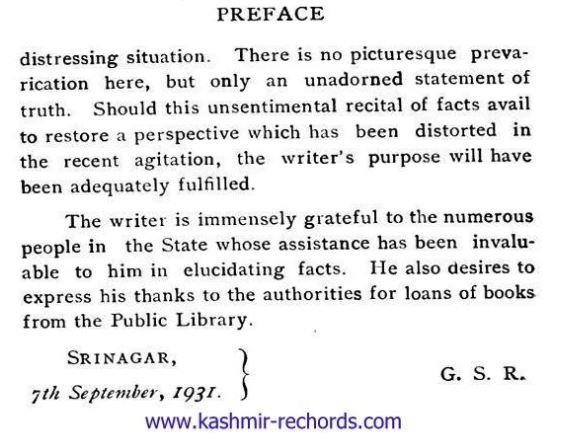
Recovering a Forgotten Memory
Recognising the suffering of Kashmiri Pandits on July 13, 1931 does not diminish the deaths that occurred outside the Central Jail.
History need not choose one victim over another.However, a complete understanding of July 1931 requires acknowledging both the jail firing and the communal violence that followed.
The tragedy of ‘Batta Loot‘ reminds us that ordinary civilians—shopkeepers, traders, families and neighbourhoods—paid an immense price during those disturbances. Ignoring that experience leaves the historical record incomplete.
The events of July 13, 1931 altered Kashmir’s political history, but they also scarred its social fabric.For Kashmiri Pandits, it became Batta Loot—a day remembered not for political symbolism but for the organised destruction of homes, businesses and lives.
Nearly a century later, rare official correspondence and G.S. Raghavan’s Warning of Kashmir invite historians to revisit this neglected chapter with scholarly objectivity rather than inherited political narratives.
History achieves its greatest value not when it reinforces established myths, but when it restores forgotten truths. Only by acknowledging the full scope of human suffering can the story of July 13, 1931 be understood in its complete historical context.
Dear Esteemed Readers,
Every article published by Kashmir Rechords is the result of painstaking research, extensive archival work and countless hours spent uncovering rare historical records that are often unavailable elsewhere.
If you value such authentic and well-researched documentation of Kashmir’s history, we humbly request your support. No contribution is too small—every tiny donation helps us continue preserving and presenting forgotten chapters of our shared heritage.
Please consider supporting our work by scanning the QR Code below. Even the smallest contribution means a great deal to us and helps keep this mission alive.

Thank you for standing with Kashmir Rechords Foundation in preserving history for future generations.