
(Kashmir Rechords’ Response)
There is something uneasy about history being compressed into a punchline—especially when that history involves the Kashmiri Pandit resistance, a story of blood, exile and silent resilience
Samay Raina, a gifted comedian of a new India, recently stepped into that uneasy terrain. His remark—that Kashmiri Pandits “only fight when the fight is fair”—was perhaps intended to provoke thought, maybe even empathy. Instead, it opened the floodgates to a familiar and troubling chorus: that Kashmiri Pandits “ran away,” that they “did not fight,” that theirs was a story of retreat, not resistance.
But history, particularly the story of the Kashmiri Pandit exodus, is not a stage for convenient one-liners.
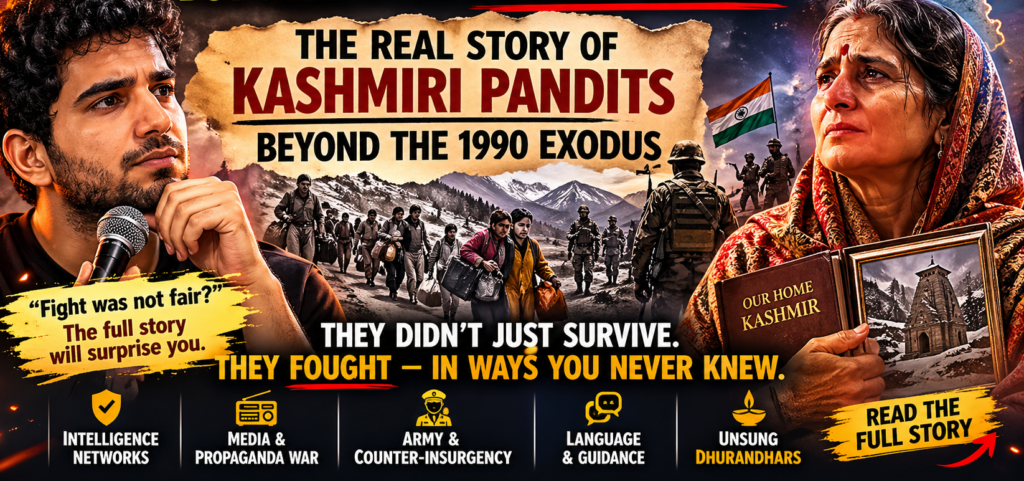
The Fight That Was Not Seen
Yes, many left in 1990. But not all. And more importantly, those who left did not stop fighting. They fought differently.
Not with slogans or street battles, but through institutions, intelligence and endurance:
- They rebuilt shattered intelligence networks, even as many among them were targeted and killed.
- They stood by the Indian State and its agencies, irrespective of which government was in power.
- They countered propaganda, a far more insidious weapon than bullets in a proxy war.
- They continued to serve in broken institutions, keeping alive the skeletal framework of India’s presence in the Valley.
This was not the absence of courage.
This was courage, redefined under siege.
A Story Closer to Home
There is an irony that makes Samay Raina’s statement feel incomplete.
His own father, Rajesh Raina, chose to move back to Kashmir during those fraught years—working with All India Radio and Doordarshan when many others, including employees from different communities, stepped away.
That too was a frontline.
Not of guns, but of voice, narrative and national presence.
If that is not fighting, what is?
Beyond the Visible Battlefield
The narrative that Kashmiri Pandits did not fight collapses when confronted with uncomfortable truths:
- Many joined the armed forces and security agencies.
- Some became language experts, helping Indian forces navigate an unfamiliar linguistic and cultural terrain.
- Others worked quietly as guides, informants and strategists in counter-insurgency operations.
- Countless individuals resisted through media, administration and civil networks.
Their names are not shouted from rooftops.
Perhaps because their work demanded silence.
Perhaps because history has not yet caught up with their sacrifices.
But they existed—and they mattered.
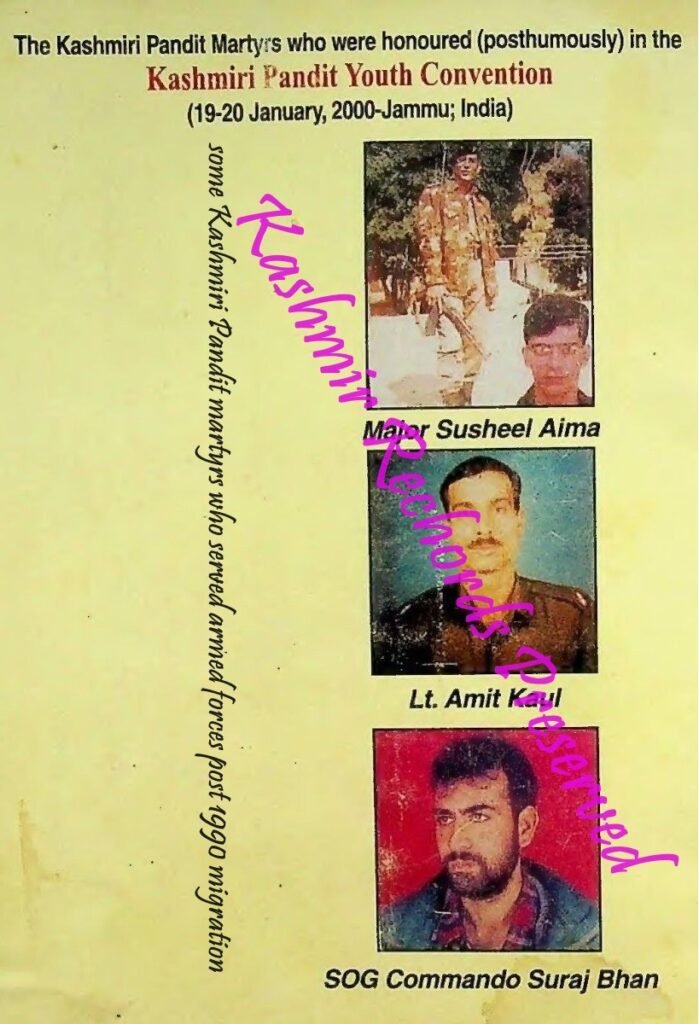
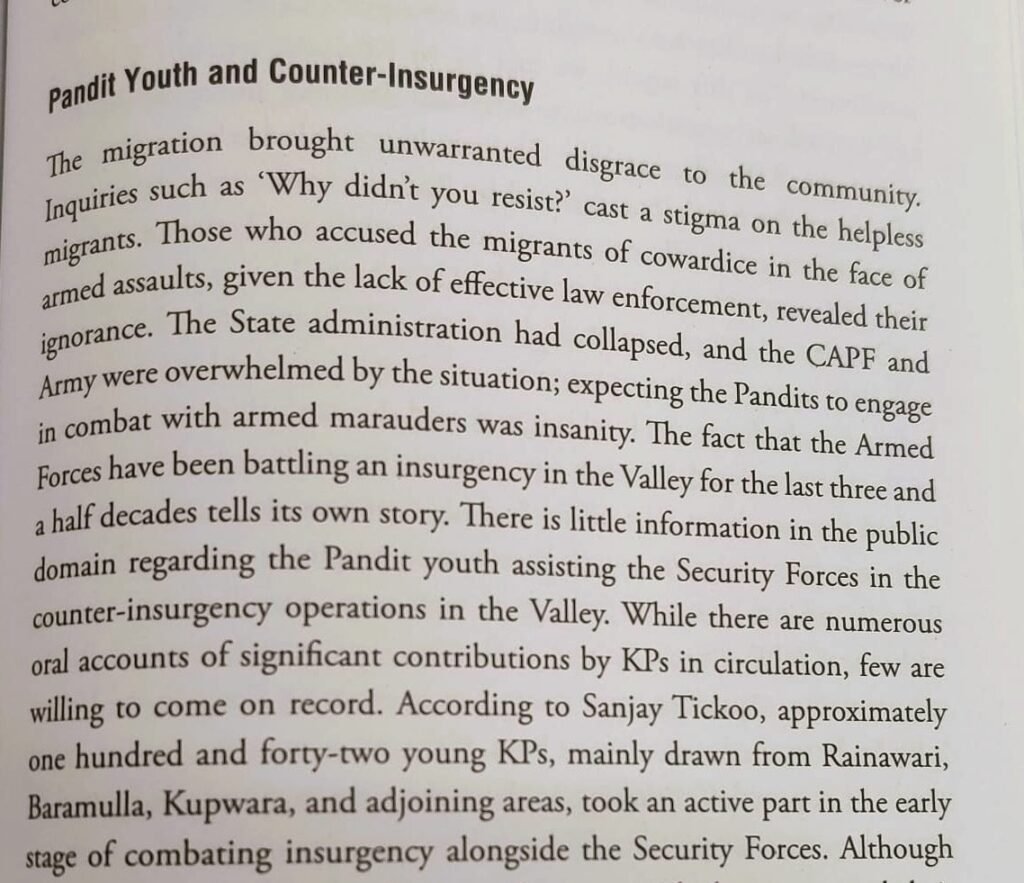
Yoginder Kandhari, a seasoned Army veteran, dedicates an entire chapter in his book on the Kashmir insurgency to “Kashmiri Pandit Youth and Counter-Insurgency,” highlighting the often-overlooked role played by Pandit youth in supporting operations during one of the most turbulent phases in the Valley.
The Problem with Simplification
To say “the fight was not fair” is not entirely wrong.
But to stop there is to miss the essence of what followed.
Because when a fight is not fair, you do not always pick up a sword.
Sometimes, you choose to survive, regroup and resist in ways that history struggles to record.
Reducing that to a matter of “no choice” risks sounding—not just incomplete—but childish in its understanding.
A Message to the Echo Chamber
More troubling than the remark itself were those who seized upon it— the keyboard warriors were quick to label an entire community as cowardly.
They forget:
👉 It was this very community that refused to convert even at the edge of the sword.
👉 It was this community that absorbed displacement without dissolving identity.
👉 It was this community that continued to fight—quietly, persistently and often invisibly.
Stories Yet to Be Told
There are stories here—of courage without spectacle, of resistance without applause.
Stories of real “Dhurandhars”—strategists, survivors, silent warriors, Posts and Telegraph Officials, Official Mediamen, Intelligence Officials, etc
Perhaps one day, filmmakers like Aditya Dhar will bring them to light.
Not as footnotes, but as central characters in India’s modern history.
And perhaps then, even comedians will find better material—
not in half-truths, but in the full weight of lived experience.
In the End
Humour has power.But so does History.
And when the two intersect, what is needed is not just wit— but depth, memory and responsibility.
An Appeal: Keep These Stories Alive…
Every story we share at Kashmir Rechords is not just history—it is memory, pain, resilience and a voice that refuses to fade away. You won’t find such real and credible stories anywhere.
Behind every archived clipping and forgotten narrative lies a community’s struggle to be remembered. But preserving or narrating these stories is not easy—and we cannot do it alone.
Your financial support, however even very small, is not just a donation—it is a gesture of remembrance, a stand for truth and a lifeline for our continued work.
Help us keep these voices alive. Help us survive.
If these stories have touched you, we humbly request you to KINDLY contribute and support Kashmir Rechords.
Donate to Kashmir Rechords Foundation:
Bank Details:
KASHMIR RECHORDS FOUNDATION (Regd)
Acct No: 0274010100003893
Jammu and Kashmir Bank.
IFSC: JAKA0CHAWRI
You may also use our QR Code: