

(Kashmir Rechords Exclusive)
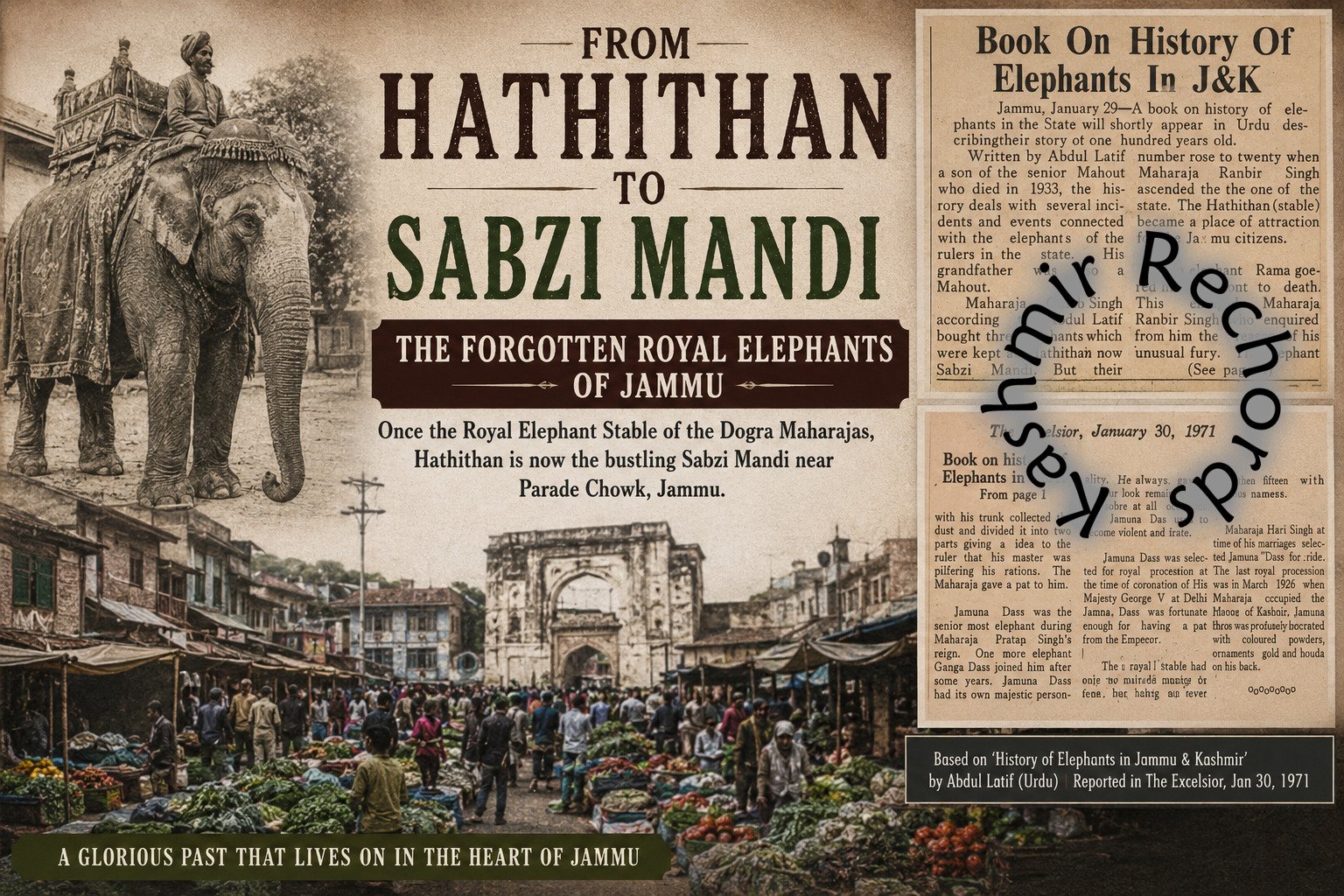
There was a time when the heart of Jammu echoed not with the voices of vegetable vendors or the bustle of shoppers, but with the thunderous footsteps of royal elephants.
Today, thousands pass through the bustling Sabzi Mandi near Parade Chowk without realizing that the same ground once housed the magnificent Hathithan—the Royal Elephant Stable of the Dogra Maharajas. What survives today is merely a marketplace; what has disappeared is an extraordinary chapter of Jammu’s forgotten heritage.
Urdu Book That Preserved a Vanishing Legacy
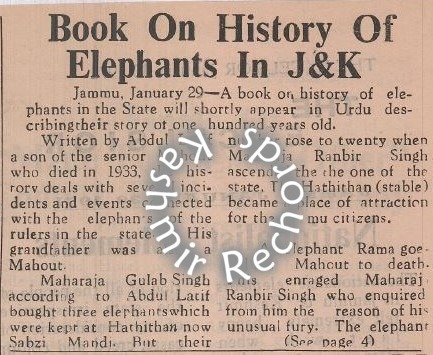
In January 1971, The Excelsior reported the publication of an unusual Urdu book titled `History of Elephants in Jammu & Kashmir‘, written by Abdul Latif, whose family had served the Dogra rulers for generations. Kashmir Rechords is reproducing the preserved relevant newsclippings for the benefit of esteemed readers.
According to the contents of the newsitem, Latif was not merely narrating history. He was preserving memories inherited from his father and grandfather—both senior Mahouts (elephant keepers) attached to the royal establishment. His work therefore carries the rare authenticity of an eyewitness tradition handed down within the royal stables themselves.
When Maharaja Gulab Singh Brought Three Royal Elephants
The story begins in 1846, when Maharaja Gulab Singh established the princely State of Jammu and Kashmir.
According to Abdul Latif, the Maharaja brought three elephants into Jammu shortly after founding the State. These majestic animals were housed at Hathithan, strategically located barely a kilometre from the royal Mubarak Mandi Palace.
As successive rulers expanded the royal establishment, the elephant population steadily increased.
By the time Maharaja Ranbir Singh ascended the throne, the number had risen to nearly twenty elephants, reflecting both the prestige and ceremonial grandeur of the Dogra court.
Hathithan: The Stable That Became a Marketplace
Few places in Jammu have undergone such a remarkable transformation. Hathithan was once a sprawling elephant camp where the royal animals lived, trained and prepared for ceremonial occasions. Massive banyan trees provided shade, while experienced Mahouts looked after the prized animals. Today the same site is one of Jammu’s busiest vegetable markets.
According to noted journalist Shiv Chander Sharma, remnants of the original Hathi Khana—including side gates of the old enclosure—still survive, though they are largely overlooked by people who visit the area only to buy vegetables.
Rama: The Elephant That Solved His Own Murder Mystery
Among the most fascinating stories narrated by Abdul Latif is that of an elephant named Rama. In 1870, Rama suddenly killed his Mahout.The incident naturally enraged Maharaja Ranbir Singh, who personally visited the elephant to understand the cause behind the unexpected violence.
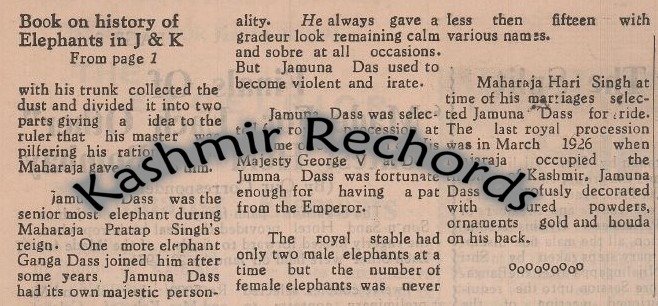
What followed sounds almost unbelievable! Instead of attacking the ruler, Rama quietly used his trunk to gather dust from the ground and divide it into two separate heaps.
The Maharaja interpreted this unusual gesture after listening to the Mahouts’ explanation.
The elephant, they believed, was indicating that his keeper had been stealing a portion of the animal’s daily ration.
Rather than acting out of blind rage, Rama’s violence was seen as the tragic consequence of prolonged neglect and mistreatment.
Whether literally true or embellished through oral tradition, the story reflects the remarkable intelligence long attributed to elephants and the close emotional bond between these animals and their keepers.
Jamuna Dass: The Gentle Giant of the Dogra Court
If Rama became famous for his fury, Jamuna Dass became legendary for his dignity. During the reign of Maharaja Pratap Singh (1885–1925), Jamuna Dass was regarded as the senior-most royal elephant.
Abdul Latif in his book describes him as majestic, calm and exceptionally graceful. His imposing appearance itself enhanced the splendour of royal ceremonies. Later another elephant, Ganga Dass, joined the royal stable, but Jamuna Dass remained the pride of the establishment.
The Elephant Chosen by a Maharaja
Perhaps no elephant in Jammu’s history enjoyed greater honour than Jamuna Dass. Whenever Maharaja Hari Singh celebrated his marriages, it was Jamuna Dass who was selected to carry the ruler in royal processions.
The elephant thus became an inseparable part of some of the most important ceremonial occasions of the Dogra dynasty.
The Last Royal Procession
History often ends quietly. The last great appearance of Jammu’s royal elephants came in March 1926, when Maharaja Hari Singh formally ascended the throne.
For the occasion, Jamuna Dass was transformed into a living symbol of royalty. His body was adorned with colourful powders, gold ornaments, and an elaborate howdah mounted on his back.
It was a spectacle that represented not merely the accession of a ruler, but the culmination of an entire royal tradition that had flourished for nearly eighty years. Soon afterwards, changing times gradually ended the ceremonial importance of elephants in the princely State.
More Female Elephants Than Males
An interesting detail recorded by Abdul Latif in his book reveals that the royal stables generally maintained only two male elephants, whereas the number of female elephants was rarely below fifteen.
This suggests that the elephant establishment was carefully managed, possibly with breeding, temperament and ceremonial requirements in mind—details that deserve deeper historical investigation.
A Heritage Buried Beneath Everyday Life
Today, the average visitor to Parade Chowk, Jammu is unlikely to imagine that beneath the crowded vegetable market once stood one of the most important royal elephant establishments in northern India.
The banyan tree, the forgotten gates, the memories preserved by Mahouts, and Abdul Latif’s remarkable Urdu book and the newspaper cuttings of January 1971 together remind us that history often survives not in monuments, but in overlooked corners of our cities.
Jammu’s Hathithan is one such place—a forgotten royal stable hidden in plain sight.
Call-to-Action
Do you have family memories or old photographs of historic Jammu locations? Share your stories in the comments below. You may also contact us at support@kashmir-rechords.com. We will publish your memorable stories to preserve our heritage.