
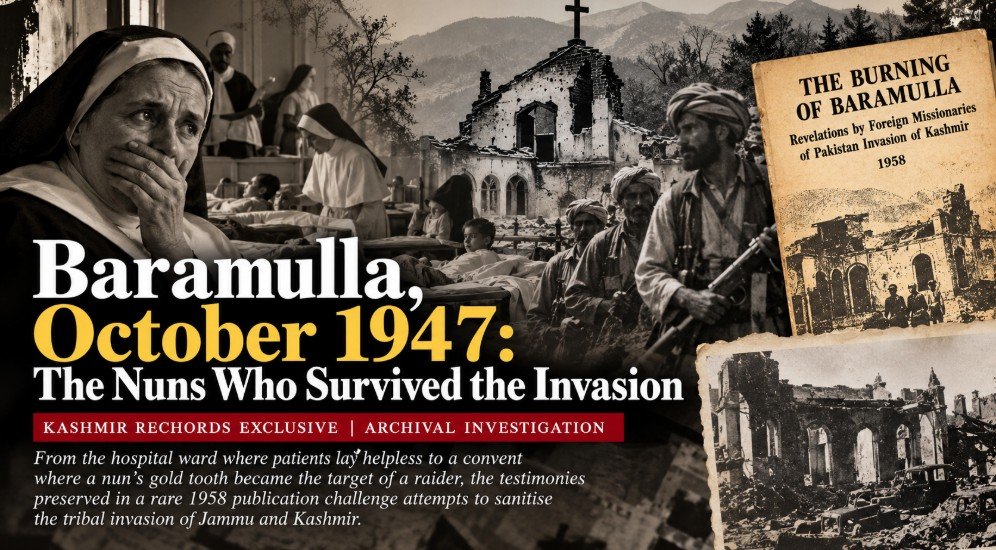
Kashmir Rechords Exclusive | Archival Investigation
In October 1947, as armed tribal raiders swept into Jammu and Kashmir from the direction of Pakistan, Baramulla became one of the most horrifying scenes of the invasion. The attack on St Joseph’s Convent and Hospital left a trail of death, destruction and terror in a place dedicated to healing the sick, caring for children and sheltering the vulnerable.
Among those who witnessed the unfolding horror were foreign Catholic missionaries—women and men who had come to Kashmir to serve, not to fight. They had no military command, no political constituency to defend and no reason to turn a hospital ward into a battlefield.
Yet, when the raiders arrived, these missionaries found themselves confronting violence that would remain etched in their memories for the rest of their lives.
Their testimony survives in a little-known publication issued in 1958.
Titled The Burning of Baramulla: Revelations by Foreign Missionaries of Pakistan Invasion of Kashmir, the booklet—a copy of which is preserved by Kashmir Rechords,reproduces statements attributed to missionaries associated with St Joseph’s Convent and Hospital.
Nearly eleven years after the invasion, their recollections were published as evidence against accounts that denied or minimised what had happened in Baramulla.
For Kashmir Rechords, this is more than a story of a ruined Convent. It is an examination of how eyewitness testimony can challenge political denial—and why the voices of those who witnessed the violence must not be forgotten.
Sister Priscilla: When the hospital became a killing ground
Sister Priscilla’s account is among the most disturbing testimonies in the publication.
She was in the hospital dispensary while another sister was attending to patients in the ward. Suddenly, she heard gunfire.
She rushed to close the dispensary and then went towards the hospital Verandah. What she witnessed was not an isolated exchange of gunfire.
Armed men were arriving, shots were being fired and people who had come to the hospital for treatment were caught in the violence.
The testimony describes deaths and injuries among people associated with the hospital, including the wife of a Military Officer. Sister Priscilla also recalled that the Convent’s Mother Superior was wounded.
The violence continued inside the hospital complex. Medicines and instruments lay scattered across the floor, and doors had been broken. A place where patients should have been receiving care had become a scene of panic and devastation.
Sister Priscilla’s recollection is particularly significant because she was not describing a distant battlefield. She was recounting what she had seen in and around the hospital and convent.
She also recalled a confrontation with a man who identified himself as a brigand leader. According to her testimony, he claimed that the armed men were no longer under his control.
Monsignor Shanks: The terror reached the children’s ward
If Sister Priscilla’s testimony brings the reader into the hospital, Monsignor Shanks’s recollections reveal the wider scale of the terror.
His account describes attacks affecting both the hospital and the convent. He recalled armed tribesmen entering the premises and the missionaries being caught amid successive waves of violence.
The most harrowing part of his narrative concerns the children’s ward.
The sisters and other members of the hospital community found themselves confronted with wounded and dying patients, including babies and young children. The account describes the extraordinary strain on the medical
staff, who struggled to care for the injured while their own lives remained in danger.
The missionaries were not simply fleeing an attack. They were trying to protect people who could not flee at all.
In his recollection, the Convent community’s fear was compounded by uncertainty. The sound of gunfire, the arrival of armed men and the threat of renewed violence made even the most ordinary acts of care dangerous.
Despite their exhaustion and the destruction around them, the staff continued tending to the wounded.
The testimony also records the kindness shown by some Kashmiri villagers and few local people who helped the missionaries during their ordeal.
Sister Michael: When the raiders came for Nun’s gold tooth
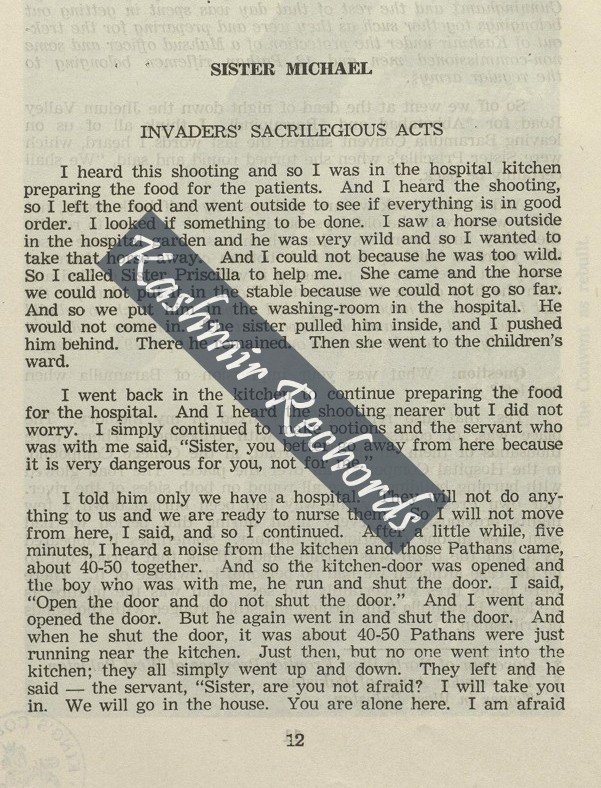
Among the booklet’s most startling testimonies is that of Sister Michael, who described an encounter in which armed men entered the Convent and attempted to take valuables.
She recalled hearing gunfire while working in the hospital kitchen. As the danger grew, she and the other sisters tried to secure the premises and protect those around them.
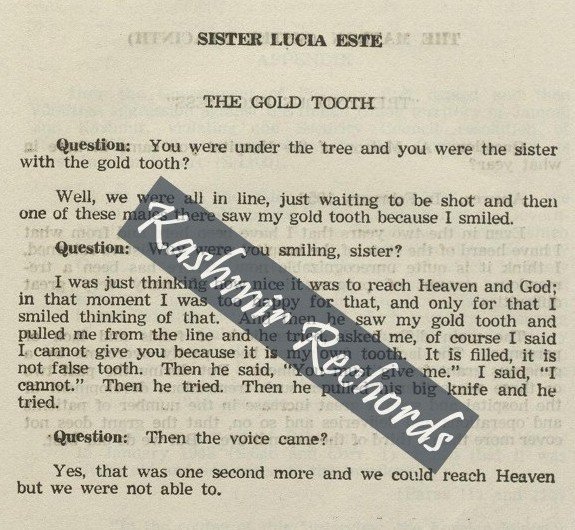
Her testimony describes raiders entering rooms, searching for possessions and threatening the women. In one particularly chilling episode, a Nun’s gold tooth became the object of their attention.
According to Sister Michael, an armed man noticed the gold tooth and attempted to extract it. The episode was not merely an instance of theft; it was an act of violence against a woman already at the mercy of armed men.
The detail is almost unbearable in its simplicity. A nun who had devoted herself to caring for others was reduced, in the eyes of a raider, to the value of a piece of gold in her mouth.
A nun who had devoted herself to caring for others was reduced, in the eyes of a raider, to the value of a piece of gold in her mouth
Sister Michael’s testimony also describes how the women were gathered and threatened, while members of the hospital community feared that they would be killed.
Sister Lucia Este: The gold tooth and seconds between life, death
The publication returns to the episode through Sister Lucia Este, whose testimony gives the story one of its most haunting human details.
She recalled standing with the other women, waiting to be shot, when one of the armed men noticed her gold tooth.
Her recollection describes the man attempting to remove it with a knife. She believed that death was imminent.
The published testimony records her recollection of the moment when another voice interrupted the attack. In her account, the intervention came just in time.
Destruction of Baramulla: A town scarred by the invasion
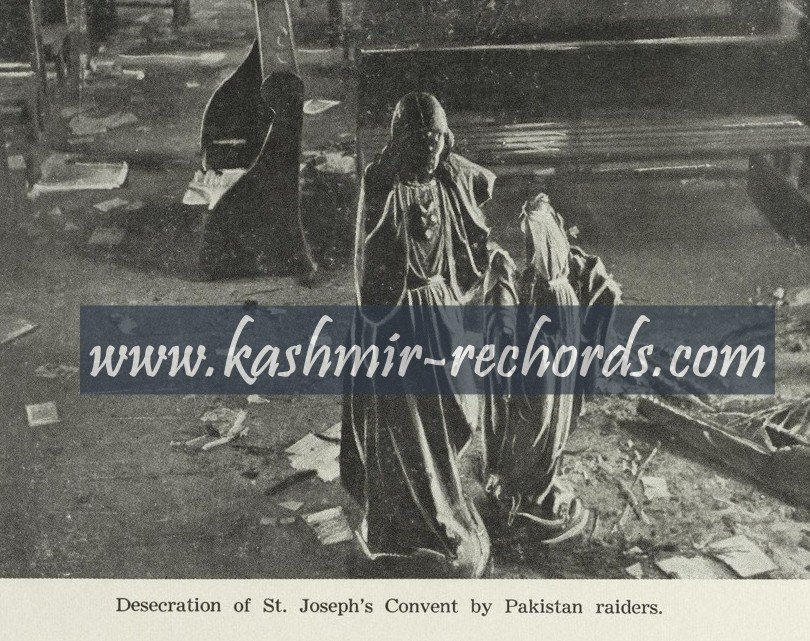
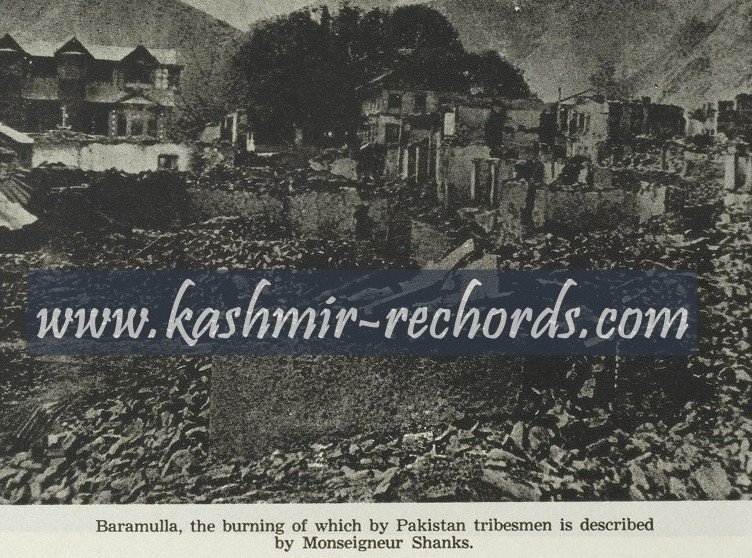
The Convent and Hospital were part of a wider tragedy.The 1958 book contains rare photographs of damaged buildings and the devastated town. Their captions describe the destruction and subsequent reconstruction of Baramulla. These images provide a visual counterpart to the missionaries’ testimony: the ruined structures show the physical consequences of the violence described in the text.
Monsignor Shanks’s account recalls the town as he saw it after the destruction. His description conveys the scale of the devastation and the difficulty of rebuilding lives and institutions after the raiders had passed through.
The hospital staff had endured fear, hunger and exhaustion, as well as the loss of familiar surroundings. They had tried to protect patients while coping with damage to the very facilities on which their work depended.
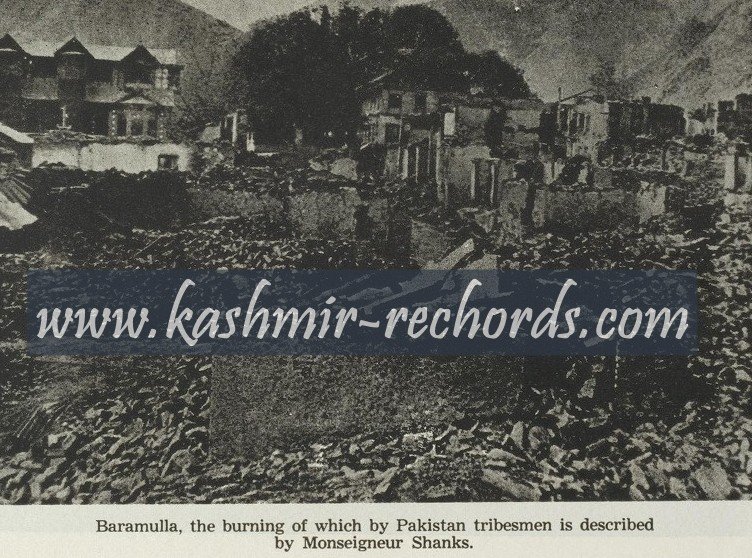
The photographs are significant because they prevent the story from becoming merely a contest between competing political narratives. The buildings themselves bear witness to the destruction that the publication sought to document.
The tragedy of Baramulla was not confined to the walls of a religious institution. It was part of the wider suffering inflicted on the town during the invasion.
What did Pakistan’s official denials say?
The booklet’s introduction places these eyewitness statements against the diplomatic controversy that followed Pakistan’s invasion of Jammu and Kashmir in 1947.
It reproduces statements attributed to Pakistan’s Foreign Minister, SirMuhammad Zafrulla Khan, indicating that he had no knowledge of the events at Baramulla beyond what had been reported to him. The publication also refers to Pakistan’s denials and to the dispute over the presence and conduct of the invading forces.
That context does not make the missionaries’ testimonies any less relevant.
The critical question is whether the denials can be reconciled with the, specific experiences recorded by people who were present.
The witnesses described armed tribal men entering the hospital and convent, shooting, killing, threatening women, looting valuables and endangering vulnerable patients. They also described damage to buildings and the desperate efforts of hospital staff to care for the injured.
Andrew Whitehead: Returning to the witnesses
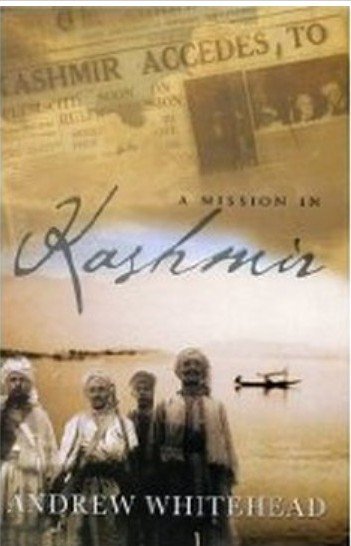
Decades later, British journalist and historian Andrew Whitehead returned to the events of 1947 in his book A Mission in Kashmir.Whitehead’s research is important because it goes beyond simply repeating the official narratives of either country. He interviewed people who had lived through the turmoil, examined archival records, consulted contemporary newspapers and investigated how the events were subsequently remembered.
His work drew on more than forty interviews with people who experienced the upheaval of 1947. He also pursued the testimony of people connected with the Baramulla mission, including some surviving nuns and others who remembered the attack.
Whitehead’s historical approach brings the experiences of people caught up in the invasion to the centre of the story. The nuns were not merely characters in a political dispute; they were witnesses to the violence.
He also examines the role of the invading force, its indiscipline, the intervention of individuals and the political uses to which the tragedy was put.
This makes A Mission in Kashmir an important companion to the 1958 publication.
Abdul Manan Khalifa’s Concocted Kashmir Story
The account of Baramulla established through the 1958 publication and later examined by Andrew Whitehead has also been contested by writers and commentators sympathetic to Pakistan. Some accounts have misinterpreted or challenged the established narrative in ways that risk promoting a distorted version of events.
One work that warrants examination is Abdul Manan Khalifa’s Kashmir Story, published in 1970. Khalifa’s account is to advance a narrative that attributes the Convent tragedy to the Indian Army rather than to the invading tribal force. This claim must be assessed against the chronology: the Indian Army landed in Srinagar on October 27, 1947 while tribal raiders had already entered the Baramulla area.
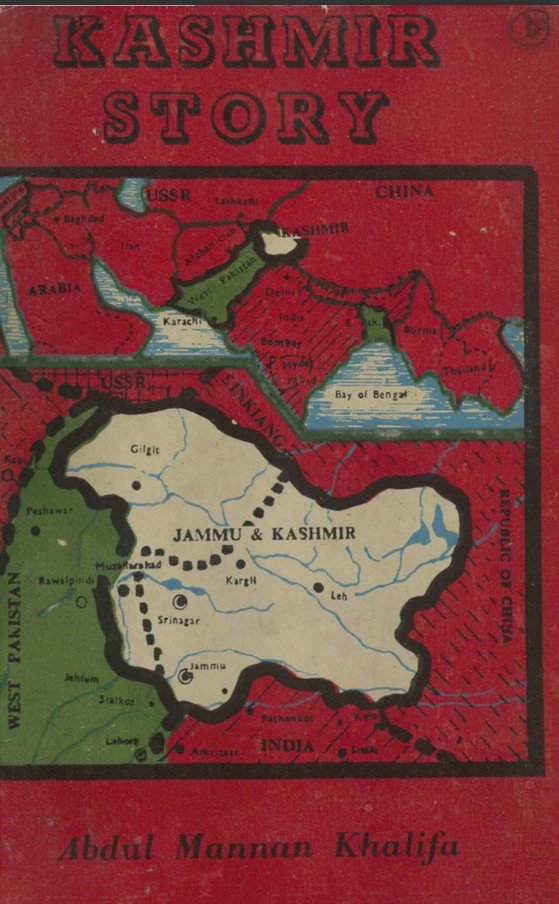
Khalifa identified himself as an engineer who had served during Maharaja Hari Singh’s regime and later held a senior engineering position in Pakistan-occupied Kashmir. His professional and political background ma be relevant to understanding his perspective, but it does not, by itself, establish his motives. Any allegation that he deliberately promoted propaganda should be supported by specific passages and documentary evidence.
Geelani’s Wular Kinare: When political memory becomes historical narrative
A similar examination is warranted of Wular Kinare, the autobiographical work of Syed Ali Shah Geelani.
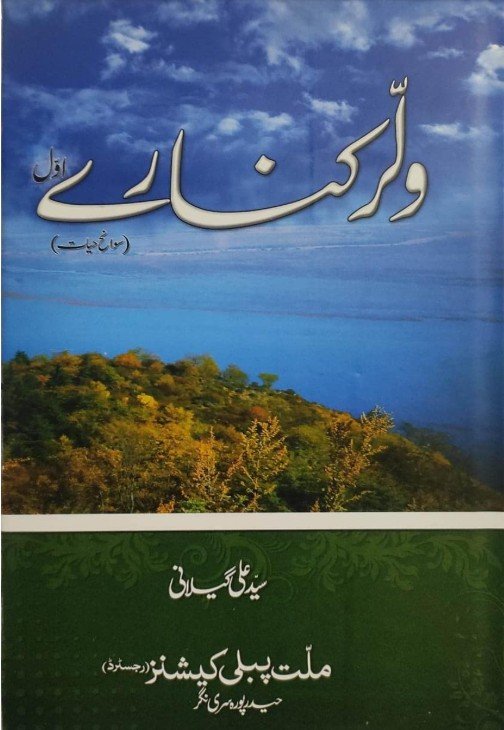
Geelani was a prominent pro-Pakistan separatist leader whose political position on Kashmir was well known. That position provides relevant context when assessing his account, but it does not, on its own, establish the accuracy or inaccuracy of any particular passage. Claims about the Baramulla tragedy should therefore be examined against the documentary record and the specific evidence presented in the book and not through false narratives.
Dewan Ram Prakash’s Fight for Kashmir
Dewan Ram Prakash’s historical book Fight for Kashmir, published in Delhi in 1948, is another source to consider when examining the events of 1947. Published just a year after the tragedy that devastated Baramulla and other parts of Kashmir, the book offers a contemporary account of the period.
Its claims and supporting evidence should be assessed closely and compared with other contemporary records. Such a comparison can help test the assertions made by writers sympathetic to Pakistan and establish which accounts are supported by the available evidence.
Was there an attempt to rewrite the tragedy?
The history of Baramulla raises a broader question about the political use of historical memory. When an event becomes central to a national narrative, details can be selected, amplified, contested or distorted to serve a political purpose. The result may be that the original victims disappear behind the arguments of those who claim to speak for them.
Baramulla offers a compelling example of why this process must be examined carefully. The 1958 publication sought to establish Pakistan’s responsibility for the invasion and preserved detailed missionary testimony. Andrew Whitehead later revisited the episode, reaffirming the importance of the attackb while also scrutinising the ways in which aspects of the story were used in political argument.
That later scrutiny is a strength of the historical record, not a reason to abandon it. Any claim that Pakistan’s authorities deliberately organised a campaign to blame India for the convent tragedy must be supported by documentary evidence, such as official statements, correspondence, contemporary reporting or identifiable publications making that allegation. Political sympathy for Pakistan, by itself, does not establish coordination by the Pakistani State.
The controversy over Baramulla is part of a wider problem in the history of the Kashmir conflict: the tendency to use civilian suffering as an instrument in political argument.
The tribal invasion of 1947, the accession of Jammu and Kashmir to India, the arrival of Indian troops and the subsequent war have all generated competing narratives. The experiences of ordinary people have too often been filtered through the political objectives of those telling the story.
The sisters of St Joseph’s offer a way to return to the human evidence. They were not writing a political manifesto. They were recounting their experiences inside a hospital and convent. Their testimony describes specific acts, particular individuals and the ordeal of caring for the wounded while under threat.