(Kashmir Rechords Exclusive)
At a time when Dogri lived in the voices of its people but not in the pages of serious scholarship, when its own custodians failed to document it for the world, a young woman from faraway Japan stepped in to do what many closer home did not.
Her name was Noriko Mayeda.
In the early 1960s, she arrived not as a tourist, but as a seeker—drawn by a language, a culture, and a tradition that even its native landscape had not fully recorded.
A Stranger Who Listened When Others Didn’t
Kashmir Rechords brings to light a striking and uncomfortable truth—one that many in Jammu may find both surprising and introspective.
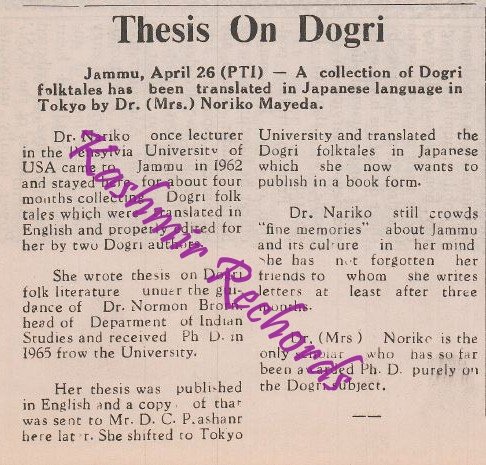
In 1962, Dr. Mayeda spent nearly four months in Jammu, patiently collecting Dogri folktales—stories that had survived centuries through memory, yet remained absent from formal documentation.
While the region lived these stories, it took an outsider to recognize their urgency.
Working with local Dogri writers of the time, she translated these oral narratives into English and refined them into a structured body of work—turning fragile memory into enduring record.
A Thesis That India Overlooked
Under the mentorship of Norman D. Brown at the University of Pennsylvania, she transformed her fieldwork into a doctoral thesis on Dogri folk literature.
In 1965, she earned her Ph.D.—a rare and pioneering academic milestone for a language (Dogri) that was still fighting for recognition even within its own homeland.
That same year, Press Trust of India (PTI) carried her story from Jammu (April 26, 1965). Local newspapers reproduced it, acknowledging—however briefly—the significance of her work.
Today, that moment survives only in fading newsprint, preserved by Kashmir Rechords.
Taking Dogri Where It Had Never Reached
Dr. Mayeda did not stop at documentation.
She carried Dogri across continents—to Tokyo—where she translated its folktales into Japanese. Her effort was not merely academic; it was cultural diplomacy in its purest form.
Through her, the voice of Jammu found listeners in a land thousands of miles away.
A Bond That Distance Could Not Break
Years after leaving India, she continued to remember Jammu—not as a research site, but as a lived experience.
She wrote letters to friends she had made, recalling what she called “fine memories” of its people and culture. In her heart, Jammu was not left behind—it was carried forward.
Uncomfortable Legacy
Dr. Noriko Mayeda remains one of the very few scholars—perhaps the only one of her time—to earn a Ph.D. solely dedicated to Dogri.
And yet, her name is scarcely remembered in the very region whose stories she preserved.
It is a quiet irony of history:
What many in Jammu did not record, a Japanese scholar did.
What was taken for granted here, was treasured elsewhere.
Long before globalization made cultural exchange fashionable, Noriko Mayeda ensured that Dogri would not remain confined to fading voices.
She gave it a written form, a global presence, and a dignity that still resonates.
❤️For Kashmir Rechords
If you value such forgotten histories, support Kashmir Rechords, a registered NGO with Government of India.
Your contribution helps reclaim stories that time—and sometimes society—chooses to forget.
Behind every archived clipping and forgotten narrative lies a struggle to be remembered. But preserving these stories is not easy—and we cannot do it alone.
Your support, no matter how small is it, is not just a donation—it is a gesture of remembrance.
Please consider donating to our bank account. Every contribution matters.
Donate to Kashmir Rechords Foundation:
Bank Details:
KASHMIR RECHORDS FOUNDATION (Regd)
Acct No: 0274010100003893
Jammu and Kashmir Bank.
IFSC: JAKA0CHAWRI
You may also use our QR Code: