
How Swami Sant Dev, once banished by Maharaja Hari Singh, returned to inspire dreams of ruling up to Lahore before Kashmir’s accession to India.
(Kashmir Rechords Exclusive)
History often remembers wars, treaties and signatures.
But sometimes, history turns on whispers.
In the turbulent years before Jammu and Kashmir acceded to India, a mysterious priest — Rajguru Swami Sant Dev — re-entered the life of Maharaja Hari Singh and altered the psychological landscape of a kingdom standing at the edge of destiny.
What makes the story compelling is not merely influence — but rejection, disappearance and an astonishing return.
The First Fall: Banished by a Sceptic King
Swami Sant Dev had risen to prominence during the reign of Maharaja Pratap Singh. Pratap Singh, deeply inclined toward mysticism, kept astrologers and swamis close. Sant Dev became Rajguru and was treated with full state protocol — cars sent to receive him, elaborate arrangements for his comfort, official communications addressed to him as Swami Sant Dev Ji Maharaj.
Then came 1925.
Pratap Singh died. Hari Singh ascended the throne.
Unlike his uncle, Hari Singh was modern, disciplined and in the words of his own son, “far from being a religious man.” One of his early acts was decisive — he banished the Swamis and Gurus who had flourished under the previous regime. Sant Dev was sent away.
It seemed the curtain had fallen.
The Vanishing Act — And the Return
For nearly two decades, Sant Dev faded into obscurity. No one knew his origins. No one knew his true age. Some claimed he was over a hundred. Some even whispered he was a British plant. Nothing was proven.
Then, in 1944, he reappeared.
By 1946, he had not merely returned — he had re-established himself as Rajguru to the very ruler who had once expelled him.
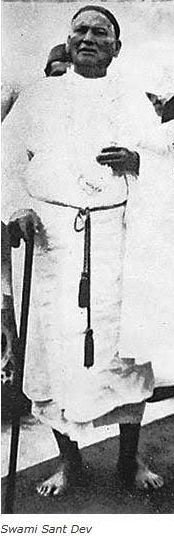
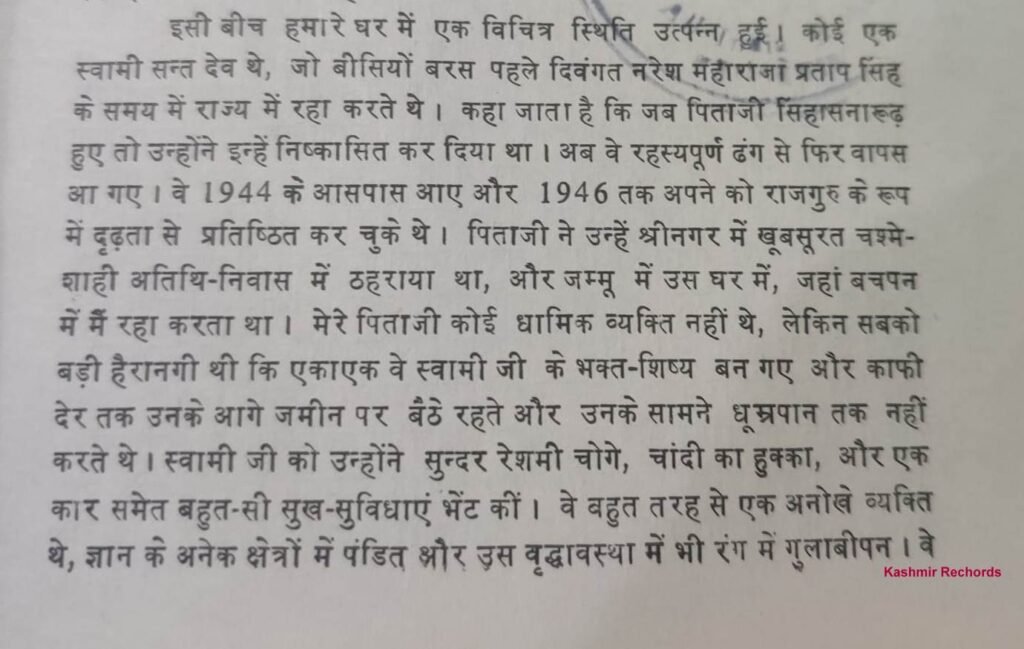
From May 1946 until October 1947, he lived within palace compounds in Srinagar. He was given the beautiful Chashma Shahi guest house and a residence in Jammu. The Maharaja who once banished him now offered him silk robes, a car and royal hospitality.
The transformation stunned the court.
Hari Singh used to now sit on the ground before him for long hours. He would not smoke in his presence. He became, in effect, a disciple.
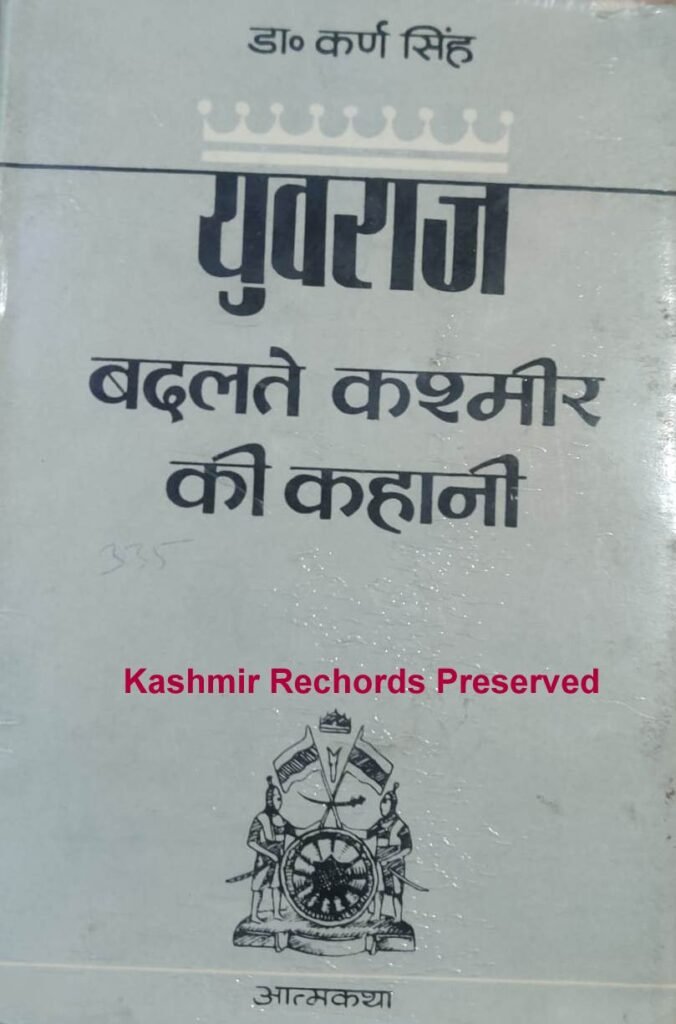
Even his son, Karan Singh, watched in disbelief. Dr Karan Singh later expressed bewilderment in his autobiography Heir Apparent (Hindi edition: Yuvraj: Badalte Kashmir Ki Kahani).
The Prophecy of Lahore
What changed?
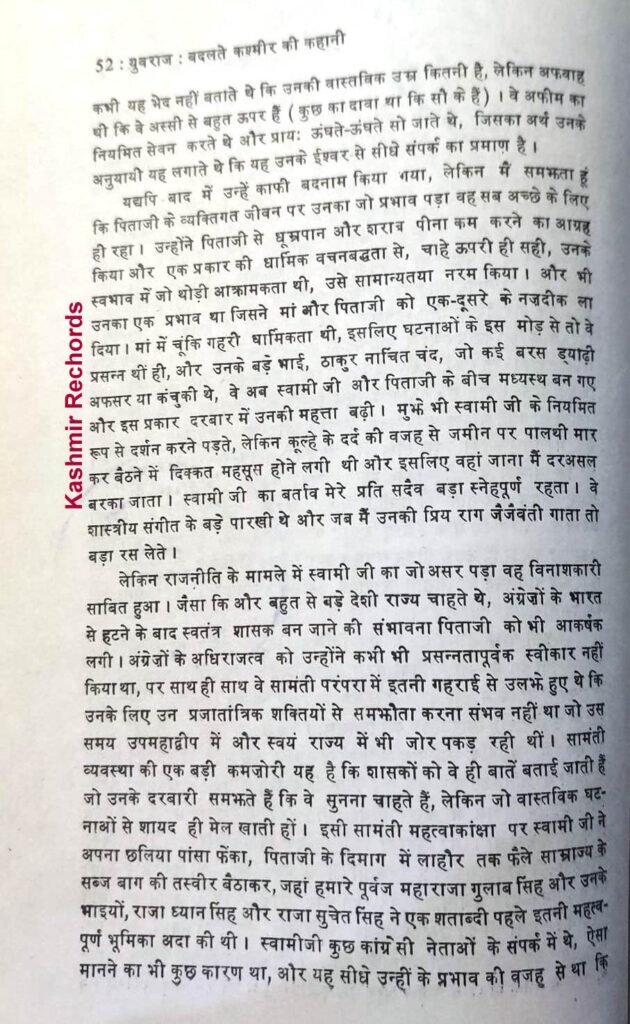
According to Dr. Karan Singh’s widely read autobiography, Heir Apparent, Sant Dev convinced the Maharaja that destiny held extraordinary promise.
He writes:
“The Swami had convinced my father that luck was smiling on him and that he would become the sovereign of an extended kingdom sweeping down to Lahore.”
(Heir Apparent: An Autobiography, Oxford, 1989, p. 37)
In the Hindi edition, Yuvraj: Badalte Kashmir Ki Kahani, the sentiment carries similar weight — the Swami assuring the Maharaja that his fate was grand, that he was destined to rule a vast and expanded realm.
For a ruler standing at the crossroads of 1947 — when British paramountcy was ending and princely states were to choose between India, Pakistan, or independence — such words were intoxicating.
Independence was no longer merely a political option. It became a vision. A destiny. A promise of Lahore.
The greener pastures were not metaphorical — they were geographical.
Rasputin in the Palace
Tall, pink-complexioned, and commanding even in advanced age, Sant Dev cultivated an aura of mystique. He was rumoured to possess occult powers. He loved luxury, the company of women and was said to consume opium.
In whispered comparisons, he became Kashmir’s version of Grigori Rasputin — the Russian faith-healer whose influence over Tsar Nicholas II was blamed for imperial catastrophe.
And like Rasputin, Sant Dev’s power was psychological.
He did not command armies.
He commanded imagination.
The Dream Collapses
But destiny did not follow prophecy.
In October 1947, tribal raiders from Pakistan invaded Kashmir. The fragile dream of an independent kingdom “sweeping down to Lahore” shattered under the weight of invasion and urgency.
Hari Singh signed the Instrument of Accession to India.
The greener pastures faded into the smoke of war.
Gradually, as events overtook aspiration, the Maharaja is believed to have realised that Sant Dev’s claims were exaggerated. The aura dimmed. The influence waned.
Once again, the Swami receded into obscurity — as mysteriously as he had appeared and reappeared.
The Irony of Power
The irony is profound.Hari Singh — the rational ruler who had banished mystics — later became deeply influenced by one who offered him a vision of imperial expansion. The sceptic became a believer. The exile became Rajguru.
And in that arc of rejection, disappearance and return lies one of the most fascinating psychological subplots of Kashmir’s accession.
History records the signature on the Instrument of Accession.
But behind that signature was a ruler who, for a fleeting moment, believed he might rule all the way to Lahore.
And behind that belief stood a mysterious Swami — who appeared, disappeared and reappeared — leaving behind a legend that still lingers in the annals of Kashmir’s past.
A Question That Lingers
Was Sant Dev a mystic, a manipulator, or merely a man who understood the psychology of kings?
Did his whispered promises of sovereignty shape Kashmir’s hesitation at a decisive moment in subcontinental history?
Or was he simply a dramatic footnote in a much larger tragedy?